

Persian Area Rug for Small Living Room: Size Guide
Choosing a Persian area rug for small living room is not simply a matter…
Article Guide
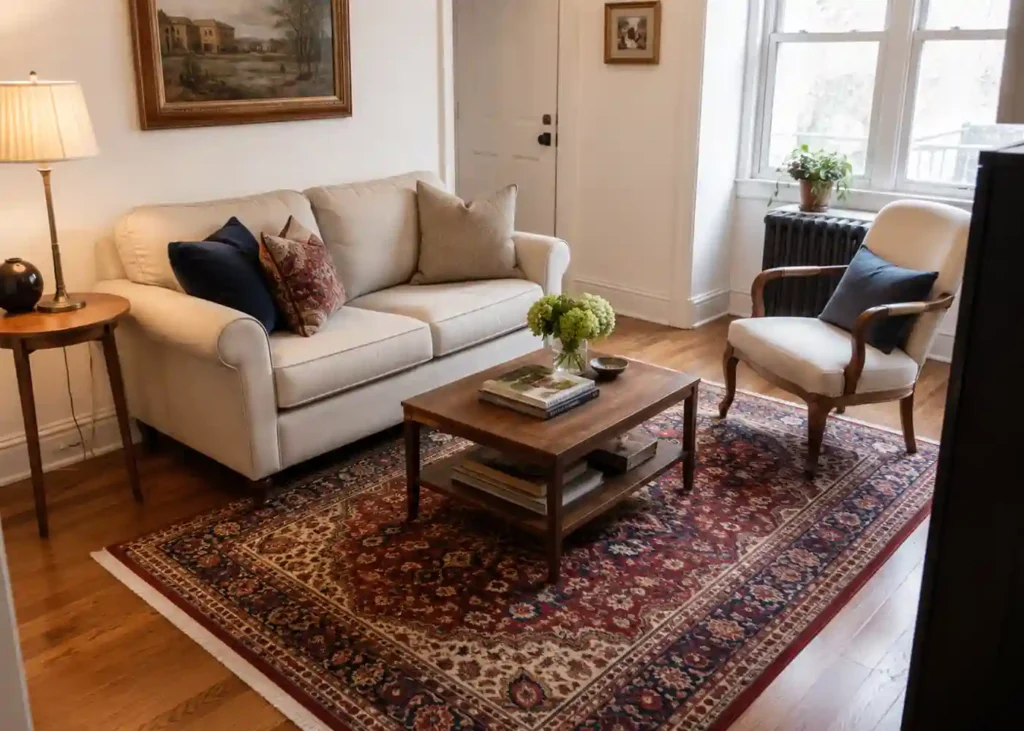
Choosing a Persian area rug for small living room is not simply a matter of finding the smallest rug available. The right rug should connect the seating, create visual balance, leave enough open floor for movement, and add character without making the room feel crowded. A rug that is too small can make the furniture look disconnected, while a rug that is too large can reduce breathing space around the edges of the room.
A handmade Persian rug can work especially well in a compact living room because it adds color, texture, craftsmanship, and a strong focal point in a single layer. Instead of filling the room with many decorative objects, one carefully selected rug can give the entire space a more complete and personal identity.
This guide explains how to choose the correct dimensions, placement, color, pattern, material, and weaving style. It also shows how to shop for a one-of-a-kind handmade rug through Arghavan Rugs without relying on standard machine-made sizing alone.
Quick Answer: What Is the Best Persian Area Rug for a Small Living Room?
For many compact living rooms, a rug close to 5 × 8 feet or 6 × 9 feet works well. However, furniture dimensions are more important than the room label. A small loveseat and one chair may work with a compact rug placed under the coffee table, while a full-size sofa and two armchairs usually need a larger rug that reaches under the front legs of the seating.
The most reliable rule is this:
- Choose a rug wide enough to visually connect the sofa and chairs.
- Whenever possible, place the front legs of the main seating on the rug.
- Keep the coffee table fully on the rug.
- Leave a visible border of flooring around the seating zone.
- Measure the furniture arrangement before measuring the entire room.
Retail sizing guides from West Elm and Wayfair also recommend using furniture placement as the main reference. A 5 × 8 rug often works with a loveseat or compact sofa, while a 6 × 9 rug can allow the front sofa legs to rest on the rug in a small or narrow living room.
What Does “Area Rug” Mean?
An area rug is a movable rug that covers part of the floor rather than the entire room. It can be handmade or machine made. Therefore, a Persian area rug is not automatically a machine-made carpet. An authentic Persian area rug may be hand-knotted, handwoven, antique, semi-antique, tribal, floral, geometric, wool, silk, or a combination of materials.
If you are unsure how to distinguish construction types, read the Arghavan Rugs guide to handmade vs machine-made rugs. The back, fringe, knot structure, material, and natural variations all provide useful evidence.
Why a Persian Rug Works So Well in a Small Living Room
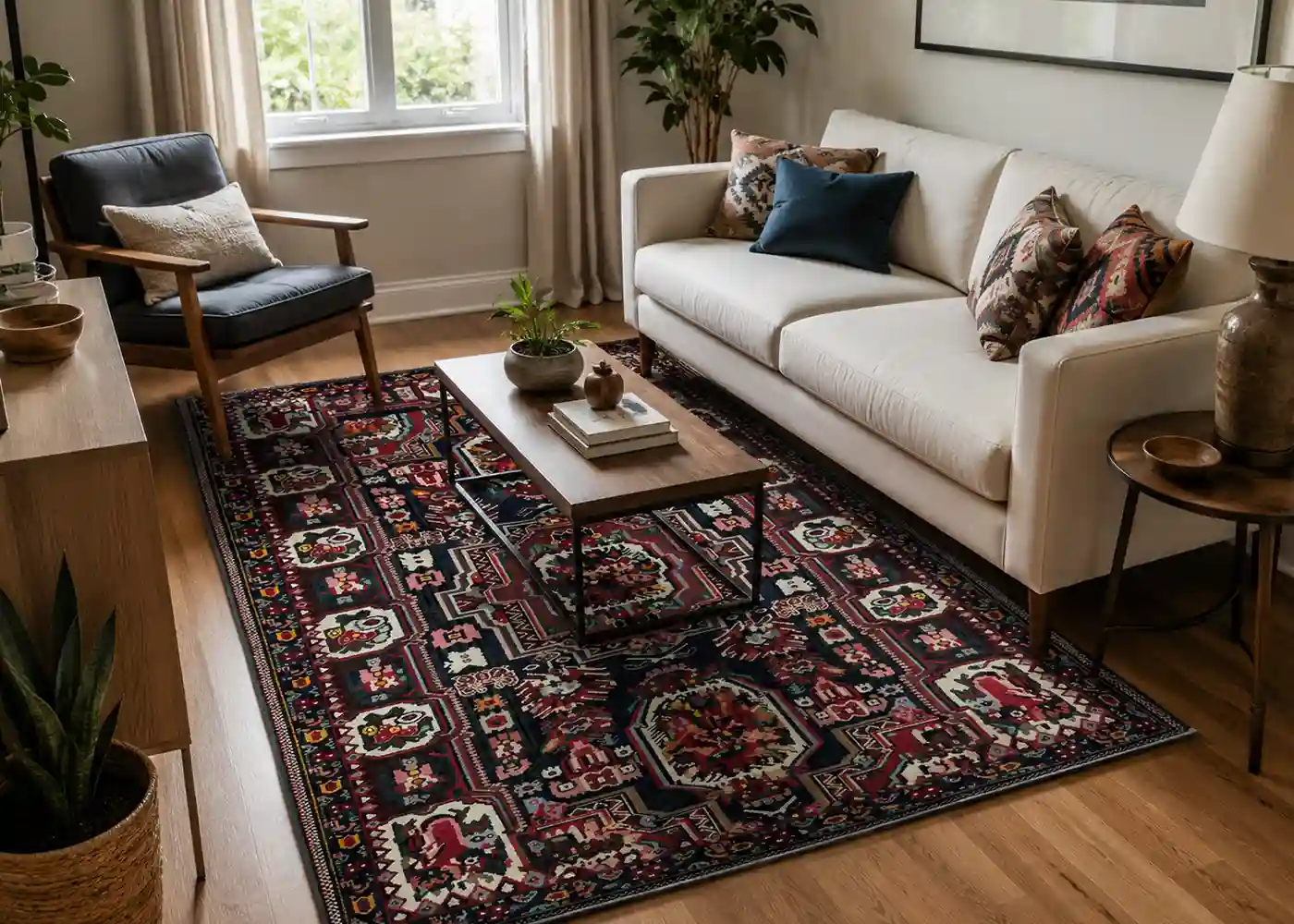
Small rooms need fewer but stronger design decisions. A Persian rug can perform several jobs at once:
- It defines the seating area.
- It adds softness over wood, tile, or stone flooring.
- It introduces color without requiring many accessories.
- It creates contrast with simple modern furniture.
- It can connect different furniture finishes and fabrics.
- It adds artistic value and handwoven character.
Because handmade Persian rugs contain variation in drawing, color, texture, and weave, they often make a small room feel collected rather than mass-produced. A compact room does not need a plain rug. It needs a rug whose scale, colors, and visual weight are appropriate for the space.
Measure the Seating Area, Not Only the Room
One of the most common mistakes is buying a rug based only on wall-to-wall measurements. A living room may be physically small but contain a narrow loveseat, leaving space for a generous rug. Another room may be larger but crowded with a deep sofa, recliner, side tables, and a media cabinet.
Measure the actual furniture grouping:
- Measure the width of the sofa.
- Measure the distance from the front of the sofa to the opposite chairs or media unit.
- Measure the coffee table.
- Mark the desired rug outline on the floor with removable painter’s tape.
- Walk around the taped area and check doors, drawers, and traffic paths.
- Photograph the outline from the room entrance to judge visual proportion.
This simple test is especially important when buying handmade rugs because their measurements may not match standard retail labels exactly. A rug measuring 147 × 200 cm or 160 × 217 cm may fit your furniture more naturally than a standardized machine-made size.
Best Rug Sizes for a Small Living Room
3 × 5 Feet or Similar: Accent Placement
A very small Persian rug can work in front of a compact loveseat, under a small coffee table, beside a reading chair, or in a defined corner. It should be treated as an accent piece rather than as the main foundation for a full sofa-and-chair arrangement.
This size is useful when:
- The room has one loveseat and a small table.
- The rug is intended for a reading corner.
- You want to layer a small Persian rug over a larger neutral rug.
- The room has limited clearance near a door.
- The rug is being used as a decorative focal point rather than a complete furniture anchor.
Arghavan Rugs has a dedicated small rugs collection containing handmade pieces in compact dimensions. These rugs can work beautifully beside a sofa, in a conversation corner, near a fireplace, or as a layered accent.
4 × 6 Feet: Compact Coffee-Table Layout
A rug close to 4 × 6 feet is usually best when the coffee table sits fully on the rug and the sofa legs remain off it. This layout can look intentional in a very compact apartment, but the rug should not appear lost between larger furniture pieces.
Try to choose a rug that is not dramatically narrower than the sofa. The design should also be strong enough to hold attention from the center of the seating arrangement.
5 × 8 Feet: A Flexible Choice for Small Rooms
A 5 × 8 rug is one of the most useful starting points for a small living room. It may sit just in front of the sofa, or the front legs of a compact sofa may rest on it depending on furniture depth and room layout.
This size often works for:
- A loveseat with one or two chairs.
- A compact three-seat sofa with a narrow coffee table.
- An apartment living room with furniture against the walls.
- A small rectangular seating area.
- A Persian rug used as the primary visual feature.
Many handmade Persian rugs fall near this range without matching it exactly. That is not a disadvantage. The goal is to fit the room, not a retail label.
6 × 9 Feet: Better Furniture Connection
A 6 × 9 rug can be the strongest option when the room is small but the furniture is full-sized. It often provides enough width for the front legs of a sofa and chairs to sit on the rug, creating a connected and finished seating area.
Choose this size when:
- The sofa is wider than a loveseat.
- Two chairs face or angle toward the sofa.
- You want the rug to anchor the entire conversation area.
- The room is narrow but reasonably long.
- A 5 × 8 outline looks visually disconnected from the seating.
For rugs near this scale, browse the medium rugs collection. The collection includes handmade pieces in dimensions that can suit compact living rooms while providing more furniture coverage than a small accent rug.
8 × 10 Feet: Sometimes Better Even in a Small Room
Not every small living room needs a small rug. If the room is open to a dining area or kitchen, a larger rug can clearly define the living zone. An 8 × 10 rug may also make the room appear more unified because the furniture sits together rather than floating around a small center rug.
Use painter’s tape before choosing this size. Confirm that the rug will not block doors, extend awkwardly into a walkway, or disappear beneath cabinets. When the outline fits, choosing the larger rug can create a calmer and more generous look.
Three Placement Options That Actually Work
1. Coffee Table Only
The rug sits in the center of the seating arrangement with the coffee table fully on it. Sofa and chair legs remain on the floor.
This arrangement is best for very compact rooms, accent rugs, and situations where the rug is visually important but physically smaller than the seating group.
To make it look intentional:
- Center the rug with the coffee table.
- Keep spacing around the rug visually even.
- Avoid leaving a large empty gap between the sofa and rug.
- Use a rug with enough pattern or color to hold the center of the room.
2. Front Legs on the Rug
The front legs of the sofa and chairs sit on the rug while the rear legs remain on the floor. This is usually the best placement for a Persian area rug for small living room use because it connects the furniture without requiring full-room coverage.
This layout creates a clear seating zone and prevents the rug from looking like a separate island. It also allows more of the Persian design to remain visible than a full furniture-on-rug arrangement.
3. All Furniture on the Rug
All four legs of the sofa and chairs rest on the rug. This layout feels luxurious and complete but requires more space. It can work in a small open-plan home when the rug defines the entire living area and there is sufficient circulation around it.
Do not force this arrangement if the rug must touch walls, block doors, or crowd storage furniture. The objective is balance, not maximum coverage.
How Much Floor Should Remain Visible?
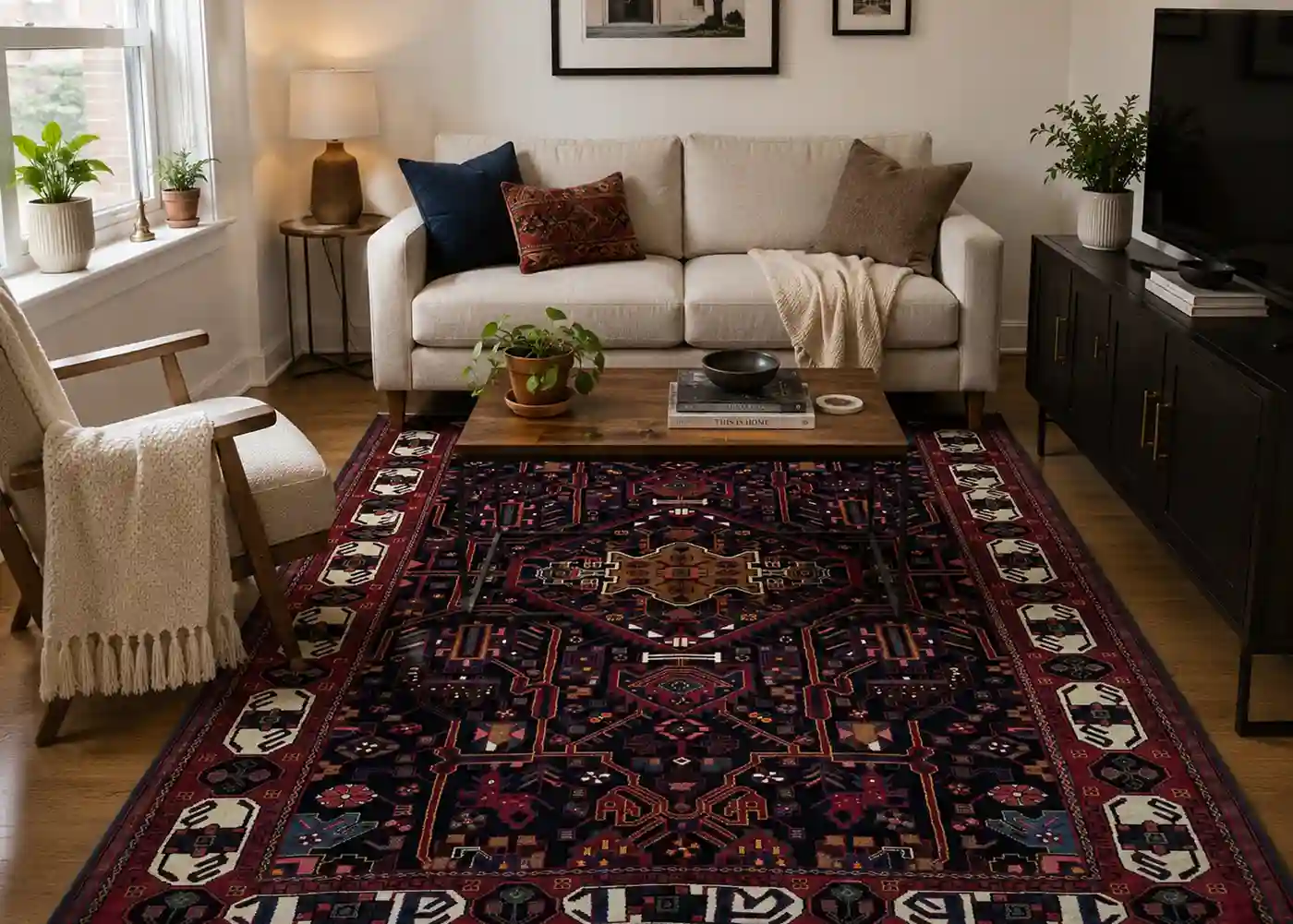
There is no universal border measurement for every small room. The visible floor should feel deliberate and relatively balanced around the rug. In compact living rooms, circulation and door clearance matter more than following one fixed decorative rule.
Check these points:
- The rug should not press tightly against every wall.
- Main walking paths should remain clear.
- Doors should open without catching the pile.
- The rug should not stop awkwardly in the middle of a doorway.
- Furniture should look anchored rather than squeezed.
Choose Color by Visual Weight, Not by a “Light Colors Only” Rule
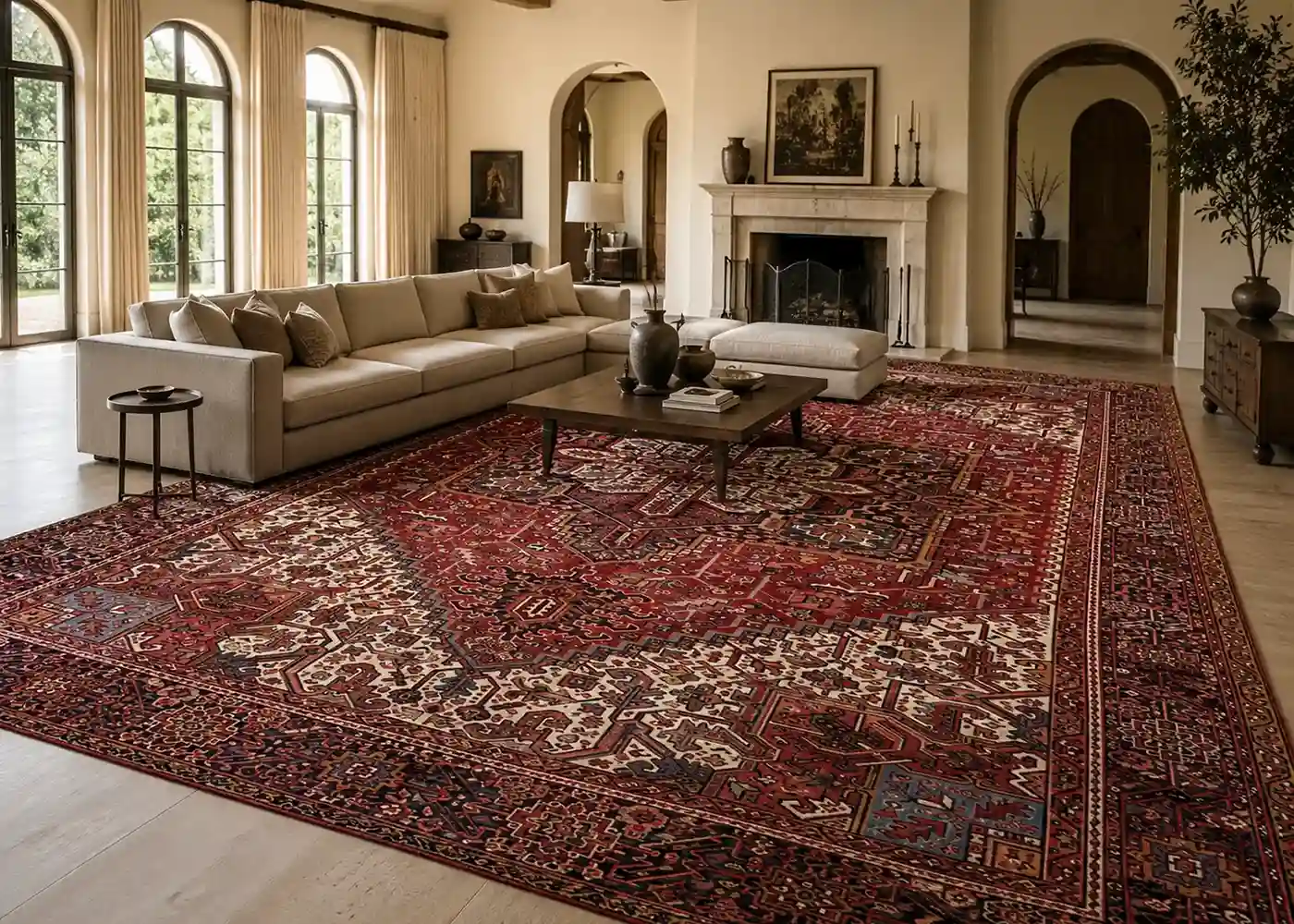
A common decorating claim says that only pale rugs belong in small rooms. This is too simplistic. A dark navy, deep red, or geometric Persian rug can look excellent in a compact living room when the walls, furniture, and lighting provide balance.
Light and Neutral Persian Rugs
Cream, ivory, beige, pale blue, and soft gray rugs can create an airy effect. They are particularly effective with dark sofas, walnut furniture, or rooms that receive limited natural light.
Choose a lighter rug when:
- The sofa and floor are both dark.
- The room has limited daylight.
- You prefer a quiet, refined interior.
- The rug has fine floral detail that benefits from a lighter field.
Deep Red and Navy Persian Rugs
Rich colors can make a small room feel warm, intentional, and memorable. They work particularly well with neutral upholstery, white or cream walls, leather seating, and warm wood.
A dark rug does not automatically make a room look smaller. Problems usually occur when every major surface is dark and lighting is weak. A deep rug with lighter furniture can create strong contrast and visual depth.
Multicolor Rugs
A multicolor Persian rug can make decorating easier because it provides several tones to repeat in cushions, art, curtains, and accessories. In a small living room, repeat only two or three rug colors elsewhere. Repeating every color can make the room feel busy.
What Pattern Scale Works Best?
Pattern scale should be considered together with furniture and rug dimensions.
Fine Floral Patterns
Nain, Tabriz, Kashan, and related floral traditions can introduce elegance and intricate detail. They often work well when the furniture has clean lines and mostly solid upholstery.
Bold Geometric Patterns
Heriz, Gharajeh, Turkmen, Baluch, and other geometric rugs can give a compact room structure and personality. A strong central medallion can anchor the coffee table, while repeating tribal motifs can add rhythm without requiring extra decoration.
Allover Patterns
An allover design can be useful when furniture covers the center of the rug. Because the pattern repeats across the field, the rug remains visually interesting even when a coffee table hides part of it.
Large Central Medallions
A medallion can work beautifully in a small living room, but placement matters. Ideally, the coffee table should align with the medallion rather than cutting across it awkwardly. Before purchasing, compare the product photo with your furniture footprint.
Wool or Silk for a Small Living Room?
Material should be chosen according to how the room is used, not only according to appearance.
Wool Persian Rugs
Wool is usually the more practical choice for an everyday living room. It offers resilience, warmth, texture, and comfort. A quality wool rug can handle regular foot traffic when cared for properly.
Wool is generally suitable for:
- Family living rooms.
- Homes with regular guests.
- Rooms where furniture may occasionally be moved.
- Spaces where comfort and durability are priorities.
Silk and Wool-Silk Rugs
Silk adds sheen and allows exceptionally fine detail, but it is more sensitive to heavy use, moisture, and careless cleaning. A silk or wool-silk Persian rug may be appropriate for a formal sitting room or a low-traffic apartment where the rug can be protected.
For a more detailed comparison, read Wool vs Silk Persian Rug before deciding.
Best Persian Rug Styles for a Small Living Room
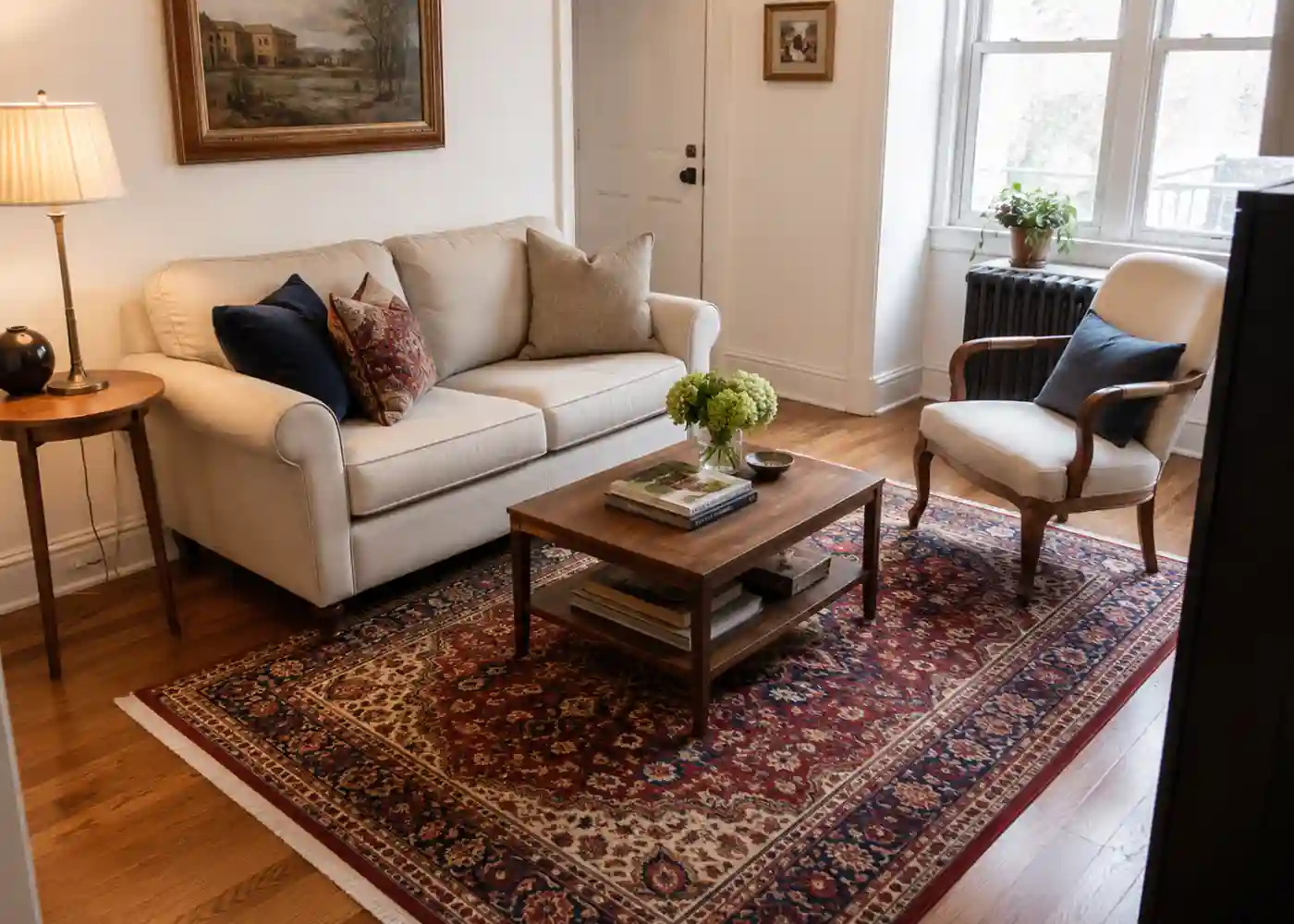
Nain Rugs
Nain rugs often use cream, ivory, navy, pale blue, and finely drawn floral motifs. They can create a refined and calm foundation for a small room, particularly when the interior is modern, neutral, or formal.
Heriz and Gharajeh Rugs
These rugs are known for stronger geometry and architectural motifs. They can add energy and character to a simple room. In a small space, pair a bold Heriz-style rug with quieter upholstery and fewer decorative accessories.
You can compare available pieces in the Heriz rugs collection.
Turkmen Rugs
Turkmen rugs often use repeating geometric motifs and deep reds, although other colors are also available. Their compact sizes can work well beside a sofa, under a coffee table, or in a small conversation area.
Sanandaj Rugs
Sanandaj rugs can offer refined geometric drawing and strong handwoven character. Smaller pieces may function as collector accents, reading-corner rugs, or distinctive focal points in compact rooms.
Antique and Semi-Antique Rugs
An older rug can add depth and history to a modern small room. Time-softened colors often work beautifully with contemporary furniture. However, condition, restoration, pile wear, and intended traffic should be reviewed carefully.
Browse old and antique rugs if you want a piece with age, patina, and individual history.
How to Match the Rug with the Sofa
Neutral Sofa
A beige, cream, gray, white, or taupe sofa provides freedom. You can choose a rich red, navy, green, or multicolor Persian rug and repeat one accent color in cushions or artwork.
Dark Sofa
With charcoal, navy, dark brown, or black upholstery, consider a rug containing ivory, cream, light blue, gold, or warm red to create separation from the floor and sofa.
Colored Sofa
Do not search only for an exact color match. Instead, find a rug that contains a small amount of the sofa color or a compatible neighboring tone. Exact matching can look artificial, while coordinated variation feels more collected.
Patterned Sofa
If the sofa has a visible pattern, choose a Persian rug with a different pattern scale. For example, pair a broad striped sofa with a finer floral rug, or a small repeating upholstery pattern with a larger geometric rug.
How to Use a Small Persian Rug in a Room That Needs More Coverage
Sometimes the ideal Persian rug is smaller than the floor area you want to cover. Instead of rejecting the piece, consider layering it over a larger neutral base rug.
A small Persian rug can be layered over:
- A plain wool rug.
- A natural-fiber rug with a low, firm texture.
- A neutral flatweave.
- A larger low-contrast area rug.
Place the Persian rug where it will be visually centered beneath the coffee table or in front of the sofa. Avoid thick, unstable combinations that create a trip hazard. Use suitable rug pads where necessary.
Common Mistakes to Avoid
Buying the Smallest Rug to Save Money
A smaller rug is not automatically better for a small room. If it fails to connect the furniture, the space can appear more fragmented and less finished.
Choosing by Room Size Alone
Furniture footprint, traffic flow, and rug placement are more important than a generic room category.
Ignoring Exact Product Measurements
Handmade rugs are individual textiles. Do not assume that every rug listed as “small” or “medium” has a standardized dimension. Read the centimeter and feet measurements carefully.
Matching Every Color
A room does not need to repeat every shade in the rug. Choose two or three colors and let the remaining tones provide depth.
Hiding the Best Part of the Design
Check where the coffee table and sofa legs will sit. A beautiful medallion or focal motif should not be covered unintentionally.
Ignoring Lifestyle
A delicate silk rug may be beautiful but unsuitable for an active family room. A stronger wool rug may provide a better balance of beauty and daily practicality.
Buying Without Checking Authenticity
Use clear product photographs and inspect the back, fringe, structure, materials, dimensions, and condition. The guide to identifying an authentic Persian rug explains the most useful clues.
How to Buy a Persian Area Rug for Small Living Room Use Online
Online buying can be effective when the seller provides enough information to evaluate the exact rug. Before ordering, review:
- Full dimensions in centimeters and feet.
- Clear front and back photographs.
- Close-ups of pile, fringe, sides, and condition.
- Material information.
- Origin and weaving description.
- Restoration or age information where relevant.
- Shipping and return terms.
- Confirmation that the photographed rug is the exact piece being sold.
At Arghavan Rugs, available rugs are presented as individually selected handmade pieces. The brand emphasizes authentic handwoven construction, Persian craftsmanship, careful selection, and one-of-a-kind character. You can review the company’s approach on the Why Choose Arghavan Rugs page.
Because handmade rugs are unique, inventory changes as individual pieces are sold. Start with the complete rug collections, then compare the Small and Medium categories based on your taped floor measurements.
A Simple Buying Strategy from Arghavan Rugs
- Measure the sofa and seating footprint.
- Outline two possible rug sizes with painter’s tape.
- Decide whether you want coffee-table-only or front-legs-on placement.
- Browse Small Rugs for accent and compact layouts.
- Browse Medium Rugs when the rug must connect the seating.
- Choose wool for an active everyday living room or consider silk for formal, low-traffic use.
- Compare rug colors with the sofa, floor, wall color, and daylight.
- Ask Arghavan Rugs for extra photographs or sizing guidance before ordering.
If you need help selecting a specific Persian area rug for small living room placement, use the Arghavan Rugs contact page. Include your room measurements, sofa width, a photograph of the space, and your preferred colors. This makes the recommendation much more accurate.
Frequently Asked Questions
What size Persian rug is best for a small living room?
A rug close to 5 × 8 or 6 × 9 feet is a useful starting point, but the best size depends on the sofa width and placement. A compact rug may sit under the coffee table, while a larger rug should reach under the front legs of the sofa and chairs.
Can a Persian rug make a small living room look bigger?
Yes. A properly sized rug can connect the furniture and reduce visual fragmentation. A rug that is too small often has the opposite effect. Lighter colors can create openness, but darker rugs can also work when balanced with light walls, furniture, and good illumination.
Should the sofa sit on the Persian rug?
In many small living rooms, placing the front sofa legs on the rug creates the most balanced result. A very small accent rug may sit entirely in front of the sofa, while a larger rug may support all furniture legs.
Is a 5 × 8 rug large enough for a small living room?
It can be. A 5 × 8 rug often works with a loveseat, compact sofa, and small seating arrangement. Use painter’s tape to test whether it visually connects the furniture.
Is a 6 × 9 rug too large for a small room?
Not necessarily. A 6 × 9 rug may make the room feel more complete if it anchors the sofa and chairs while leaving clear walking space and visible flooring around the seating zone.
What color Persian rug is best for a small room?
Cream, ivory, and light blue can create a softer atmosphere, while navy, red, and geometric multicolor rugs can add warmth and depth. The best choice depends on the sofa, flooring, walls, and natural light.
Are handmade Persian rugs suitable for apartments?
Yes. Handmade rugs are available in many dimensions, including compact sizes suitable for apartments, condos, reading corners, offices, and small living rooms. Their visual character can make a simple apartment feel more personal and refined.
Should I choose wool or silk?
Wool is usually better for a living room used every day. Silk is more appropriate for formal or low-traffic spaces where its finer surface can be protected.
Can I layer a small Persian rug?
Yes. A small Persian rug can be layered over a larger neutral flatweave or low-pile rug. Make sure the layers remain stable and do not create a raised edge or trip hazard.
Where can I buy an authentic Persian area rug for a small living room?
You can browse curated handmade pieces through Arghavan Rugs. Compare the exact measurements in the Small Rugs and Medium Rugs collections, then contact the store for help matching a rug to your seating arrangement.
Final Conclusion
The best Persian area rug for small living room use is not always the palest rug or the smallest size. It is the piece that connects the furniture, supports movement, complements the room’s colors, and adds character without visual clutter.
Start by measuring the seating arrangement rather than relying only on wall dimensions. Test the rug outline with painter’s tape. Decide whether the rug will sit under the coffee table, support the front furniture legs, or hold the full seating group. Then choose a material and design that match the way the room is used.
A handmade Persian rug can become the most important element in a compact living room. Through Arghavan Rugs, you can compare one-of-a-kind small and medium Persian rugs, review exact dimensions, and request guidance before purchasing. The goal is not simply to fill floor space—it is to choose a rug that makes the entire room feel intentional, warm, and complete.
Editorial Sources
- West Elm Living Room Rug Guide
- Wayfair: How to Place a Rug in a Living Room
- Architectural Digest: How to Choose Rug Sizes
Editorial note: Rug-size recommendations are general design guidelines. Exact placement should be based on furniture dimensions, door clearance, circulation, and the individual measurements of the handmade rug.