

Handmade Rugs in Brampton | Persian Rug Buying Guide
Discover handmade rugs in Brampton and learn how to choose authentic Persian rugs by…
Article Guide
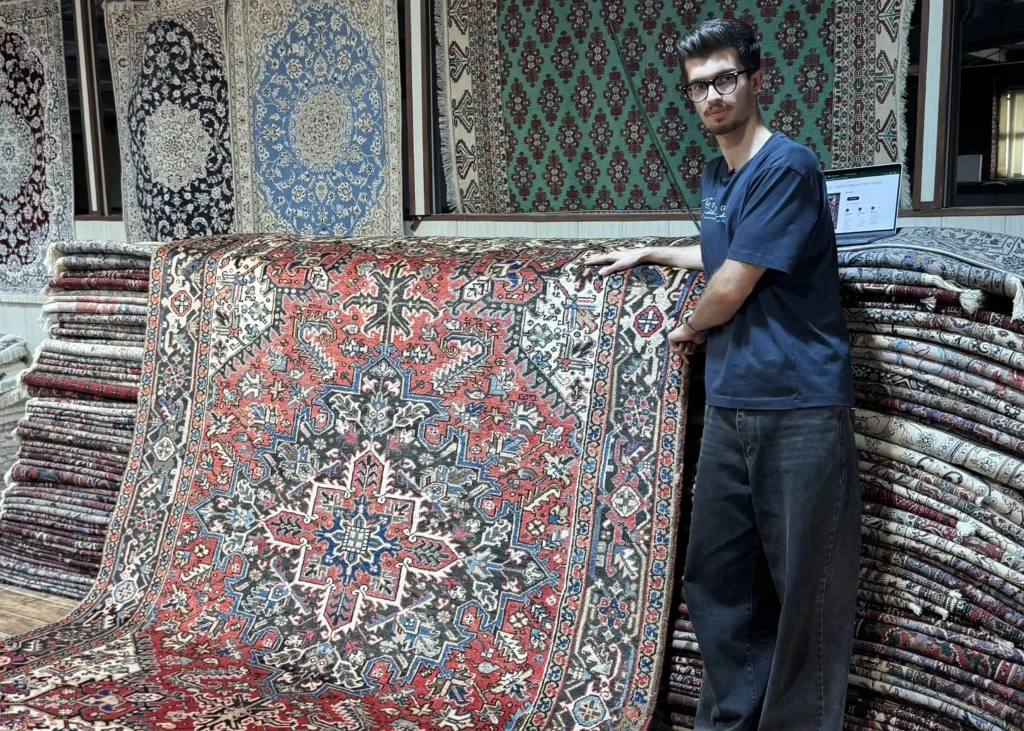
Shopping for handmade rugs in Brampton is about much more than choosing a colour or finding a carpet that covers an empty section of flooring. A genuine handmade Persian rug brings craftsmanship, texture, history and individuality into a home. Because every piece is woven by hand, the rug becomes part of the room’s identity rather than simply another decorative accessory.
Homes across Brampton vary considerably in size and character. A spacious family room in Credit Valley may need a large rug that connects several furniture pieces, while a townhouse in Mount Pleasant may benefit from a carefully proportioned medium rug. Long entrances in Castlemore, Bramalea or Heart Lake can be transformed with runners, while smaller rugs may be ideal for bedrooms, offices and reading areas.
In this local buying guide, Arghavan Rugs explains how to choose authentic Persian rugs in Brampton according to size, material, construction, design, condition and intended use. It also explains what buyers should examine before ordering a handmade rug online and how to avoid the most common purchasing mistakes.
Why Handmade Rugs Suit Brampton Homes
A handmade rug can solve several interior-design problems simultaneously. It can connect furniture, soften hard flooring, introduce colour, reduce the visual emptiness of a large room and give a modern interior a stronger sense of character.
Many contemporary homes use neutral walls, hardwood floors, stone surfaces and simple furniture. These materials create a clean interior, but the room may feel cold or unfinished without a textile element. A handmade Persian rug adds pattern and warmth while preserving the elegance of the architecture.
Traditional Brampton interiors can benefit from handmade rugs for a different reason. Floral Tabriz, Kashan, Nain or Moud rugs can relate naturally to carved wood, formal dining furniture, framed artwork and classic decorative details. Geometric Heriz, tribal and village rugs can create a stronger and less formal atmosphere.
The most important advantage is individuality. Machine-made carpets are produced repeatedly in identical patterns and standardised colours. A handmade rug contains subtle variations in colour, knotting, drawing and proportion. These variations document the work of the weaver and make each carpet unique.
How to Buy Handmade Rugs in Brampton Online
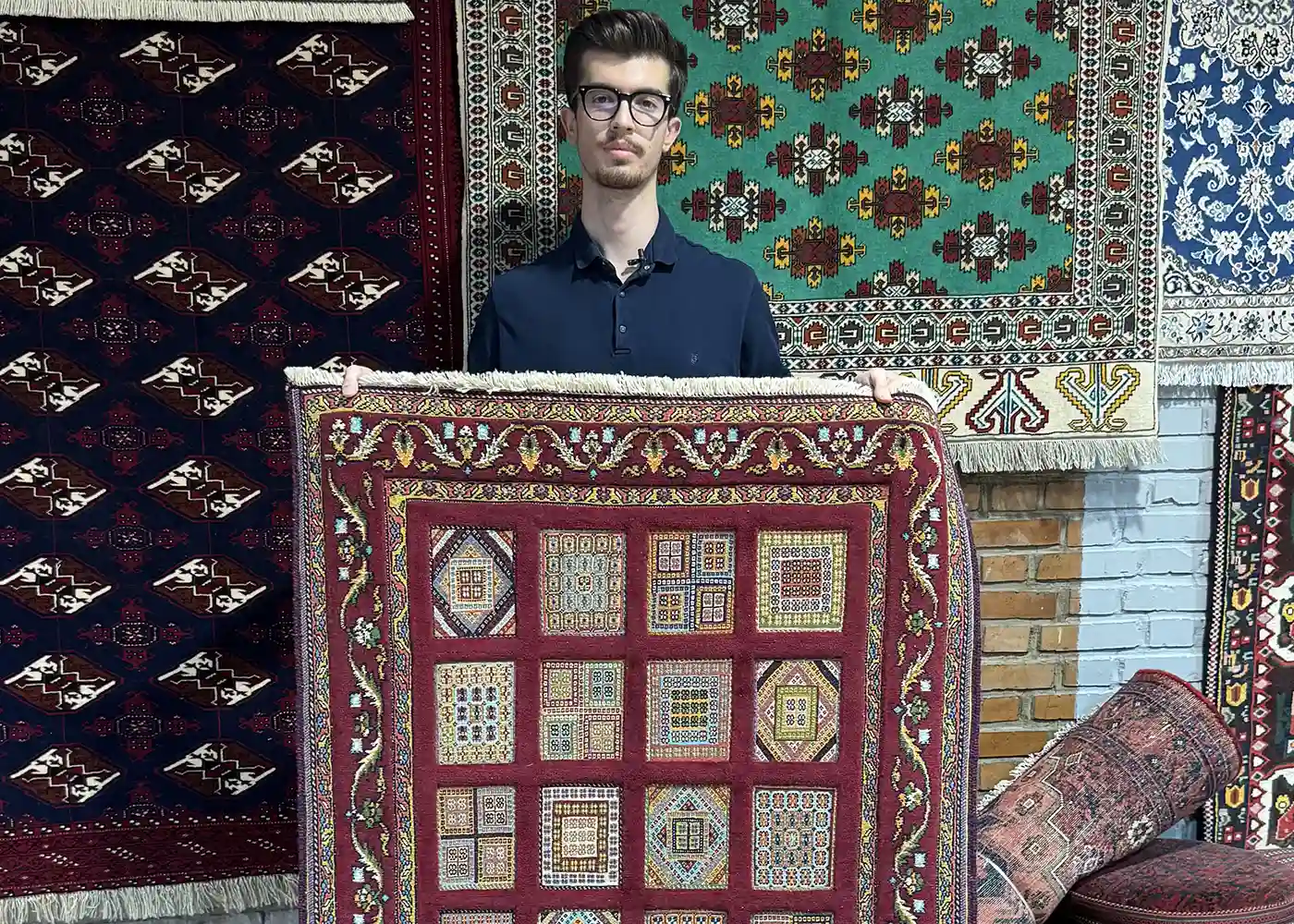
Buyers no longer need to limit themselves to the rugs displayed in a nearby showroom. Shopping online provides access to different Persian weaving regions, dimensions, materials, age groups and price levels. The quality of the experience, however, depends on the information supplied for the exact rug being sold.
When buying handmade rugs in Brampton online, do not judge a piece from one styled photograph. Request enough visual information to understand the entire carpet, including its field, borders, corners, fringes, side finishes, pile and back.
A reliable product presentation should provide the exact dimensions rather than a general size category. Handmade rugs are not always perfectly rectangular, and small variations between opposite sides can occur. These differences are usually part of handmade construction, but the measurements must still suit your room.
Before completing an order, buyers should be able to request:
- A full photograph of the rug from directly above
- Close-up photographs of the pile and knotting
- Images of all four corners
- Clear photographs of the fringes and side finishes
- A photograph of the back
- A video recorded in natural light
- Information about repairs, wear or restoration
- Confirmation of the material and weaving origin
For a complete explanation of the process, read the guide to buying authentic Persian rugs online.
What Makes a Rug Truly Handmade?
A Persian-style pattern does not automatically make a carpet handmade or Persian. Machine-made rugs can reproduce medallions, flowers, Herati patterns and tribal motifs with considerable visual accuracy. Construction must therefore be examined separately from design.
Examine the Back
In a hand-knotted rug, the design is formed by knots tied around the foundation threads. The pattern should consequently be visible from the back, although its colour may appear less intense than on the pile side.
Machine-made rugs may have an applied backing, a regular synthetic grid or a highly uniform structure. Perfect mechanical consistency is not always proof by itself, but the back often provides the clearest starting point for evaluation.
Inspect the Fringes
On a traditional hand-knotted rug, the fringes are usually extensions of the warp threads running through the length of the carpet. They are structural components rather than decorative pieces sewn onto the ends.
Added fringe can appear on repaired handmade rugs, so attached fringe does not automatically prove that the entire carpet is machine-made. It does, however, require closer examination and an honest explanation from the seller.
Look for Controlled Handmade Variation
Small differences in knots, outlines and colour are normal in handmade weaving. The goal is not perfect mechanical repetition. The goal is a controlled design that remains balanced despite being created by human hands.
Large distortions, severe waviness or inconsistent motifs may indicate structural problems rather than desirable handmade character. Buyers must learn to distinguish natural variation from poor construction.
Use the detailed guides to handmade versus machine-made rugs and identifying an authentic Persian rug before making a final decision.
Choosing the Right Rug Size
Size has a greater effect on the appearance of a room than many buyers expect. Even an exceptional handmade rug can look disconnected if it is too small for the furniture arrangement. An oversized piece may hide too much flooring or make circulation around the room difficult.
Measure the actual furniture layout rather than estimating the room from wall to wall. Mark the proposed rug dimensions on the floor with painter’s tape. This makes it easier to see whether the rug connects the furniture, blocks a doorway or leaves an awkward strip of exposed flooring.
| Room or Area | Useful Starting Size | Placement Goal |
|---|---|---|
| Small sitting area | Approximately 120 × 180 cm to 150 × 200 cm | Place around the coffee table or beneath the front furniture legs |
| Standard living room | Approximately 160 × 230 cm to 200 × 300 cm | Connect the sofa and main chairs |
| Large family room | Approximately 250 × 350 cm or larger | Anchor the complete seating arrangement |
| Dining room | Based on table size plus chair clearance | Keep chair legs on the rug when pulled back |
| Hallway | Length based on corridor proportions | Leave visible flooring along the sides and ends |
| Bedroom | Small bedside rugs or one larger rug | Add comfort without interfering with doors |
These measurements are starting points rather than universal rules. Furniture dimensions, room shape, doors, floor vents and circulation paths must also be considered.
You can compare the current small rug collection, medium rugs, large rugs and extra-large rugs after measuring your space.
Persian Rugs for Brampton Living Rooms
The living room is often the most visually important location for a handmade rug. The carpet must relate to the sofa, chairs, coffee table, lighting and wall colours while remaining practical for everyday movement.
In most seating arrangements, the rug should extend beneath at least the front legs of the sofa and chairs. This creates one connected composition. A small rug floating beneath the coffee table may make the furniture appear separated, even when the rug itself is beautiful.
For formal living rooms, a central-medallion rug can establish a strong focal point. The medallion should be positioned intentionally and should not be almost completely hidden beneath a large coffee table.
All-over patterns are often more flexible. Herati, floral, lattice and repeated geometric designs remain visually active even when furniture covers part of the field. They can work particularly well in rooms where the seating arrangement is not perfectly symmetrical.
Before choosing a design, decide whether the rug should become the main feature or support the existing furniture. A rich red, navy or highly detailed rug can command attention. A softly coloured ivory, beige, muted blue or aged rug can contribute texture without dominating the room.
Rugs for Open-Concept Family Rooms
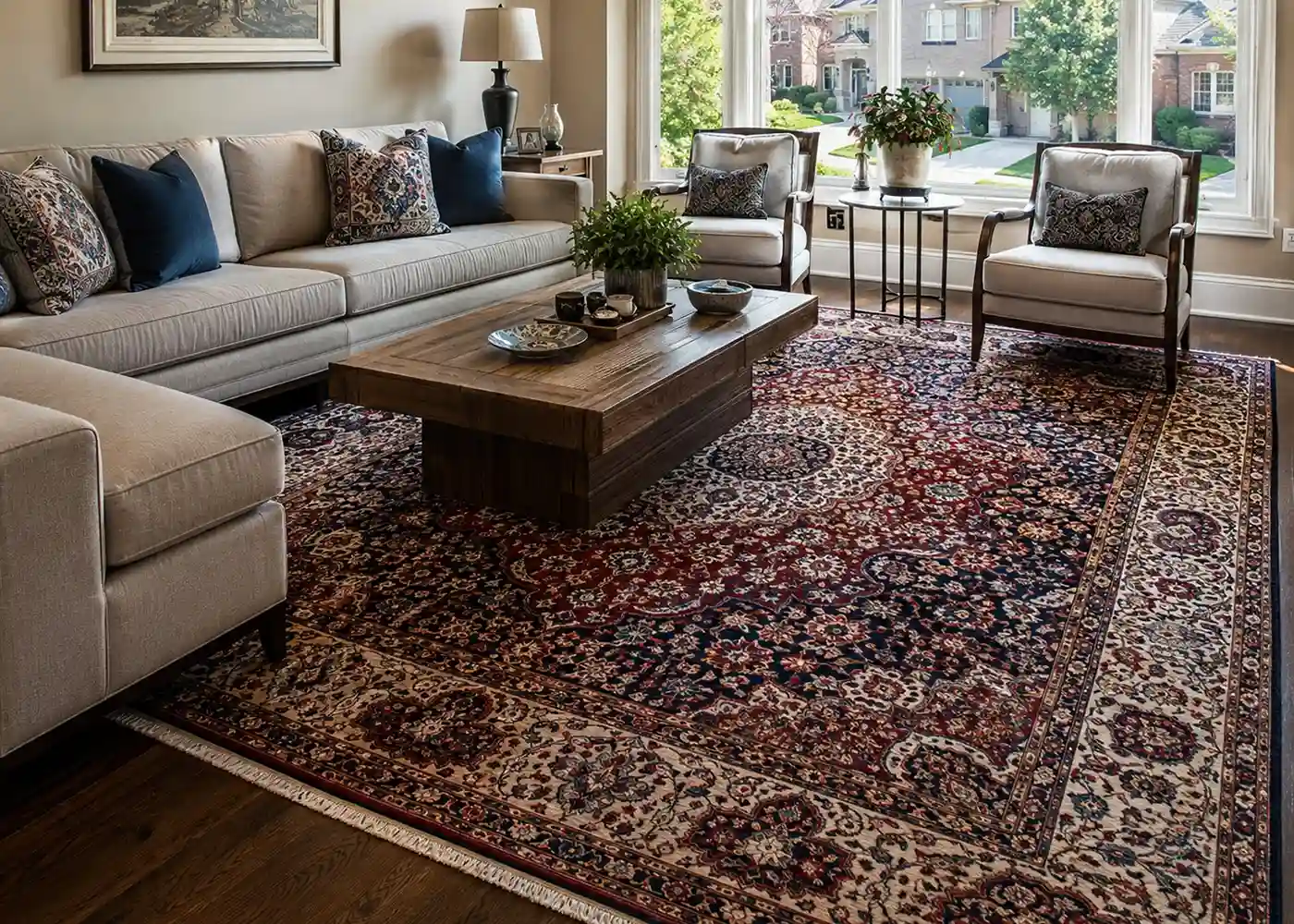
Open-concept interiors can feel spacious, but they often lack clear visual boundaries. A large handmade rug can define the family area without constructing a wall or interrupting the flow between the kitchen, dining area and seating space.
The rug should be large enough to relate to all the principal seating elements. If only the coffee table touches the carpet, the room may still feel fragmented. Extending the rug beneath the sofa and chairs creates a more deliberate interior.
In a busy family room, consider durability before fineness. A strong wool rug with a balanced pile and practical colour palette is generally easier to use than a delicate silk carpet. Dense patterns and medium tones can also make ordinary signs of daily use less visually distracting.
Geometric Heriz rugs, strong village carpets and durable wool Tabriz rugs can give a large room structure. For lighter interiors, an ivory or blue Nain-style composition may create refinement, provided the room’s traffic level is appropriate for the specific rug.
Persian Rugs for Dining Rooms
A dining-room rug has to perform differently from a decorative rug in a low-traffic space. It must accommodate the table, chairs and repeated movement created when people sit down or stand up.
The most common sizing mistake is selecting a rug that only fits beneath the table when the chairs are pushed in. When a chair is pulled back, its rear legs may fall outside the rug and catch against the edge.
Measure the tabletop and add sufficient clearance on every side for the chairs. Test the proposed dimensions with tape before ordering. The exact allowance depends on the chairs and room, so direct measurement is more reliable than relying on a single universal formula.
All-over patterns can be particularly practical beneath dining tables because the design does not depend on one visible central medallion. Floral repeats, Mahi patterns and geometric fields continue to look balanced when the centre is partly covered.
Wool is normally more appropriate than silk for frequently used dining rooms. Spills should still be treated immediately, and the rug should never be cleaned with an ordinary household carpet shampooer.
For additional measurements and placement advice, read the guide to choosing the best Persian rug size for a dining room.
Hallway and Entryway Rugs
Entrances and corridors are among the best locations for handmade runners, but they are also exposed to frequent traffic. A runner introduces colour and direction into a narrow area while protecting part of the flooring.
Choose a runner that leaves visible floor along both sides. A carpet fitted too tightly against the walls can look like installed hallway carpeting rather than a deliberately selected handmade piece.
Door clearance must also be checked. Thick pile may interfere with an inward-opening door. A flatter runner, low-pile carpet or kilim can be more practical where clearance is limited.
During wet or snowy weather, avoid placing a valuable handmade rug directly where outdoor shoes bring in moisture, grit and road salt. Use a separate entrance mat and position the handmade runner farther inside the home.
Explore the current collection of handmade Persian hall runners for long entrances, upstairs corridors and transitional spaces.
Wool or Silk: Which Material Is Better?
Material should be chosen according to use rather than prestige. Silk is not automatically better than wool, and a wool rug is not automatically ordinary. Exceptional carpets can be woven in either material.
Wool Rugs
Wool is the most practical option for many Brampton households. Good-quality wool is resilient, comfortable and suitable for living rooms, family rooms, bedrooms, offices and hallways.
Wool fibres can support detailed drawing while retaining a warmer and more substantial texture. A properly constructed wool rug can handle regular use, although it still requires appropriate care and professional cleaning.
Wool Rugs with Silk Highlights
Some Persian rugs use wool for the principal pile and silk for selected flowers, outlines or decorative details. The silk reflects light and can make parts of the pattern appear more defined.
Silk highlights should strengthen the design rather than simply create random shine. The quality of the wool, drawing and construction remains important even when silk is present.
Silk Rugs
Silk allows fine yarns, compact knotting and highly detailed patterns. Its reflective surface changes according to lighting and viewing direction, creating a refined and sometimes luminous appearance.
Full-silk or silk-rich rugs are generally better suited to formal rooms, private studies, low-traffic bedrooms or collectible interiors. They require more careful handling and should not be selected only because the word “silk” sounds luxurious.
Compare the materials in the complete wool versus silk Persian rug guide.
Popular Persian Rug Styles for Brampton Interiors
The right regional style depends on the architecture, furniture and atmosphere of the room. No single Persian rug type is suitable for every interior.
Tabriz Rugs
Tabriz rugs are produced in an extensive range of designs, from medallion and floral compositions to Mahi, pictorial and architectural patterns. Fine drawing and carefully organised borders make many Tabriz rugs suitable for formal living rooms and dining spaces.
A detailed Tabriz carpet can also create contrast in a modern room with simple furniture. Buyers should evaluate the individual rug rather than assuming that every piece carrying the Tabriz name has the same quality.
Nain Rugs
Nain rugs are often associated with ivory, cream and blue palettes, refined floral drawing and elegant medallions. These characteristics can work well in bright interiors with neutral furniture and controlled traffic.
Because pale fields show marks more easily, the intended room and household activity should be considered before buying.
Heriz Rugs
Heriz rugs are recognised for strong geometric drawing, angular medallions and confident colour combinations. Their visual weight can anchor a large family room or add character to a minimal interior.
A Heriz rug does not need to be placed in a traditional room. Its geometry can create an effective relationship with contemporary furniture, leather, wood and metal.
Kashan Rugs
Kashan rugs commonly feature curvilinear floral designs, medallions and formal borders. Red, navy, cream and blue palettes appear frequently, although individual examples vary considerably.
They can suit formal reception rooms, dining rooms and traditional interiors where a central composition is desirable.
Moud and Birjand Rugs
Moud and Birjand rugs may feature Herati repeats, medallions, garden-inspired compartments or finely organised floral structures. Their balanced detail can work in offices, libraries and living rooms.
Turkmen and Tribal Rugs
Turkmen, Baluch and other tribal rugs often use geometric motifs, repeated guls and strong earthy palettes. Small and medium examples can bring individuality to bedrooms, reading corners and layered modern interiors.
Kilims
Kilims are flat-woven textiles without a traditional pile. Their lighter structure and graphic patterns can suit casual, bohemian and modern interiors.
They are useful where a heavy pile rug would interfere with a door or where the homeowner wants a more relaxed visual effect. Browse the collection of handmade Persian kilims for flat-woven options.
Choosing Colour for Your Interior
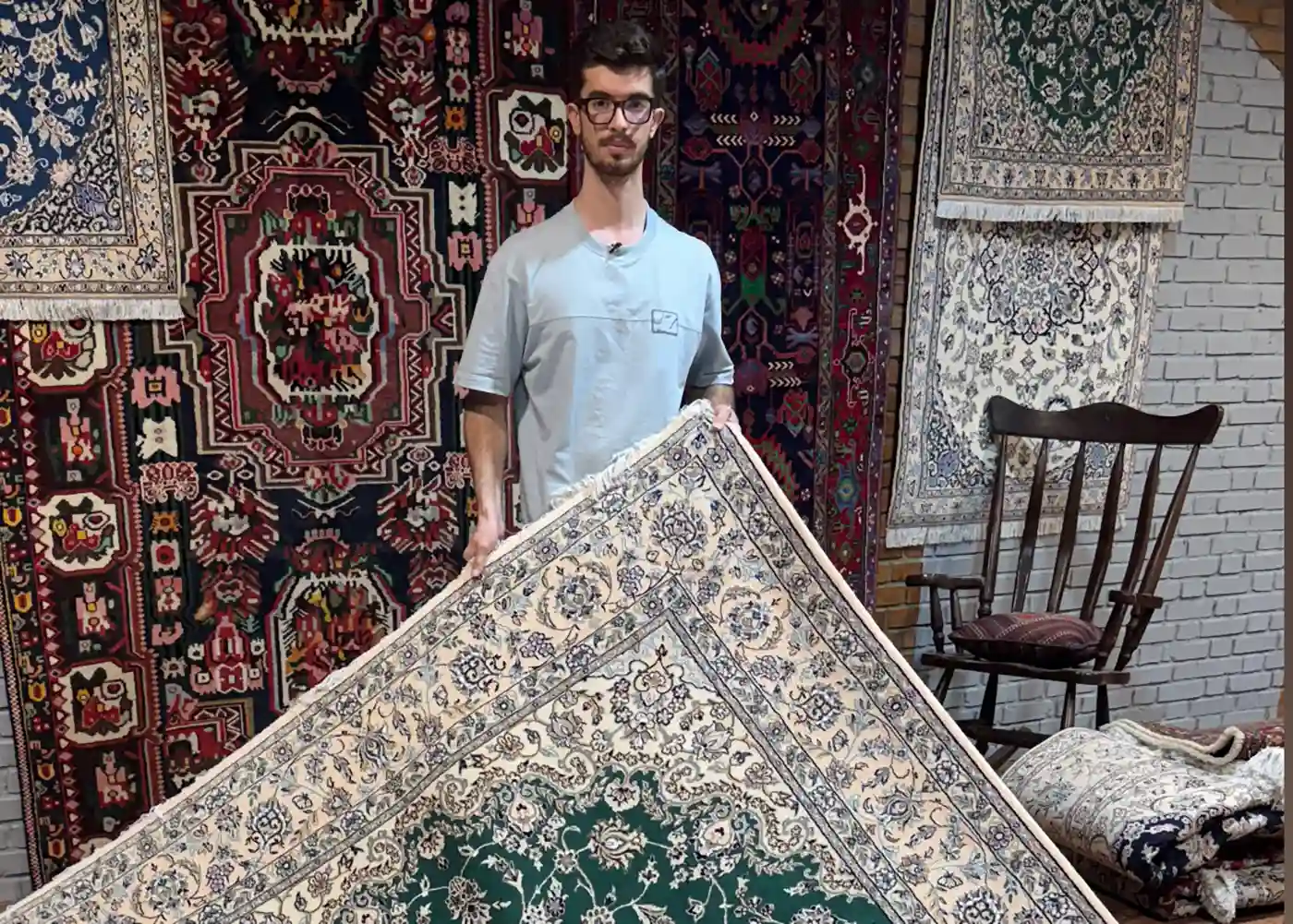
Rug colours should be evaluated in relation to flooring, wall colour, furniture and natural light. A carpet photographed in direct daylight can appear different under warm indoor lighting.
Before ordering, request a video of the rug in natural light and ask whether the pile has a light and dark direction. Many handmade rugs appear brighter when viewed from one end and deeper when viewed from the opposite direction.
Dark Rugs
Navy, deep red, brown and dark green rugs add weight and formality. They can make a large room feel more grounded, especially when the surrounding furniture is pale or neutral.
Light Rugs
Ivory, cream, beige and pale blue rugs create an open and refined atmosphere. They can make a smaller room feel lighter but may show spills and surface marks more quickly.
Muted and Aged Colours
Softened reds, faded blues, warm browns and gently aged palettes can connect traditional craftsmanship with contemporary furniture. These colours often produce a collected interior rather than a newly decorated appearance.
Strong Geometric Colour
Bold tribal or village rugs can become the principal artistic element in an otherwise restrained room. When using a highly patterned rug, avoid repeating every colour in cushions, curtains and accessories. Allow the carpet to remain distinctive.
Handmade Rugs for Family Homes and Pets
A handmade rug can be used in an active household, but the material, colour and construction should match the lifestyle. Buyers with children or pets should normally prioritise resilient wool, stable construction and practical colours.
A medium-tone rug with a detailed pattern is often more forgiving than a very pale, visually open field. Minor everyday marks are less noticeable when the design contains several colours and repeated motifs.
Long claws can catch on loose or damaged areas, so the rug’s pile, fringes and side finishes should be inspected. Existing weaknesses should be repaired before placing an older rug in an active room.
Vacuum gently without pulling the fringes into the machine. Avoid aggressive rotating brushes on delicate rugs, and treat spills by blotting rather than scrubbing.
A suitable rug pad can reduce movement, provide cushioning and limit friction between the carpet and hard flooring. The pad should be selected according to the rug and floor type.
Antique and Semi-Antique Persian Rugs in Brampton
Older Persian rugs offer colour, texture and visual maturity that new carpets cannot always reproduce. Wear, patina and subtle changes in colour may contribute to their character when they have developed naturally.
Age alone, however, does not establish quality or value. An older rug must still be evaluated for origin, materials, drawing, condition, restoration, colour stability and structural integrity.
Before buying an antique or semi-antique rug, examine:
- Areas of low or missing pile
- Rewoven sections and later repairs
- Shortened or reconstructed ends
- Damaged side cords
- Colour run or surface recolouring
- Moth damage
- Brittle foundation threads
- Distortion or inability to lie flat
A carefully restored rug can still be desirable. The important issue is whether the restoration is appropriate, stable and accurately disclosed.
Buyers looking for pieces with age and patina can browse the old and antique Persian rug collection.
Online Rug Buying Checklist
Use the following process before purchasing handmade rugs in Brampton online.
- Measure the room. Record the available width and length and note doors, vents and circulation routes.
- Measure the furniture arrangement. Decide which furniture legs should sit on the rug.
- Confirm the exact rug dimensions. Do not rely only on labels such as small, medium or large.
- Study the complete front. Check whether the field, borders and corners appear balanced.
- Inspect the back. Examine the knotting, repairs and visibility of the design.
- Check the fringes and sides. Look for damage, reconstruction or weak areas.
- Confirm the material. Ask whether the pile is wool, silk or a combination and whether the foundation is cotton or silk.
- Ask about condition. Request details about stains, wear, repairs, moth damage and colour run.
- Request a natural-light video. This helps evaluate colour and pile direction.
- Review delivery information. Understand the shipping method, tracking, insurance and customs responsibilities.
- Review the return policy. International handmade-rug purchases may have different return conditions from ordinary online retail products.
- Ask all questions before payment. Do not make assumptions about colour, age, material or condition.
Persian Rug Delivery to Brampton
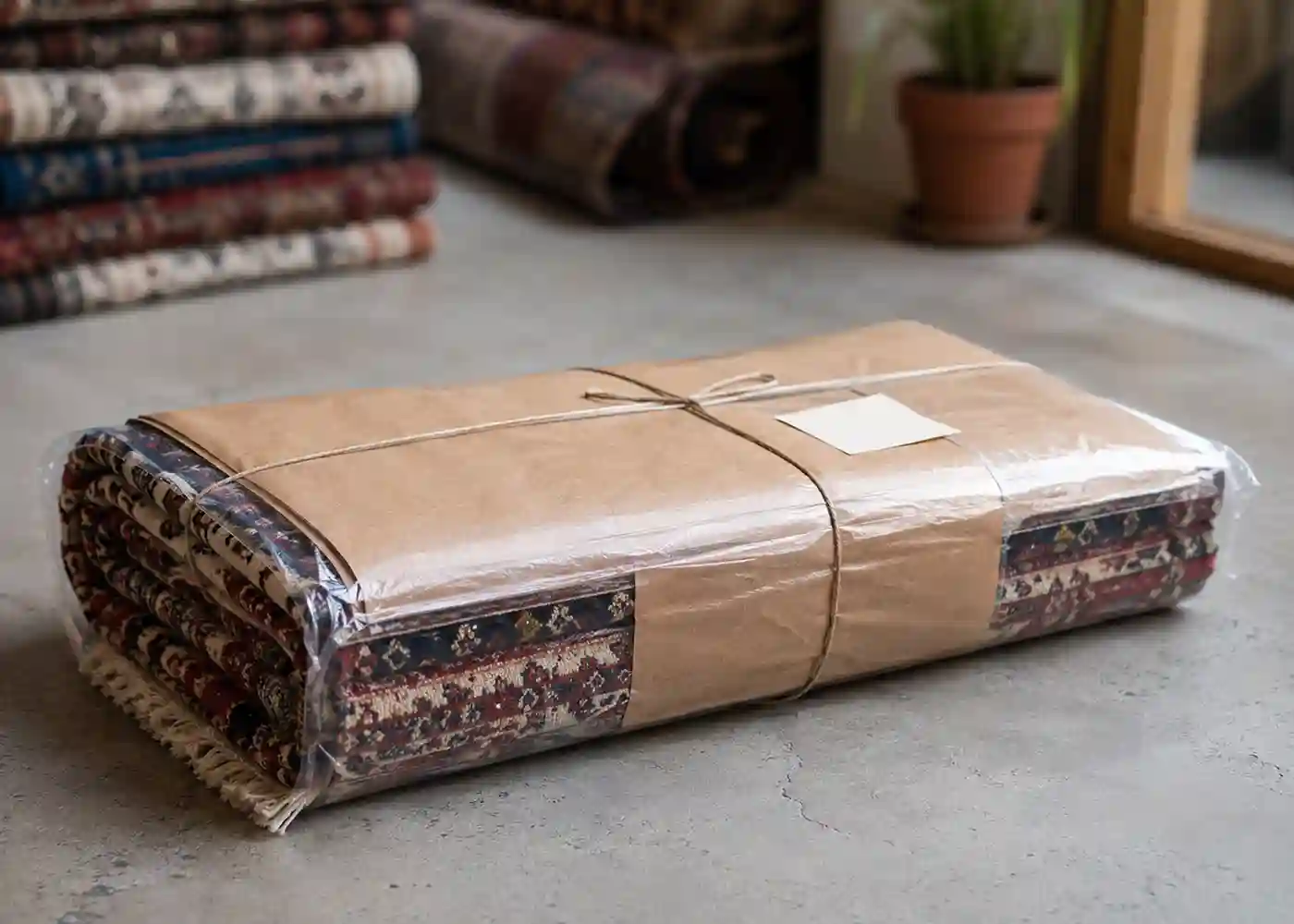
Online buyers should review delivery conditions before choosing a rug, particularly when purchasing a large or heavy carpet. Shipping arrangements may differ according to the rug’s packed weight, destination and delivery method.
Confirm whether the shipment will be delivered directly to the address or whether another collection arrangement applies to an oversized order. Buyers should also understand tracking, insurance, customs procedures and any local charges that may apply.
Do not rely on an old article or social-media post for current shipping conditions. Review the latest Arghavan Rugs delivery information before ordering and contact the team with the exact Brampton postal code when clarification is required.
Before dispatch, request final photographs or a video of the exact carpet. Confirm that the product, dimensions and condition match the piece you selected.
Questions to Ask Before Buying a Handmade Rug
A responsible seller should be able to answer specific questions about the individual carpet rather than only providing general descriptions of Persian rugs.
- Is this exact rug handmade?
- Was it woven in Iran or is it Persian-style?
- What region or weaving tradition is it associated with?
- What is the exact length and width?
- Are the dimensions measured with or without the fringes?
- What material is used for the pile?
- What material is used for the foundation?
- Are silk details structural or decorative highlights?
- Has the rug been repaired or restored?
- Are there stains, low pile, moth damage or colour run?
- Have the ends or sides been reconstructed?
- Does the rug lie flat?
- Can additional photographs of the back be provided?
- Can the rug be shown in natural light on video?
- What delivery method applies to the rug’s weight?
- What return, cancellation and insurance conditions apply?
Clear answers reduce uncertainty and help buyers compare rugs based on real characteristics rather than attractive marketing labels.
Why Choose Arghavan Rugs?
Buying a handmade Persian rug requires confidence in the description, photography and communication surrounding the piece. Arghavan Rugs focuses on authentic handmade carpets selected for their craftsmanship, materials, design and individual character.
The online collection includes room-size Persian rugs, smaller carpets, runners, kilims and older pieces. Buyers can compare different dimensions and weaving styles rather than choosing from one generic type of carpet.
Each rug should be evaluated as an individual work. Two carpets from the same region may differ in wool quality, knotting, colour, design and condition. Personal guidance is therefore useful when buyers are choosing between several pieces for a specific room.
Begin by browsing all handmade Persian rugs. For more information about the company’s approach to authenticity and production, visit Why Choose Arghavan Rugs.
Buyers can also contact Arghavan Rugs to request additional photographs, videos, measurements or help comparing carpets for a Brampton home.
Frequently Asked Questions About Handmade Rugs in Brampton
Where can I buy handmade rugs in Brampton?
You can browse authentic handmade Persian rugs online through Arghavan Rugs and compare available carpets by size, regional style, material, colour and age. Request detailed photographs and videos of the exact rug before completing the purchase.
Can I order Persian rugs online for delivery to Brampton?
Arghavan Rugs provides international delivery information for online orders. Because delivery methods and import conditions can change, review the current delivery page and confirm the arrangement for your specific Brampton postal code before paying.
How do I know whether a Persian rug is genuinely handmade?
Examine the back, knot structure, foundation and fringes. In a traditional hand-knotted rug, the pattern is formed through the foundation and the fringes are generally extensions of the warp threads. Natural variations may be visible, but construction should still remain controlled and stable.
What is the best material for a busy Brampton family home?
Wool is usually the most practical material for active living rooms, family rooms, bedrooms and hallways. It generally handles regular traffic better than silk. The rug’s construction, pile, condition and colour should also be considered.
What size Persian rug should I choose for a living room?
The rug should normally be large enough to connect the main sofa and chairs. In many layouts, placing at least the front furniture legs on the carpet creates a more complete arrangement. Measure the furniture rather than relying only on the overall room size.
Are Persian rugs suitable for modern Brampton interiors?
Yes. A traditional rug can create an effective contrast with simple furniture, neutral walls and modern architecture. Geometric rugs add structure, while refined floral rugs introduce detail and softness.
Should I choose a medallion or an all-over pattern?
A medallion rug creates a strong central focal point and works well in symmetrical rooms. An all-over pattern is more flexible when furniture covers the centre or the room has an asymmetrical layout.
Are silk Persian rugs suitable for everyday living rooms?
Silk rugs can be used in carefully controlled rooms, but they are generally more appropriate for formal or low-traffic spaces. Wool is usually a safer option for an active everyday living room.
Can I buy antique Persian rugs for a family home?
Yes, provided the individual rug is structurally sound and suitable for the room’s traffic. Older rugs with fragile foundations, extensive wear or delicate restoration may be better reserved for quieter spaces.
Can a handmade rug be used in a home with pets?
A strong wool rug can work in a home with pets. Choose a stable construction and practical pattern, keep claws maintained and inspect fringes or damaged areas that could catch. Accidents should be treated quickly by a cleaner experienced with handmade rugs.
How can I check the rug’s real colour before ordering?
Ask for photographs and video recorded in natural light. Request views from both ends because the direction of the pile can make colours appear lighter or darker.
Is the most expensive Persian rug always the best choice?
No. The right rug is the piece that combines suitable dimensions, good construction, appropriate material, attractive design and a condition that matches your intended use. Price alone does not determine whether a rug will work successfully in your home.
Final Evaluation
Choosing handmade rugs in Brampton should begin with the room rather than the product listing. Measure the furniture, understand the traffic level and decide whether the carpet should become the principal feature or support the existing interior.
After determining the correct size, evaluate the rug itself. Confirm that it is genuinely handmade, inspect the front and back, identify the materials and ask for a complete explanation of any wear or restoration. A regional name, high knot count or silk content should never replace a complete assessment of craftsmanship and condition.
For active family rooms, a durable wool rug may be more successful than a delicate carpet chosen only for fineness. For a formal room, a refined Tabriz, Nain, Kashan or silk-rich rug may provide the desired detail. For entrances and corridors, a properly proportioned runner can transform an overlooked space. Antique and tribal rugs can bring depth and individuality to interiors that otherwise feel too new or uniform.
The best handmade rug is not necessarily the largest, finest or most expensive piece. It is the carpet whose scale, design, colour, material and character feel naturally connected to the home.
Browse the complete handmade Persian rug collection or contact Arghavan Rugs for assistance selecting an authentic rug for your Brampton living room, dining room, bedroom, hallway or family space.
Buyers in other parts of the Greater Toronto Area can also read the guide to buying handmade Persian rugs in Toronto.