

Kilim vs Persian Rug: What’s the Difference?
Kilim vs Persian Rug: compare weaving, pile, materials, designs, durability, care, and value to…
Article Guide
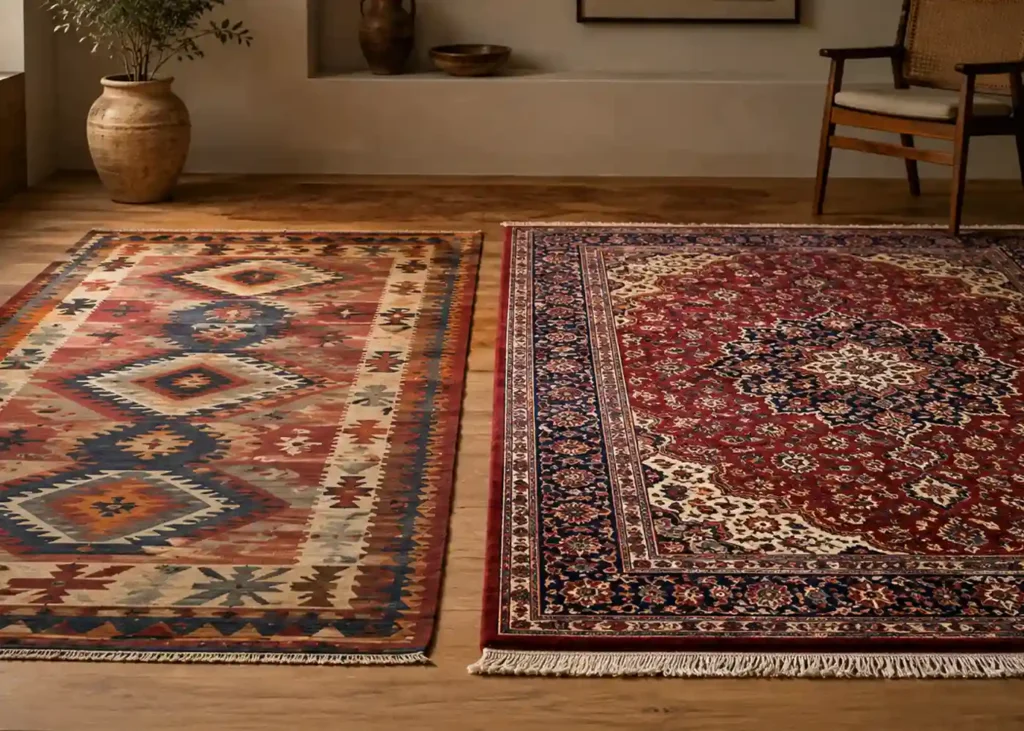
When comparing Kilim vs Persian Rug, the most important difference is the way each rug is made. A kilim is a flatwoven textile with no raised pile, while what most buyers commonly recognize as a traditional Persian rug is usually hand-knotted and has a visible pile.
But there is one important detail that is often overlooked: a kilim can also be Persian.
“Kilim” describes a weaving technique, while “Persian” primarily describes geographic and cultural origin. A flatwoven rug made in Iran may therefore correctly be described as a Persian kilim. This is why the difference between Kilim vs Persian Rug is not simply about country of origin—it is mainly about construction, texture, appearance, use, and weaving tradition.
Key conclusion: If you want a lightweight, flat, graphic textile with a more casual character, a kilim may be ideal. If you prefer softness, depth, intricate knotting, and a more substantial feel underfoot, a traditional hand-knotted Persian rug may be the better choice.
What Is a Kilim Rug?
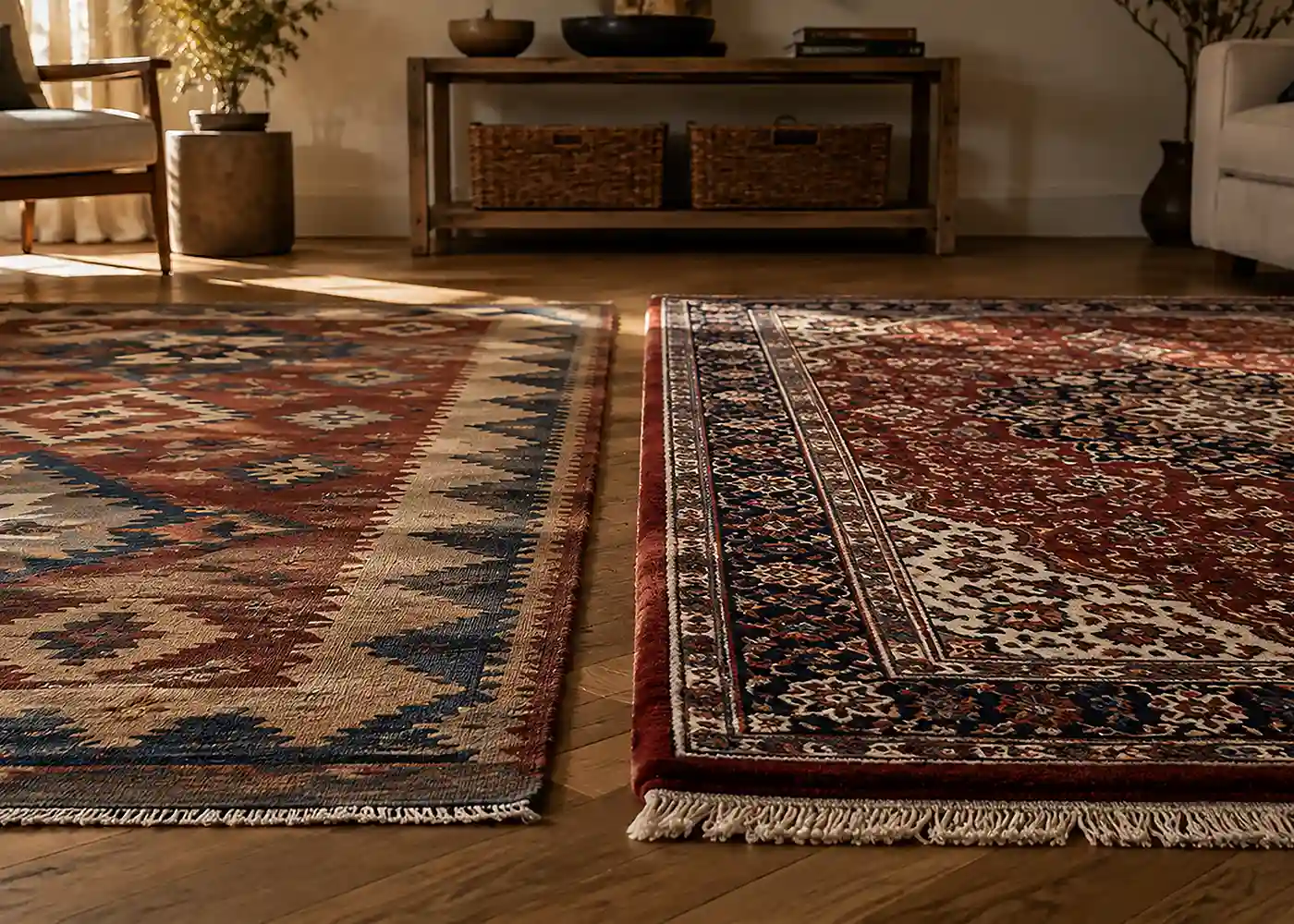
A kilim is a pileless flatwoven rug or textile. Instead of creating a raised surface by tying individual pile knots, the weaver interlaces warp and weft threads to form a flat structure.
In traditional Persian flatweaving, the weft threads may be packed tightly enough to cover most or all of the warp. Different colors can be introduced in separate areas to create geometric patterns, stripes, medallions, diamonds, hooks, animals, or tribal motifs.
Some weaving techniques produce small vertical slits where two color areas meet, a feature commonly associated with slit-tapestry weaving.
Because there is no pile rising above the foundation, a kilim generally feels thinner and flatter than a hand-knotted pile rug.
Kilims have historically been produced across Iran, Anatolia, the Caucasus, Central Asia, and other weaving regions. They were not limited to decorative floor coverings. Flatwoven textiles were also traditionally used for bags, storage pieces, tent furnishings, and other practical objects.
If you would like to explore examples, visit the Kilims collection at Arghavan Rugs.
What Is a Persian Rug?
A Persian rug is, in the broadest sense, a handmade rug associated with the weaving traditions of Iran.
However, in the modern rug market, the term Persian rug is often used more specifically for hand-knotted pile rugs. These rugs are constructed by tying knots around warp threads and securing rows of knots with weft threads.
The ends of the pile are then cut to create the soft surface visible on the face of the rug.
Persian rugs may be woven from wool, silk, cotton, or combinations of these materials.
Their designs vary enormously. Some feature central medallions and detailed floral compositions, while others use repeating geometric patterns, tribal motifs, garden designs, animals, boteh forms, or highly stylized village patterns.
Regional weaving traditions also influence the appearance and construction of Persian rugs. Tabriz, Kashan, Nain, Isfahan, Qom, Heriz, Shiraz, Kerman, Mashad, and many other weaving centers have developed recognizable traditions.
Can a Kilim Also Be Persian?
Yes.
This is one of the most important points in any Kilim vs Persian Rug comparison.
The terms are not true opposites.
Persian can describe where the textile was produced or the cultural weaving tradition to which it belongs.
Kilim describes a flatweaving method.
For example, a handmade flatwoven kilim produced in Iran may correctly be called a Persian kilim.
Therefore, when a buyer says “Kilim vs Persian Rug,” the practical comparison is usually between a flatwoven kilim and a traditional hand-knotted Persian pile rug.
Kilim vs Persian Rug: Quick Comparison
Kilim
- Flatwoven construction
- No raised pile
- Usually thinner
- Generally lighter
- Often features strong geometric designs
- Easy to move and reposition
- Suitable for layering
- Firmer and flatter texture underfoot
Traditional Persian Pile Rug
- Usually hand-knotted
- Has a raised pile
- Thicker and more cushioned
- Often heavier
- Can support extremely detailed designs
- Provides greater softness underfoot
- Often creates a more substantial visual centerpiece
- May require more specialized maintenance
These are general characteristics rather than absolute rules. Handmade textiles vary according to region, age, fiber, weave, condition, and intended use.
Kilim vs Persian Rug Construction
Construction is the clearest technical difference between a Kilim vs Persian Rug.
In a kilim, the design is created primarily through the interlacing of warp and weft. There is no separate layer of cut pile covering the woven structure. In many kilims, the colored weft itself becomes the visible surface.
In a traditional hand-knotted Persian rug, individual knots create the pile. Rows of knots are built over the foundation, producing a thicker textile with physical depth above the warp and weft structure.
This difference affects almost everything else: weight, texture, visual depth, flexibility, cleaning, furniture placement, and even how the rug looks from different viewing angles.
Texture and Thickness
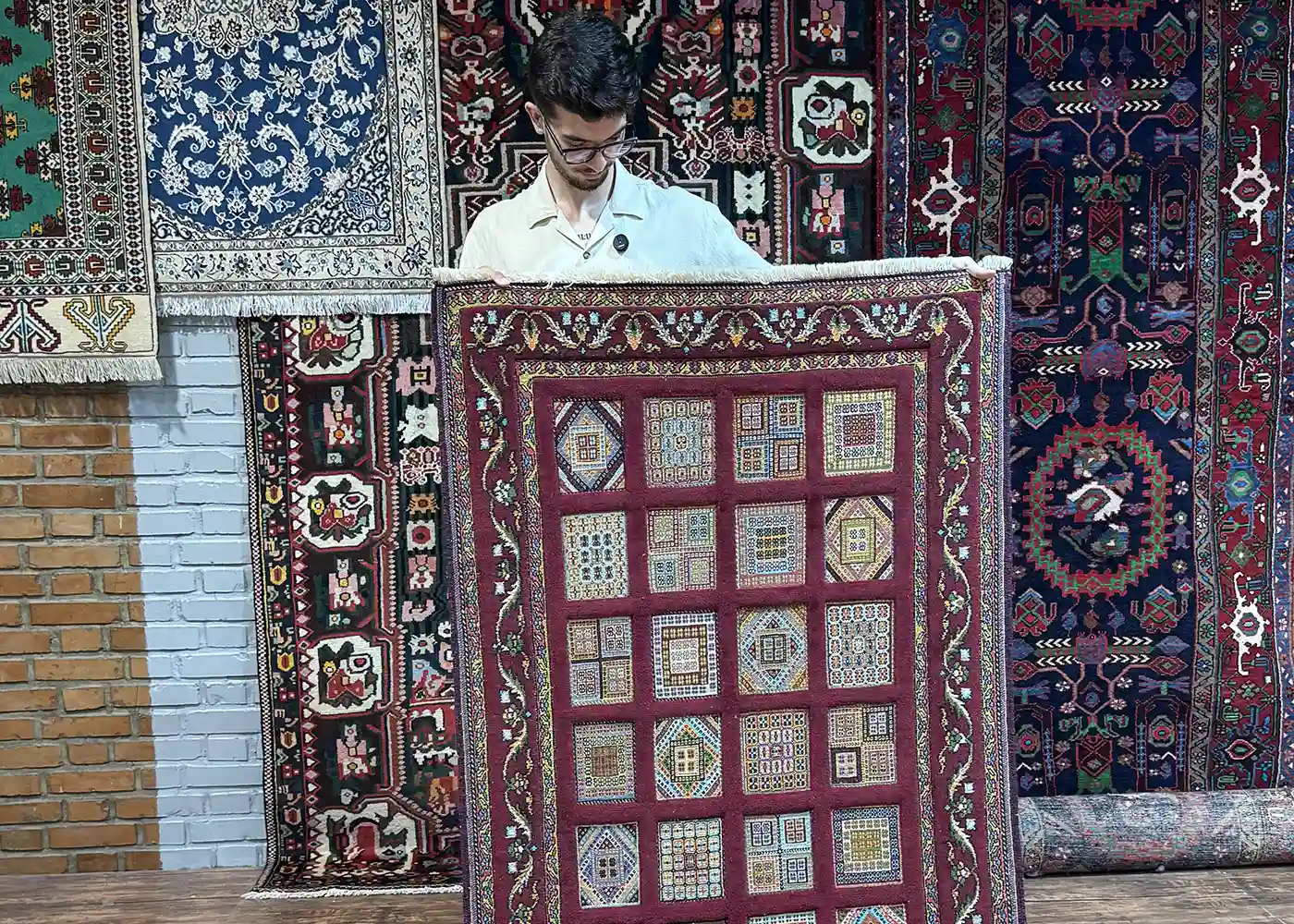
One of the easiest ways to understand Kilim vs Persian Rug is simply to touch them.
A kilim normally has a relatively flat surface. You do not feel a layer of cut pile beneath your hand. The texture comes from the woven yarn itself.
A hand-knotted Persian pile rug feels deeper. Depending on the rug, the pile may be low and finely clipped or thicker and more cushioned.
This difference is especially noticeable underfoot.
If you want softness beside a bed or beneath a living-room seating arrangement, a pile rug may provide more cushioning.
If you prefer a thinner floor covering that sits close to hardwood, stone, or tile, a kilim can work beautifully.
Design and Patterns
Kilims are strongly associated with bold geometric compositions.
Diamonds, stepped forms, hooks, stripes, angular medallions, repeated symbols, and tribal motifs are common. The weaving technique naturally encourages strong edges and geometric transitions, although kilim design is much more diverse than a single visual style.
Hand-knotted Persian rugs can also be geometric, especially tribal and village rugs.
However, pile knotting allows weavers to create extremely detailed curves, flowers, arabesques, animals, fine outlines, and complex central medallions. Higher knot density can also support particularly intricate designs.
For this reason, the difference is not simply “geometric versus floral.”
A better distinction is that the structure of each weaving technique influences how the design is expressed.
Materials Used in Kilim vs Persian Rug
Traditional kilims are commonly woven with wool, although foundations and particular regional examples may use other fibers.
Persian pile rugs are also commonly made with wool, often over a cotton or wool foundation. Fine rugs may incorporate silk, and some rugs may use silk extensively.
Material alone therefore cannot tell you whether a rug is a kilim.
A wool kilim and a wool Persian pile rug may use similar raw materials but produce completely different surfaces because their construction methods are different.
If you want to understand these materials in greater detail, read our guide to Wool vs Silk Persian Rugs.
Durability and Daily Use
Both kilims and high-quality Persian rugs can be durable when they are well made and properly used.
Their wear patterns, however, are different.
A kilim has no pile to crush or flatten. Its thin construction can make it practical beneath certain furniture arrangements and in spaces where a low-profile textile is desirable.
However, thin does not mean indestructible.
The edges, fringes, slit areas, and exposed woven structure of an older kilim may require careful handling. Antique or fragile examples should not automatically be treated as casual high-traffic floor coverings.
A well-constructed wool Persian pile rug can perform extremely well in everyday living spaces. The pile provides more cushioning, but heavy traffic, furniture pressure, dirt, moisture, and improper cleaning can gradually cause wear.
Important: Age and condition matter more than category alone. A robust newer kilim may tolerate daily use better than a fragile antique pile rug, while a strong hand-knotted wool rug may outperform a delicate old kilim in a busy family room.
Cleaning and Maintenance
Cleaning is another important part of the Kilim vs Persian Rug decision.
Both types should be treated according to their fiber, age, dye stability, weave, and condition.
Kilims should not automatically be washed aggressively simply because they are thin. Traditional dyes may react to moisture, and excessive agitation can stress the weave, edges, or fringes.
Hand-knotted Persian rugs also require appropriate care. Strong chemicals, excessive moisture, harsh scrubbing, unsuitable vacuum settings, and inexperienced washing can damage pile, foundation, fringe, or dyes.
For valuable handmade pieces, professional cleaning by someone experienced with traditional rugs is generally safer than experimenting with aggressive household cleaning methods.
Weight and Flexibility
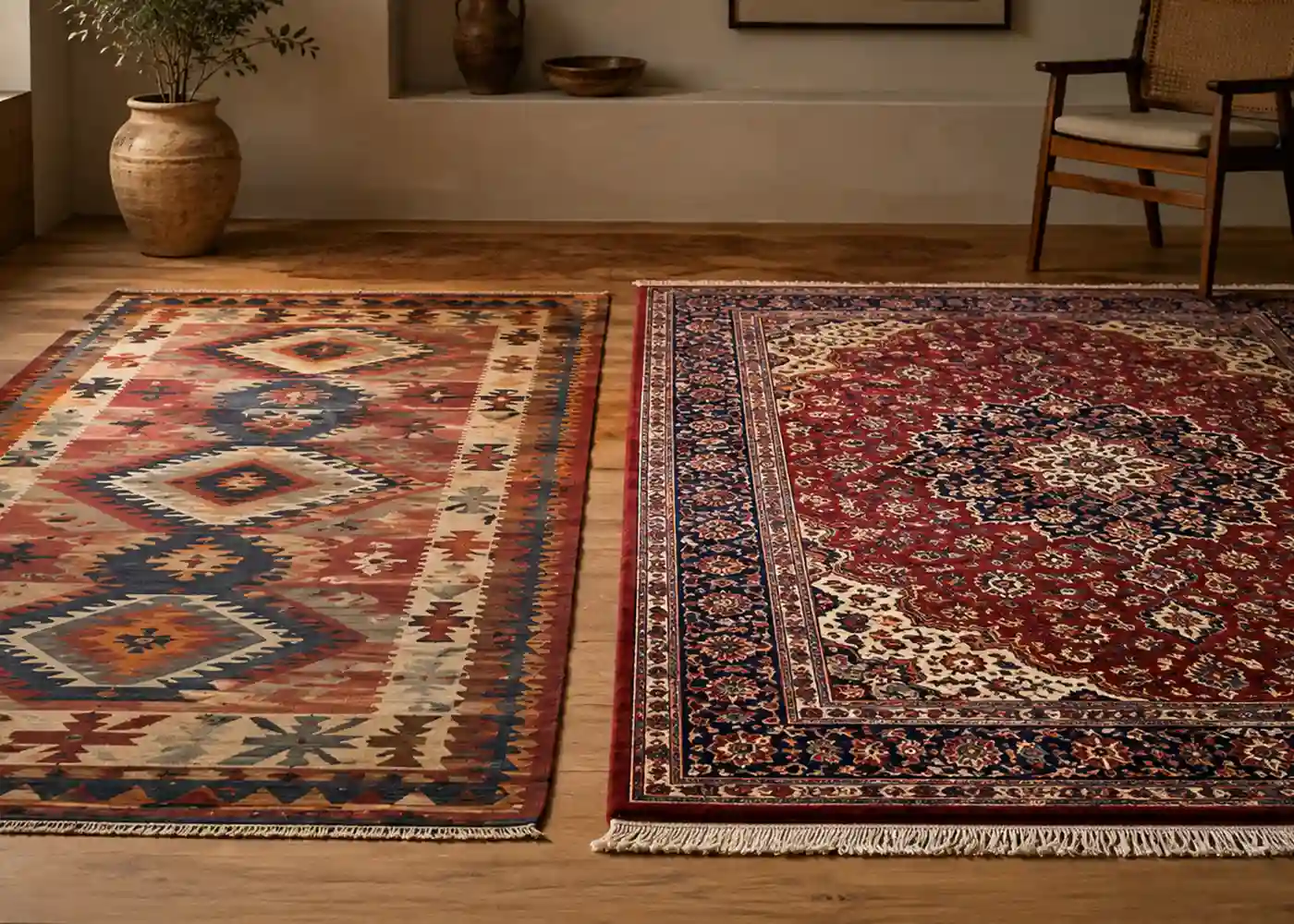
Kilims are generally lighter and more flexible than similarly sized pile rugs.
That gives them several practical advantages.
They can be easier to move, rotate, store, transport, or layer over another floor covering. Large kilims can create visual impact without adding the physical bulk of a thick rug.
Traditional Persian pile rugs tend to feel more substantial.
This additional weight can help a rug feel visually anchored in a room, particularly beneath sofas, dining tables, or larger furniture arrangements.
A suitable rug pad may be useful under either type depending on the floor, rug structure, and placement.
Kilim vs Persian Rug: Price and Value
There is no universal rule that a kilim is cheap or that a Persian pile rug is expensive.
Value depends on many variables, including:
- Age
- Origin
- Weaving group or workshop
- Materials
- Condition
- Rarity
- Size
- Design
- Technical quality
- Provenance
- Restoration
- Market demand
Some simple contemporary flatweaves may be relatively affordable, while rare antique or historically important kilims can be highly collectible.
The same is true of Persian pile rugs. A decorative everyday rug and an exceptional antique collector’s piece belong to completely different markets.
Expert distinction: Construction should never be used as the only measure of value.
A pile rug is not automatically more valuable than a kilim, and a kilim is not automatically less important simply because it has no pile.
Best Rooms for Kilims
Living Rooms
A kilim can bring pattern and color into a modern or minimalist living room without making the space feel visually heavy.
Dining Areas
The low profile may work well around furniture when the rug is appropriately sized and structurally suitable for the space.
Bedrooms
A kilim can add color beside or beneath a bed, especially when a thick cushioned surface is not necessary.
Home Offices
Flatwoven rugs can complement desks and lighter furniture while adding character to an otherwise functional space.
Layered Interiors
Kilims are especially effective for layering over larger neutral rugs or broad floor surfaces.
For shoppers looking specifically for this type of textile, explore our Kilim Rugs Collection.
Best Rooms for Persian Pile Rugs
Main Living Rooms
A large Persian rug can visually organize sofas, chairs, and tables while becoming the main artistic feature of the room.
Formal Dining Rooms
An appropriately sized wool rug can provide warmth, color, and visual structure beneath a dining table.
Bedrooms
Pile offers greater softness underfoot and can make a bedroom feel warmer and more comfortable.
Libraries and Offices
Fine Persian rugs pair naturally with wood furniture, leather, bookshelves, and both traditional and contemporary interiors.
Formal or Luxury Interiors
Intricate pile rugs can act almost like textile paintings on the floor, especially when the surrounding furniture is intentionally restrained.
How to Identify a Kilim
Start by looking at the surface.
A genuine traditional kilim should not have the raised cut pile associated with a hand-knotted pile rug.
Look closely at the structure. The colored yarns form the flat woven surface itself.
Depending on the weaving technique, you may also notice:
- Clearly visible interlacing
- Strong geometric color boundaries
- Small slits between certain color areas
- A relatively thin profile
- Design information visible from both sides on some examples
However, not every flatwoven textile is structurally identical, and not every kilim follows the same technique.
If authenticity matters—particularly when buying an old or valuable rug—construction, fibers, side finishes, ends, repairs, dyes, and provenance should be examined together.
You may also want to read our guide to Handmade vs Machine-Made Rugs to learn more about rug construction and authenticity.
Kilim vs Persian Rug: Which One Should You Choose?
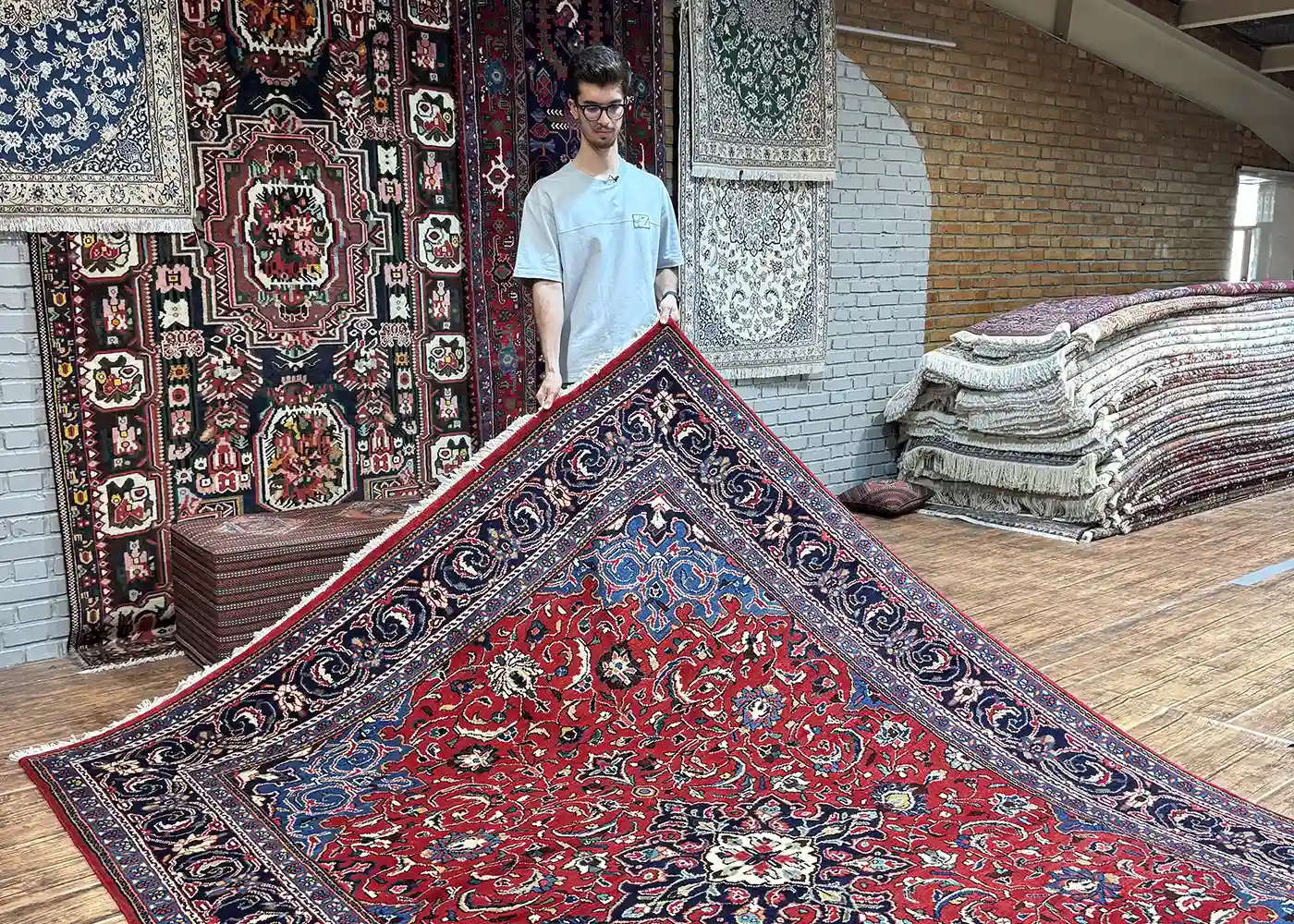
Choose a kilim if you want:
- A flat surface
- Lower visual weight
- Geometric character
- Easier movement and repositioning
- A rug suitable for layering
- Traditional flatwoven craftsmanship
Choose a hand-knotted Persian pile rug if you want:
- Greater softness underfoot
- More physical depth
- A substantial centerpiece
- Fine knot-based detail
- A traditional pile texture
- A rug that visually anchors furniture
But do not make the decision based only on labels.
Look at the individual piece.
A beautiful handmade rug should fit your room, your lifestyle, your taste, and the amount of care you are comfortable providing.
Common Myths About Kilim vs Persian Rug
Myth 1: A Kilim Is Not a Persian Rug
Not necessarily.
A kilim made in Iran can be Persian. “Kilim” refers primarily to construction, while “Persian” refers to geographic and cultural origin.
Myth 2: All Persian Rugs Have Floral Designs
False.
Persian weaving includes floral, geometric, tribal, medallion, pictorial, garden, animal, and many other design traditions.
Myth 3: Kilims Are Machine-Made Because They Are Flat
False.
Traditional kilims can be completely handmade.
Flat construction does not mean industrial production.
Myth 4: Kilims Are Always Cheaper
False.
Age, rarity, condition, origin, quality, and collector interest can make some kilims highly valuable.
Myth 5: A Thicker Rug Is Automatically Better
False.
Thickness is a physical characteristic, not a universal quality grade.
A finely woven kilim and a finely knotted pile rug should be judged according to their own textile traditions.
Frequently Asked Questions About Kilim vs Persian Rug
What is the main difference between Kilim vs Persian Rug?
The main difference is usually construction. A kilim is flatwoven and has no raised pile, while the Persian rugs most buyers have in mind are generally hand-knotted pile rugs.
Is a Kilim considered a Persian rug?
A kilim can be Persian if it was produced within an Iranian weaving tradition. Kilim refers to a type of flatweave, while Persian refers mainly to origin.
Is a Kilim handmade?
Traditional kilims are handmade on a loom. The pattern is created by weaving the yarns rather than by printing a design onto the surface.
Are Kilims thinner than Persian rugs?
Generally, yes. Because kilims have no raised pile, they usually have a thinner profile than hand-knotted pile rugs of similar dimensions.
Are Kilims good for living rooms?
Yes, especially when you want a lightweight, low-profile rug with strong pattern and color. Placement should still take the rug’s age, condition, size, and traffic level into account.
Which is more durable, a Kilim or Persian rug?
There is no universal winner. Durability depends on construction quality, fibers, age, condition, traffic, and care. Both can last for many years when well made and properly maintained.
Are Kilims valuable?
They can be. Antique, rare, well-preserved, or historically significant kilims may have substantial decorative or collector value.
Is a Kilim better for modern interiors?
Kilims often work very well in modern interiors because their flat texture and geometric patterns can complement clean furniture and simple spaces. However, traditional Persian pile rugs can also look exceptional in contemporary interiors.
Can I put furniture on a Kilim?
Yes, provided the individual rug is structurally suitable. A rug pad may help reduce movement and protect both the rug and the floor.
Should I buy a Kilim or Persian Rug?
Choose according to the individual piece and your intended use. Kilims are ideal when you prefer a thinner, lighter flatweave. Persian pile rugs are often better when you want cushioning, depth, and a more substantial textile presence.
Final Conclusion: Kilim vs Persian Rug
The Kilim vs Persian Rug comparison becomes much easier once you understand that the two names describe different things.
A kilim is defined mainly by its flatwoven, pileless construction.
A Persian rug is defined mainly by its connection to the weaving traditions of Iran. In everyday shopping language, however, “Persian rug” usually refers to the familiar hand-knotted pile rugs for which Iran is famous.
That means a kilim can also be Persian.
For buyers, the practical difference comes down to texture, thickness, design, weight, use, and personal preference.
Choose a kilim if you love lightweight construction, strong geometry, flat texture, and versatile styling.
Choose a hand-knotted Persian pile rug if you prefer softness, depth, intricate knotting, and a more substantial centerpiece.
Neither is automatically better.
The best handmade rug is the one whose construction, condition, design, size, and character are right for your home.
At Arghavan Rugs, you can explore authentic handmade pieces across our curated collections, including Kilims, Persian rugs, runners, antique pieces, and other one-of-a-kind handwoven textiles.