

Nain Rug La Guide: 4La vs 6La vs 9La & 12La
If you have ever compared handmade Nain rugs, you have probably seen descriptions such…
Article Guide
If you have ever compared handmade Nain rugs, you have probably seen descriptions such as 4La, 6La, 9La, or 12La. These numbers are often presented as if they were simple quality scores, with 4La at the top and 12La at the bottom. The reality is more interesting—and more useful for buyers.
La is a traditional grading term connected to the structure of a Nain rug’s foundation. It helps explain how fine the foundation yarn is and how much detail the rug may be capable of supporting. However, La does not directly tell you the exact knot density, the amount of silk, the age of the rug, the identity of the workshop, or its final market value.
A beautifully woven 9La Nain rug can be more desirable than a damaged, poorly designed, or incorrectly described 6La rug. Likewise, a seller’s claim that a rug is 4La should never be accepted without careful inspection, because genuine 4La Nain rugs are exceptionally fine and relatively uncommon.
This specialist guide explains how the Nain rug La system works, what separates 4La, 6La, 9La, and 12La, how the grade is inspected, and how it should influence a buying decision. For a broader introduction to the history, materials, designs, and construction of these carpets, begin with our
complete guide to handmade Nain rugs.
What Does La Mean in a Nain Rug?
The La system became closely associated with Nain because these rugs are often produced in several clearly recognized levels of fineness. Instead of judging the rug only by looking at the front, an experienced examiner can study the fringe and foundation to understand how the structural yarn has been assembled.
A foundation made from fewer, finer component strands can normally be spaced more closely than one made from thicker bundled yarn. This creates the potential for more knots within a given area and allows the weaver to produce smaller flowers, smoother curves, more delicate arabesques, and sharper outlines.
The word potential is important. A fine foundation makes detailed weaving possible, but it does not guarantee that the design was drawn well, the knots were tied consistently, the wool was excellent, or the finished rug is in good condition.
Why Nain Rugs Use a Different Grading System
Persian weaving centers have developed different ways of discussing fineness. Tabriz rugs, for example, are commonly classified through the Raj system. International sellers may describe many rugs using knots per square inch, or KPSI. Nain rugs are distinctive because the La system looks first at the construction of the foundation yarn.
This makes La a useful technical clue, but not a universal measurement. A buyer cannot take the number 6La, insert it into a fixed formula, and calculate the exact number of knots in every 6La rug. The actual density depends on how closely the warps are spaced, the vertical row count, the tension of the weave, and the workshop’s production standards.
For this reason, professional descriptions should treat La and knot density as related but separate characteristics.
How Is the La Grade Identified?
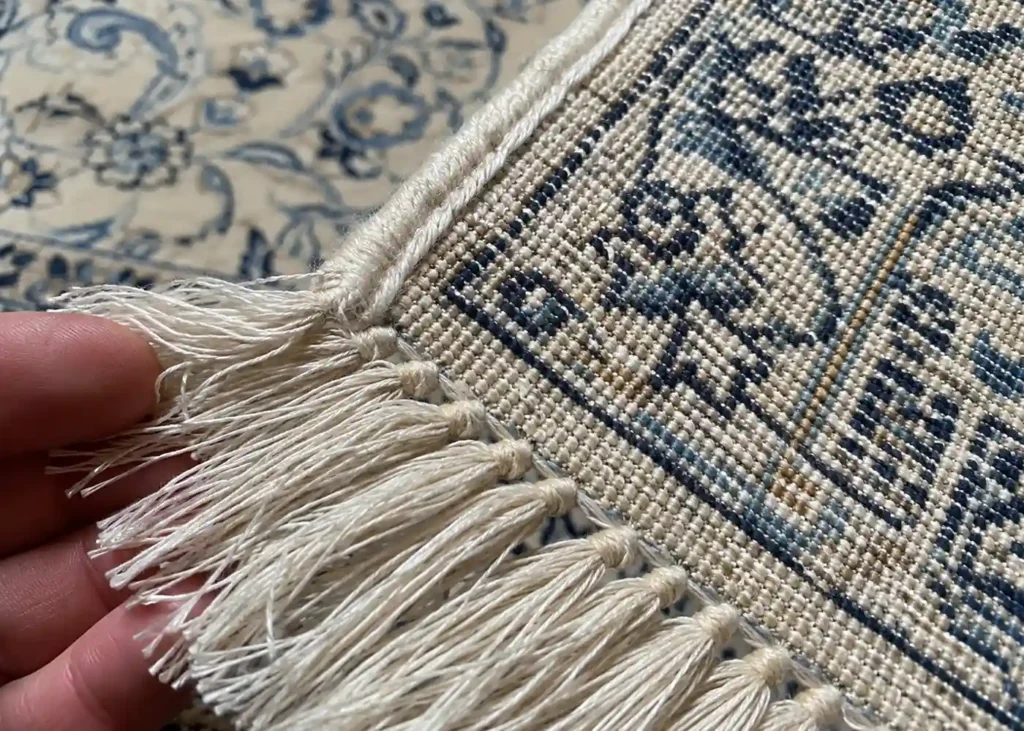
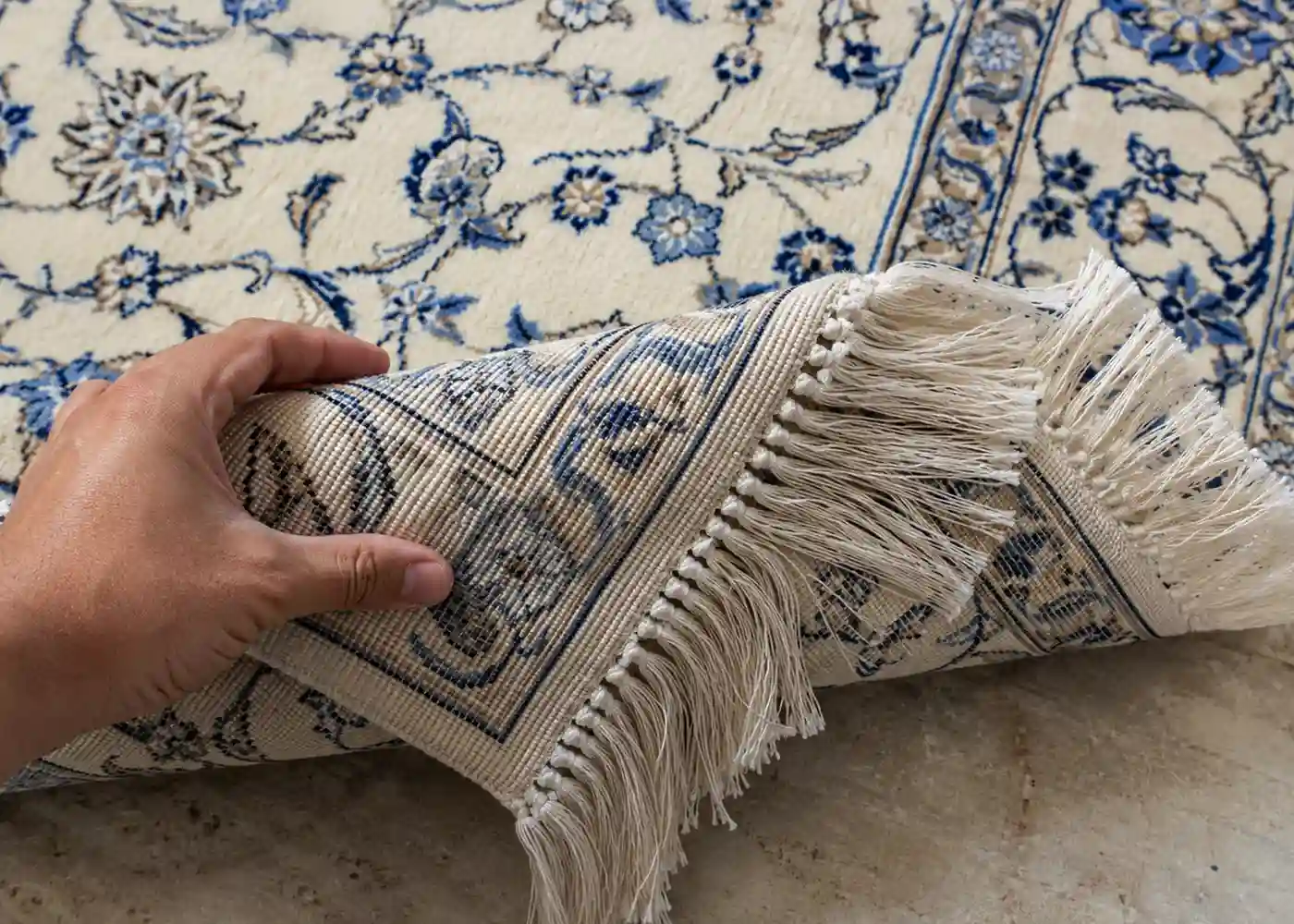
The grade is normally examined through the rug’s fringe because the fringe is an extension of the internal warp foundation. A specialist may gently separate or untwist a small section and study the individual component threads that form the yarn.
A common trade convention describes the grades in the following way:
| Grade | Common Structural Shorthand | Relative Foundation Fineness | General Market Position |
|---|---|---|---|
| 4La | Often described as 2 × 2 component strands | Exceptionally fine | Rare, highly refined, and collector-oriented |
| 6La | Often described as 3 × 2 component strands | Very fine | High-grade workshop weaving |
| 9La | Often described as 3 × 3 component strands | Fine | Widely encountered, refined, and practical |
| 12La | Often described as 4 × 3 component strands | Relatively heavier within the Nain spectrum | Commercial and more accessible category |
These combinations are useful trade shorthand, not a perfectly universal rule. Fringes may be tightly twisted, flattened, repaired, shortened, or replaced. Some rugs also have structural variations that make a quick count difficult. The conclusion should be supported by examining more than one fringe section and comparing the result with the back of the rug.
4La Nain Rugs: Exceptional Fineness and Rarity
What Is a 4La Nain Rug?
A genuine 4La Nain rug represents the finest commonly discussed level within the traditional La classification. Its foundation yarn is extremely fine, allowing the warps to be placed very close together and supporting remarkably precise knotting.
At this level, the design can achieve a miniature-like quality. Small Shah Abbasi flowers may contain internal details, arabesques can curve with very little visible stepping, and silk outlines may appear as thin, controlled accents rather than broad decorative areas.
Fine yarn also requires careful material selection. The wool must be strong enough to be spun finely without becoming weak, while the foundation must maintain consistent tension throughout the weaving process. Small technical errors become more visible in such a precise construction.
A large 4La rug can require extraordinary labor because every square area contains many closely organized knots. These pieces are generally associated with exceptional workshop production and are much less common than 6La or 9La Nain rugs.
Because of this rarity, the term 4La can be overused in marketing. A seller may apply it to any extremely fine Nain-style rug without properly checking the fringe construction or geographic origin. A serious 4La claim should be supported by clear photographs, direct inspection, accurate material information, and a complete condition report.
Who Should Buy a 4La Nain Rug?
A 4La rug is best suited to a collector, a highly controlled formal room, or a buyer who values technical refinement above everyday practicality. It may not be the ideal choice for a busy family living room, entrance, dining area, or space exposed to pets and heavy furniture movement.
The additional cost should be justified by more than the La number. Design quality, materials, condition, workshop, provenance, and actual knot consistency remain essential.
6La Nain Rugs: Fine Workshop Quality
What Is a 6La Nain Rug?
Six-La is one of the most respected and sought-after Nain classifications. It provides a fine foundation capable of supporting detailed floral patterns, controlled medallions, delicate corner pieces, and narrow silk highlights.
A high-quality 6La rug can show exceptional technical precision without reaching the extreme rarity of a genuine 4La example. For many collectors and experienced buyers, this makes 6La an attractive balance between refinement, availability, visual impact, and practical ownership.
Curves in a well-woven 6La rug should look fluid and intentional. Petals should remain distinct, small leaves should not merge into one another, and the borders should show clear relationships between the main border and smaller guard stripes.
Many 6La Nain rugs combine fine wool with silk highlights. The silk may outline selected flowers, define the medallion, brighten arabesques, or add luminosity to architectural details. However, silk is not what makes a rug 6La. The La grade describes the foundation yarn, while silk content describes the pile materials.
Is 6La the Best Choice for Most Collectors?
There is no universal best grade, but 6La often provides an appealing middle position. It is fine enough to demonstrate the technical identity of high-level Nain weaving, yet more obtainable than 4La. A well-preserved 6La rug with strong drawing and quality materials can be appropriate for a formal living room, private office, bedroom, or carefully used reception area.
Before paying a premium, confirm that the rug is genuinely 6La and not simply described that way because it looks detailed from the front.
9La Nain Rugs: Refined, Practical, and Often Undervalued
What Is a 9La Nain Rug?
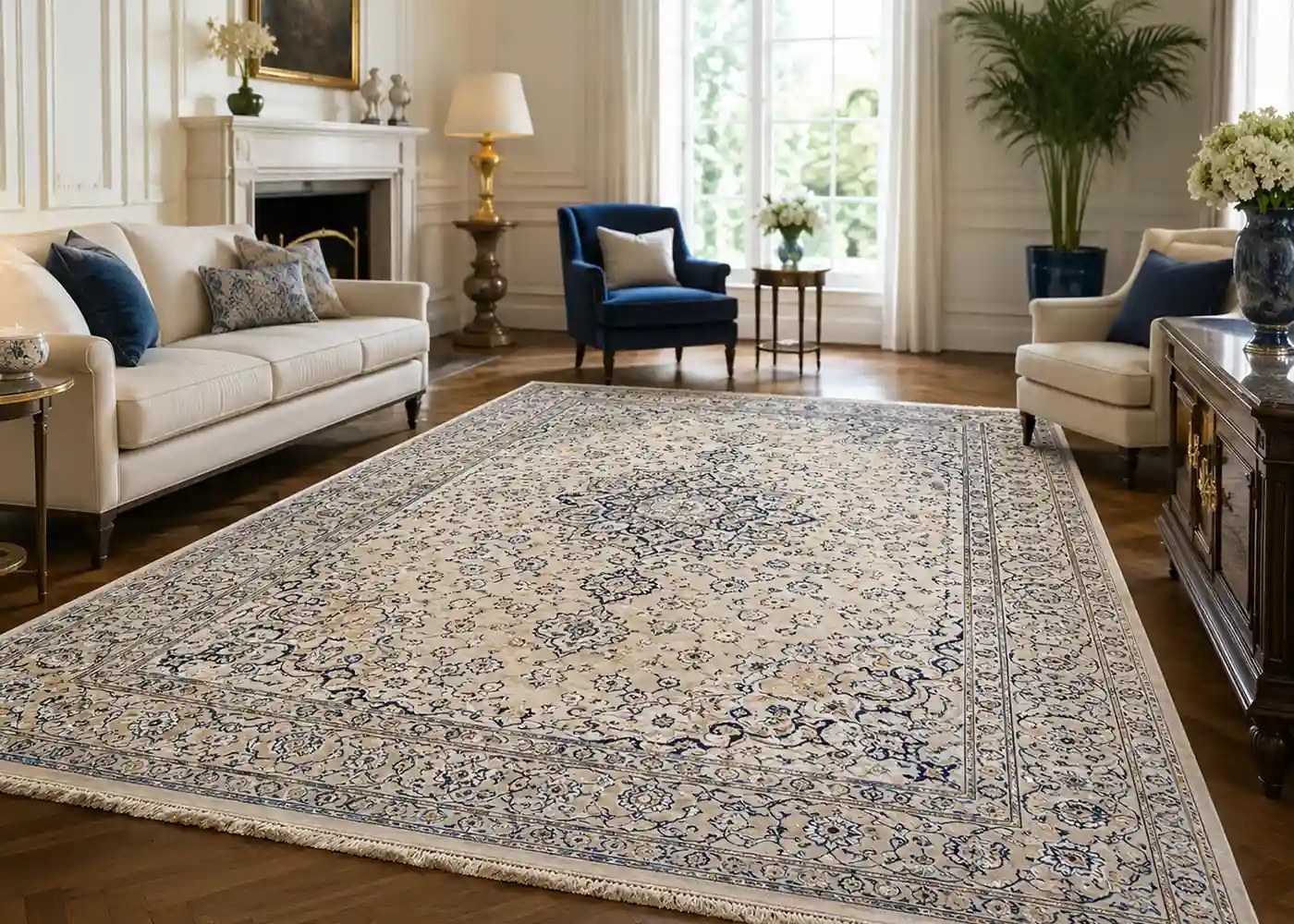
Nine-La is one of the most commonly encountered traditional Nain grades. It uses a somewhat heavier foundation yarn than 6La, but it can still support clear floral drawing, elegant medallions, balanced arabesques, and sophisticated wool-and-silk construction.
The idea that 9La means “low quality” is incorrect. Nain rugs are already associated with refined city weaving, and a good 9La example can be finer than many handmade rugs from other traditions. Its value should be judged within its own origin and construction rather than through a simplistic ranking.
A well-made 9La rug can offer several practical advantages. Its construction may feel slightly more substantial, its design can remain attractive from normal viewing distance, and its price may be more accessible than a comparable 6La or 4La piece.
Nine-La rugs can work especially well for homeowners who want an authentic handmade Nain rug for actual floor use rather than a highly delicate collector piece. Their ivory, navy, blue, beige, and occasional red or green palettes can suit both classical and modern interiors.
Can a 9La Rug Be More Valuable Than a 6La Rug?
Yes. A fine La grade increases the potential for technical detail, but the market evaluates the entire rug. A large, beautifully designed, perfectly preserved 9La rug may be worth more than a small, damaged, poorly repaired, or visually ordinary 6La piece.
Workshop attribution, age, materials, color harmony, dimensions, rarity, and current demand can all change the comparison. Our guide to
valuing an old Persian rug
explains why no single technical feature can establish final value.
12La Nain Rugs: The More Accessible Category
What Is a 12La Nain Rug?
Twelve-La generally refers to a heavier foundation yarn than the yarn used in 9La, 6La, or 4La rugs. This normally results in a more open weave and larger-scale drawing. It may not support the same miniature details found in an exceptional 4La or 6La piece, but that does not automatically make it unattractive or poorly made.
A well-composed 12La rug can still display the recognizable Nain character: an ivory or cream field, navy medallion, pale blue vines, floral borders, and balanced curvilinear ornament. From normal room distance, a strong design can be more important than microscopic detail.
The term 12La is also less consistently used than 6La and 9La in some markets. Buyers should therefore examine the actual construction and not depend solely on the product title.
This category may suit buyers who appreciate the Nain palette and design language but do not require collector-level fineness. It can also offer a practical decorative option when the materials, construction, and condition are appropriate.
4La vs 6La vs 9La vs 12La: Complete Comparison
| Feature | 4La | 6La | 9La | 12La |
|---|---|---|---|---|
| Foundation | Exceptionally fine | Very fine | Fine | Relatively heavier |
| Potential detail | Miniature-like and highly precise | Very detailed and sharply controlled | Clear, refined, and elegant | Larger and more open drawing |
| Relative availability | Very rare | Less common and desirable | Commonly encountered | Varies by market |
| Typical use | Collection or controlled formal setting | Formal room or careful residential use | Residential use with refined appearance | Decorative and more accessible use |
| Price tendency | Usually highest when authentic and well preserved | Often premium | Broad and accessible range | Usually more affordable |
| Main buying risk | False or exaggerated grading claims | Marketing based only on fineness | Being unfairly dismissed as ordinary | Inconsistent use of the term |
La Is Not the Same as Knot Density
This is the most important technical distinction in the entire La system.
La describes the construction of the foundation yarn. Knot density describes how many knots are tied within a measured area. A finer foundation can allow the warps to be placed closer together, which can produce a greater knot density, but the relationship is not perfectly fixed.
Two 6La rugs may have different knot counts because they were woven in different workshops or under different tension. Their vertical row counts may also differ even when their horizontal spacing looks similar.
Knot density should be measured directly from the back of the carpet by counting the knots in both directions. The two figures are multiplied to calculate knots per square inch or knots per square meter.
Does a Lower La Number Always Mean a Better Rug?
No. A lower La number generally indicates a finer structural category, but “better” is too broad to be decided by one measurement.
Imagine two Nain rugs. The first is described as 6La but has weak wool, awkward proportions, visible repairs, and uneven wear. The second is a 9La rug with luminous wool, controlled silk detailing, excellent symmetry, attractive colors, and a stable original foundation. Many buyers would reasonably prefer the second rug.
A complete evaluation should consider:
- Whether the rug is genuinely hand-knotted
- Whether it was woven in Nain or is only Nain-style
- The accuracy of the claimed La grade
- Actual horizontal and vertical knot density
- Quality and resilience of the wool
- Authenticity and placement of silk highlights
- Strength and alignment of the foundation
- Design balance, curves, borders, and medallion drawing
- Condition of the pile, fringes, sides, and corners
- Age, workshop attribution, and provenance
- Repairs, re-piling, coloring, or structural alterations
- Size and current decorative or collector demand
If you are still learning to inspect handmade construction, read
how to identify an authentic Persian rug
and compare the structural differences in our guide to
handmade vs machine-made rugs.
How La Changes the Appearance of a Nain Rug
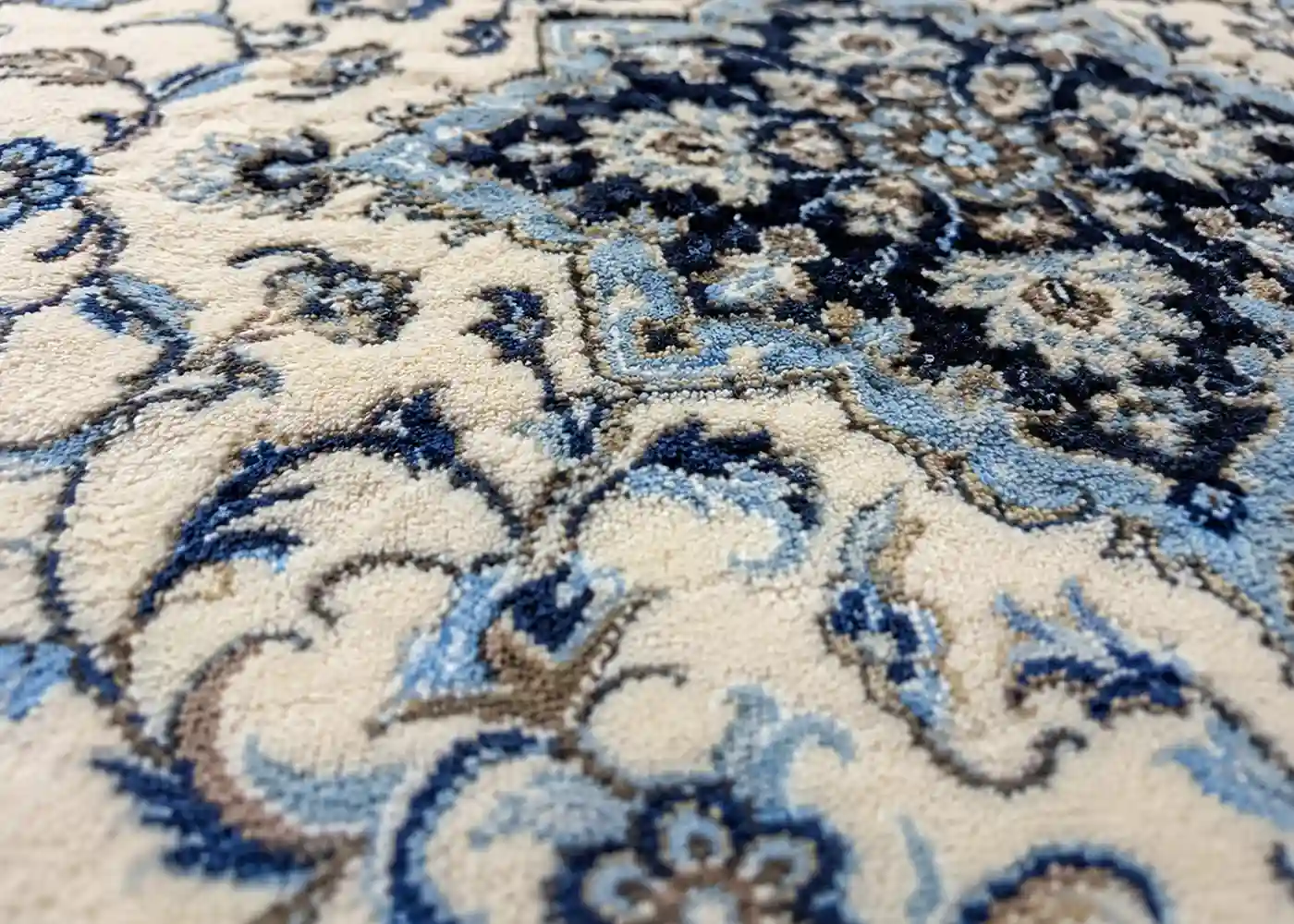
La is most visible in the way the design handles curves, outlines, and very small motifs.
Finer grades can show smaller petals, internal outlines, stamens, and color transitions without making the motif appear blocky.
Curving vines can appear smoother and more continuous when the foundation supports closer knot spacing.
Layered medallion borders and points can be rendered with greater precision in fine grades.
Fine construction allows silk details to remain narrow, controlled, and integrated with the wool pile.
Small lettering, faces, feathers, and architectural elements require a fine structural grid.
Very fine differences are easiest to appreciate at close range. A strong 9La design may have equal or greater impact across a large room.
Design scale matters. A large, bold floral composition may not require 4La fineness to be successful. Extremely fine construction is most valuable when the design actually uses that precision.
How Materials Relate to the La Grade
Nain rugs commonly combine a cotton foundation, fine wool pile, and silk highlights. The exact materials vary by workshop, period, and grade.
A fine La category may require thinner, stronger yarn, but La does not state whether the pile is wool or silk. A rug described as 6La could be primarily wool with small silk accents, while another 6La piece could contain much more silk.
Likewise, a 9La rug with excellent wool can be more durable and attractive for everyday floor use than a delicate silk-rich rug. Material choice should be matched to the intended room rather than judged through prestige alone.
Our specialist comparison of
wool vs silk Persian rugs
explains the differences in durability, appearance, maintenance, texture, and room suitability.
How La Influences the Price of a Nain Rug
Finer La grades can increase price because they generally require finer materials, closer warp spacing, greater knot density, longer weaving time, and more experienced labor. A true 4La rug of substantial size may require an extraordinary amount of work.
However, price does not rise according to a fixed La formula. A rug is not automatically worth twice as much simply because it is 6La instead of 9La.
The final value also depends on:
- Actual size and shape
- Quality of the wool and silk
- Design complexity and artistic execution
- Workshop, signature, or credible attribution
- Age and rarity
- Overall condition
- Original ends and side finishes
- Extent and quality of restoration
- Color harmony and fading
- Provenance and supporting documents
- Current demand in the relevant market
Retail price, insurance replacement value, auction value, and dealer purchase value are also different. La can help position a rug within the Nain tradition, but it does not create a universal price.
How to Inspect the La Grade Without Damaging the Rug
Make sure the end is supported and avoid pulling the fringe while the rug is under furniture pressure.
Avoid repaired, replaced, glued, shortened, or heavily worn sections.
A magnifying lens may help reveal the component threads without forcing them apart.
Use minimal pressure. Do not cut, scrape, burn, or aggressively untwist the foundation.
One fringe cord may be distorted or repaired. Compare multiple sections on both ends.
The claimed fineness should make sense when compared with actual knot spacing and design clarity.
For a rare, expensive, antique, signed, or claimed 4La rug, a specialist examination is the safest approach.
Common Mistakes Buyers Make About La
Assuming La and KPSI Are Identical
A seller may list a La grade and then attach a fixed knot count taken from a generic chart. The actual rug may not match that figure. Direct measurement is more reliable.
Believing Every 4La Claim
True 4La rugs are rare. The term should not be accepted solely because it appears on a tag, invoice, or online listing.
Thinking 9La Means Low Quality
A good 9La Nain can be finely woven, elegant, durable, and valuable. It may be the best choice for a buyer who wants authentic Nain character with greater practicality.
Ignoring the Rug’s Origin
A rug may copy the ivory-and-blue Nain style while being woven outside Nain or outside Iran. It can still be handmade, but its origin should be described accurately.
Paying for Silk Without Verifying It
Terms such as “silk-like,” “art silk,” or “bamboo silk” do not necessarily mean natural silk. Material claims can significantly influence price and should be confirmed.
Ignoring Condition Because the Weave Is Fine
A high-grade foundation does not protect a rug from moth damage, fading, foundation breaks, poor repairs, water damage, or severe pile loss.
Which Nain Rug La Grade Is Best for Your Home?
The right grade depends on the intended room, level of traffic, budget, and reason for buying.
| Your Priority | Grade to Consider | Why |
|---|---|---|
| Exceptional technical refinement | 4La | Offers the greatest potential for miniature detail and rarity |
| Fine collector or formal-room quality | 6La | Combines very fine construction with greater availability |
| Authentic refinement with practical use | 9La | Provides clear Nain character, attractive detail, and a broader price range |
| Nain-style appearance at a more accessible level | 12La | Can offer larger-scale design and decorative appeal without extreme fineness |
For a busy living room, a strong wool-based 9La rug may be a better decision than an extremely delicate 4La piece. For a formal study or private collection, the refinement of 6La or 4La may be worth the additional care and cost.
Questions to Ask Before Buying a Rug Described by La
- How was the La grade identified?
- Can you provide a clear close-up of the original fringe?
- Can you provide a detailed photograph of the back?
- Was the knot density measured directly?
- What are the pile, warp, and weft materials?
- Is the silk natural, and where is it used?
- Was the rug woven in Nain or is it Nain-style?
- Are the fringes original, repaired, or replaced?
- Has the rug been re-piled, recolored, reduced, or restored?
- Are there stains, fading, moth damage, or foundation breaks?
- Is a workshop signature or attribution being claimed?
- What is the return or inspection policy?
A trustworthy listing should describe the individual rug rather than relying on generic expressions such as “museum quality,” “investment grade,” or “the finest La.”
Frequently Asked Questions About Nain Rug La
What does La mean in a Nain rug?
La means layer or ply and refers to the component strands used in the rug’s foundation yarn. The classification is normally examined through the fringe, which continues from the internal warp foundation.
Is 4La better than 6La?
Four-La generally represents a finer and rarer structural category than 6La. However, the final quality and value also depend on design, materials, knot consistency, condition, size, workshop, and provenance.
Is a 9La Nain rug good quality?
Yes. A well-made 9La Nain rug can be fine, elegant, durable, and highly desirable. It should not be considered low quality merely because 6La and 4La grades are structurally finer.
Is 12La a real Nain classification?
Twelve-La is used in parts of the rug trade for a relatively heavier Nain foundation. The term is less consistently applied in some markets, so buyers should inspect the actual foundation and knot structure rather than relying only on the label.
Does La show the exact knot count?
No. La and knot density are related but different measurements. La describes the foundation yarn, while KPSI measures the number of knots within a square inch.
Can La be identified from a photograph?
A very clear macro photograph of an original fringe may support a preliminary opinion, but direct examination is more reliable. Twisting, repairs, replacement fringes, image quality, and scale can make online identification difficult.
Are all 6La rugs made with silk?
No. The La grade does not define the pile material. Many 6La rugs use fine wool with silk highlights, but the amount and location of silk vary.
Why are 4La Nain rugs expensive?
Genuine 4La rugs generally require extremely fine foundation yarn, dense and controlled weaving, high-quality materials, skilled labor, and substantial production time. Their relative rarity can add further value.
Can a 9La rug cost more than a 6La rug?
Yes. A larger, older, rarer, better preserved, or more artistically successful 9La rug can be more valuable than a damaged or ordinary 6La rug.
Should I buy the lowest La number I can afford?
Not necessarily. Choose the rug whose design, dimensions, materials, condition, price, and intended use are right for you. A strong 9La rug may be more suitable for daily living than a delicate collector-grade piece.
Final Thoughts
The Nain rug La system is valuable because it reveals an important part of the rug’s hidden construction. Four-La, 6La, 9La, and 12La are not merely marketing numbers; they describe meaningful differences in the fineness of the foundation yarn and the level of detail the structure may support.
However, La should be used as a starting point rather than a final verdict. It does not directly state KPSI, prove geographic origin, verify natural silk, identify a workshop, or establish market value. Those conclusions require examination of the whole rug.
A genuine 4La Nain may represent an extraordinary technical achievement. A fine 6La rug can offer exceptional workshop quality. A well-made 9La can provide elegance, durability, and strong value for real homes. Even a heavier 12La example may be attractive when its materials, design, and construction are honestly described.
The best purchase is not automatically the rug with the lowest La number. It is the rug in which the foundation, knotting, materials, design, condition, size, and price work together successfully.
After selecting a suitable rug, protect its fine foundation and silk detailing through careful maintenance. Our guide to
handmade rug care mistakes that reduce lifespan
explains the cleaning products, sunlight, moisture, storage practices, and furniture pressure that can damage a handmade carpet.
Explore Handmade Nain Rugs
Compare authentic handmade Nain rugs in different dimensions, designs, colors, and levels of fineness. Review each rug as an individual work of craftsmanship rather than choosing by a La number alone.