

Natural vs Synthetic Dyes in Antique Rugs: Lab Tests
Scientific Rug Authentication & Conservation Can the eye reliably distinguish a naturally dyed antique…
Article Guide
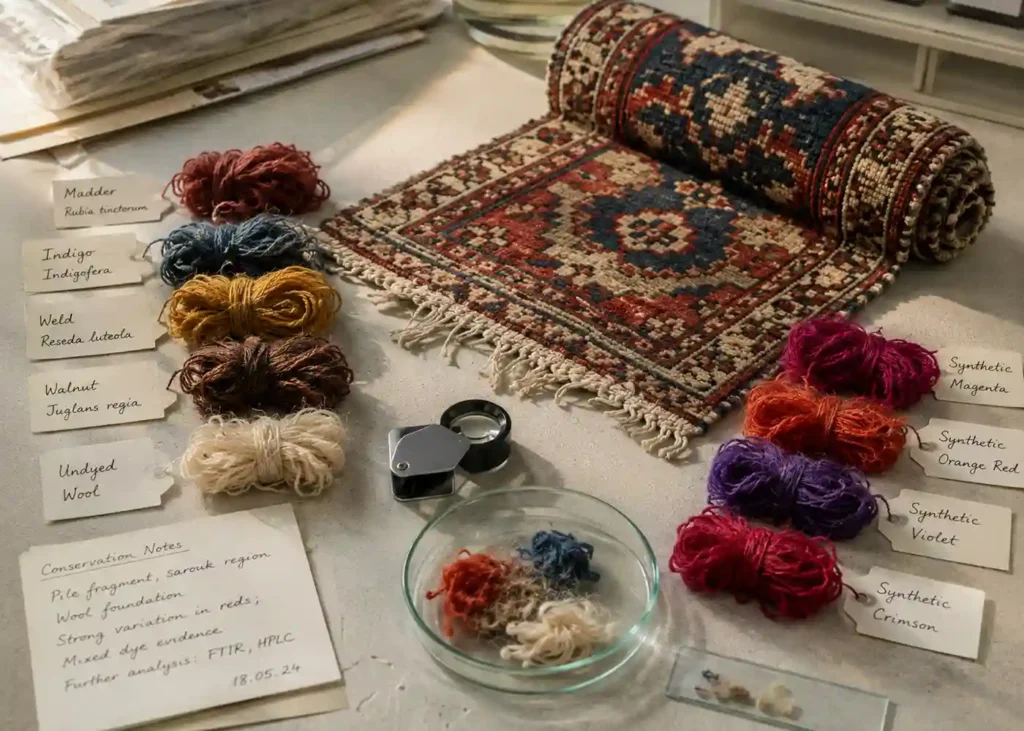
Scientific Rug Authentication & Conservation
Can the eye reliably distinguish a naturally dyed antique rug from one colored with synthetic dyes? Usually not. Fading, washing, chemical treatments, repairs, mixed dye recipes, and more than a century of aging can make visual judgment misleading. Reliable identification therefore depends on a carefully designed analytical workflow not on color alone.
Key conclusion: The most defensible answer usually comes from a multi-analytical approach. Non-invasive methods screen the rug and locate promising areas; micro-sampling methods such as HPLC-DAD or LC-MS then identify molecular markers; elemental techniques such as XRF or SEM-EDS help characterize mordants and inorganic components. No single instrument answers every question.
Why Dye Analysis Matters in Antique Rugs
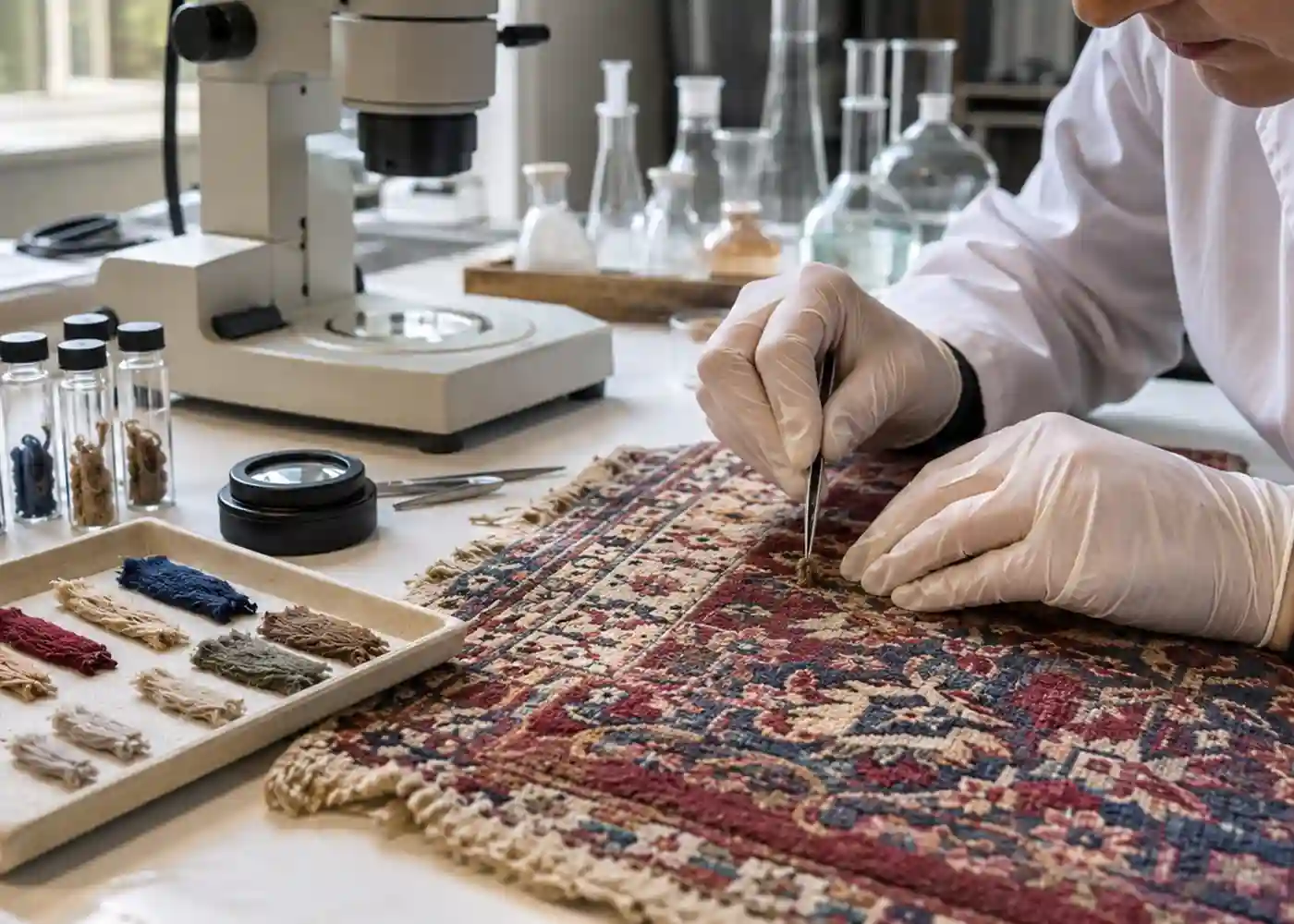
Dye analysis can contribute to the technical study of an antique rug in several ways. It may identify a natural colorant, detect an early or modern synthetic dye, reveal a mixture of colorants, clarify whether two visually similar areas were dyed differently, or help distinguish original pile from a later repair. In museum research, dye evidence may also support investigations into manufacturing technology, trade, provenance, conservation history, and attribution.
However, dye analysis is only one part of authentication. A rug’s age and origin must also be assessed through weave structure, fibers, knot type, warps and wefts, end finishes, side finishes, wear patterns, repairs, inscriptions, design comparison, documentary provenance, and—when justified—other scientific tests. For a practical overview of those structural clues, read our guide to identifying an authentic Persian rug. A dye result should therefore be treated as evidence within a larger argument, not as a stand-alone certificate of age.
Important: Detecting a synthetic dye does not automatically prove that a rug is fake, low quality, or machine made. Synthetic dyes were used in genuinely hand-knotted rugs, especially from the late nineteenth century onward. Readers who need to separate dye evidence from construction evidence can compare handmade and machine-made rug construction. The analytical question is not simply “natural or synthetic?” but which dye, in which yarn, from which part of the rug, and whether that yarn is original or a later restoration.
Natural and Synthetic Dyes: Precise Definitions
Natural dyes
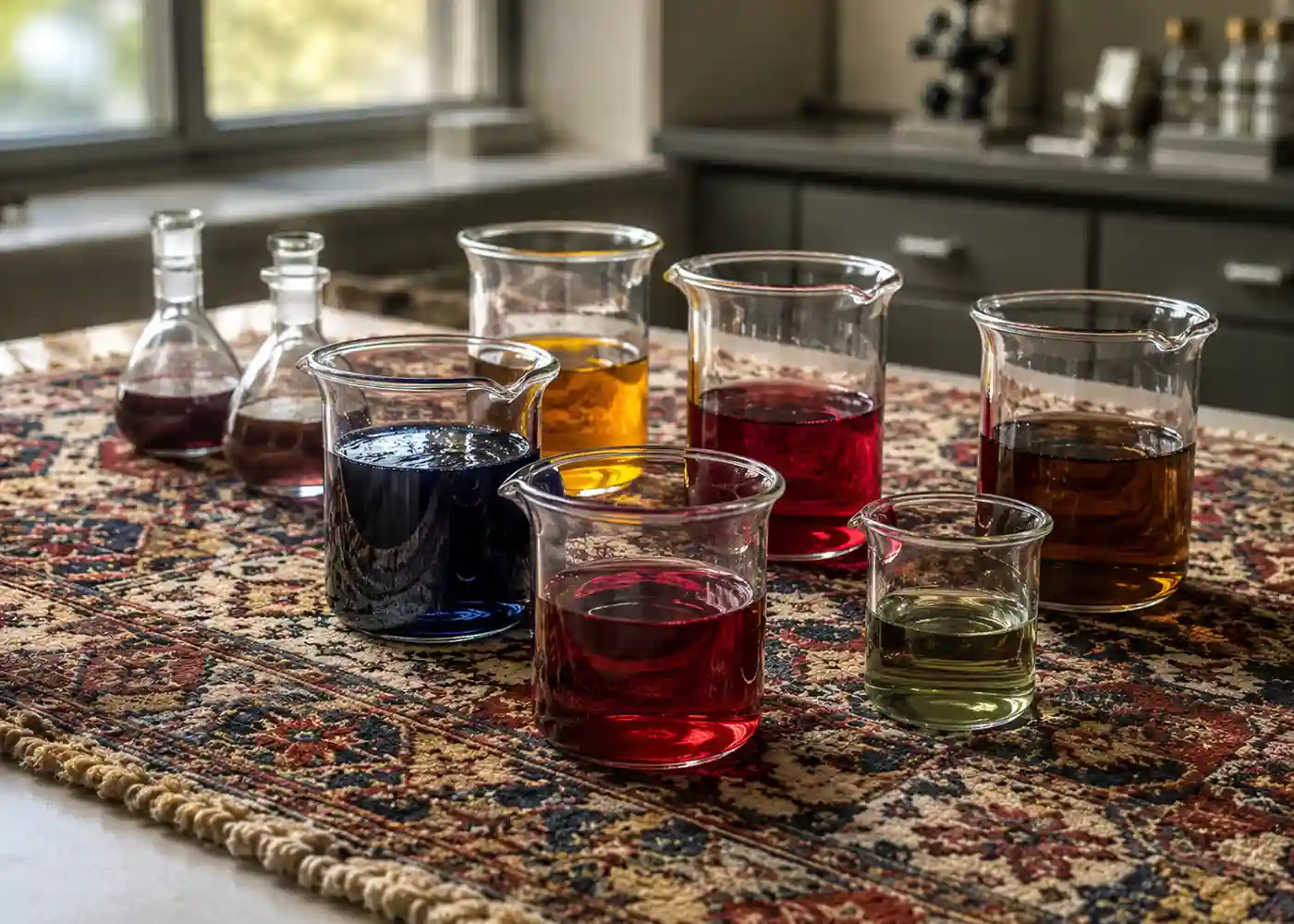
Natural dyes are colorants obtained from biological or, less commonly, mineral sources. Historic rug dyes frequently came from plants, roots, leaves, bark, fruits, lichens, or insects. Well-known examples include madder for reds and red-oranges, indigo-bearing plants for blues, weld and other flavonoid-rich plants for yellows, cochineal and lac insects for crimson or red, and combinations of blue and yellow dyes for green.
Many natural dyes are chemically complex mixtures rather than single compounds. Madder, for example, can contain several anthraquinone colorants. The proportions of these compounds may vary with plant species, geography, cultivation, harvesting, storage, dye-bath preparation, mordant, fiber type, and aging. Because fiber type affects both appearance and analytical interpretation, our comparison of wool and silk Persian rug materials provides useful background. For that reason, a laboratory may confidently identify a dye family while remaining cautious about naming one exact botanical species.
Synthetic dyes
Synthetic dyes are manufactured chemical colorants. William Henry Perkin’s mauveine, discovered in 1856 and commercialized soon afterward, marked the beginning of the modern synthetic-dye industry. Many additional synthetic dye families followed, including triphenylmethane, azo, xanthene, and synthetic anthraquinone dyes. Their adoption was not instantaneous or uniform: natural and synthetic dyes often coexisted, and both could appear in the same textile.
Some early synthetic dyes were brilliant but unstable; others were more durable. Modern synthetic dyes also vary widely in lightfastness, washfastness, and chemical behavior. Therefore, “synthetic” should not be used as a synonym for “fugitive,” just as “natural” should not automatically be equated with permanent or superior.
Why Visual Inspection Is Not Enough
Experienced rug specialists can recognize useful visual clues, but color appearance alone is not a reliable chemical identification. The same source can produce different shades, and unrelated dyes can converge toward similar colors after fading. A soft red may be madder, a faded synthetic red, a mixture, or a re-dyed yarn. A harsh-looking color may be synthetic, but it may also be a naturally dyed yarn affected by mordant choice, washing, pH, surface wear, or photographic lighting.
Common “tests” based on rubbing, smell, saliva, bleach, household acids, hot water, or burning are unsuitable for valuable rugs. They are poorly controlled, may damage fibers or mobilize dyes, and rarely provide a defensible chemical identification. Even a colorfastness test answers a different question: whether color transfers under specific conditions, not whether the dye is natural or synthetic.
Expert distinction: Colorimetry can document color objectively, and ultraviolet or infrared imaging may reveal differences invisible to the eye. These techniques are valuable for mapping and comparison, but a color coordinate or image usually cannot replace molecular identification.
A Museum-Style Analytical Workflow
- Define the question. Is the goal to identify the dye source, detect synthetic colorants, compare an original area with a repair, assess treatment risk, or refine a proposed date?
- Document the rug. Record overall and macro photographs, front and back, pile direction, repairs, corrosion, fading, stains, and the exact proposed sampling points.
- Examine without sampling. Use magnification, fiber-optic illumination, ultraviolet-induced visible fluorescence, reflectance spectroscopy, or spectral imaging where appropriate.
- Select representative yarns. Samples should be as small as possible, preferably loose or already detached fibers. Original and restored areas must not be confused.
- Analyze complementary evidence. Combine molecular dye analysis with elemental mordant analysis and fiber identification when the research question requires it.
- Compare with references. Retention times, ultraviolet-visible spectra, mass spectra, Raman bands, and elemental profiles must be evaluated against authenticated reference compounds and historically prepared dye samples.
- Report uncertainty. A professional conclusion distinguishes confirmed identification, probable assignment, dye-family attribution, and unresolved results.
Laboratory Methods Used to Analyze Antique Rug Dyes
1. Stereomicroscopy and Polarized-Light Microscopy
Microscopy is often the first analytical stage. It can help distinguish pile fibers, identify contaminating particles, inspect dye penetration, document fiber deterioration, and select a clean sample. Cross-sectional and longitudinal fiber morphology may support the identification of wool, silk, cotton, or other materials.
Microscopy does not normally identify an organic dye molecule by itself. Its strength lies in contextualizing the sample and preventing major interpretive errors—for example, analyzing a restoration yarn while assuming it is original.
2. Colorimetry
Colorimeters and spectrophotometers express color numerically, commonly through CIE L*a*b* coordinates. This makes it possible to compare faded and protected areas, monitor light-aging experiments, or document changes before and after conservation. Colorimetry is non-destructive, repeatable when conditions are controlled, and useful for mapping variation.
It is not a direct test of natural versus synthetic origin. Different chemical dyes can produce similar color values, while the same dye recipe can produce different values on different fibers or under different aging conditions.
3. Ultraviolet Examination and Multispectral Imaging
Ultraviolet-induced visible fluorescence can expose repairs, surface coatings, biological stains, optical brighteners, and differences among yarns that look similar under normal light. Multispectral or hyperspectral imaging records broader wavelength-dependent behavior and can map colorants across a large surface without removing material.
These methods are excellent for locating anomalies and planning sampling. Their limitation is specificity: fluorescence and reflectance can be influenced by the fiber, mordant, degradation, mixtures, surface dirt, and previous treatments.
4. Fiber-Optic Reflectance Spectroscopy (FORS)
FORS measures reflected light across selected ultraviolet, visible, and near-infrared wavelengths. It is non-invasive and can be used directly on a rug, making it valuable for screening large objects or fragile textiles. It can be particularly informative for certain dyes such as indigo and may distinguish groups of colorants through diagnostic spectral features.
FORS is not universally definitive. Some natural dyes produce broad, similar, or weak features; mixtures complicate interpretation; and the spectrum may be affected by fiber color, mordant, fading, and concentration. It is therefore strongest when combined with a more specific method.
5. Raman Spectroscopy and Surface-Enhanced Raman Spectroscopy (SERS)
Raman spectroscopy probes molecular vibrations and can produce a chemical “fingerprint.” It may be performed with little or no sampling and can be highly informative for some dyes and pigments. The major obstacle in historic organic colorants is fluorescence, which can overwhelm the relatively weak Raman signal.
SERS addresses this problem by placing dye molecules near metallic nanostructures, strongly enhancing Raman scattering and often reducing the fluorescence background. It can detect extremely small quantities of colorant. Depending on the procedure, however, SERS may require contact, extraction, hydrolysis, or a micro-sample, so it should not automatically be described as fully non-invasive.
6. Fourier Transform Infrared Spectroscopy (FTIR and ATR-FTIR)
FTIR identifies molecular bonds through infrared absorption. In textile studies it is especially useful for fiber characterization, coatings, degradation products, adhesives, and some inorganic or organic materials. ATR-FTIR permits direct analysis of a small fiber or surface with limited preparation.
Direct dye identification by FTIR can be difficult because dyes are often present at low concentration and their signals may be masked by the much larger spectral contribution of wool, silk, cotton, soil, or conservation materials. FTIR is therefore often a complementary rather than primary technique for identifying trace organic dyes.
7. X-Ray Fluorescence Spectroscopy (XRF)
XRF is a non-destructive elemental technique. It can detect elements associated with metallic mordants or inorganic pigments—for example iron, copper, tin, chromium, or, under suitable conditions, aluminum-related evidence. This information may help reconstruct the dyeing process and explain color, corrosion, or fiber deterioration.
XRF generally does not identify the organic dye molecule itself. Finding iron, for example, may support the presence of an iron-containing mordant or contamination, but it does not independently prove which plant or synthetic colorant was used. Elemental results must be interpreted in context.
8. Scanning Electron Microscopy with Energy-Dispersive X-Ray Spectroscopy (SEM-EDS/EDX)
SEM provides highly magnified images of fiber surfaces and deterioration, while EDS supplies elemental information from selected points. In rug research, the combination can document deposits, damage, and elements associated with mordants. Unlike handheld XRF, it usually requires a micro-sample and may involve coating or mounting.
As with XRF, SEM-EDS is primarily elemental. It helps characterize mordants and the physical state of fibers but usually cannot name a complex organic dye by itself.
9. High-Performance Liquid Chromatography with Diode-Array Detection (HPLC-DAD/PDA)
HPLC-DAD is one of the most established methods for identifying dyes in historic textiles. A tiny fiber sample is extracted, and the resulting mixture is separated into individual components as it moves through a chromatographic column. The diode-array or photodiode-array detector records ultraviolet-visible absorption spectra for the separated compounds.
Identification is based on multiple criteria, including retention time, spectral shape, absorption maxima, and comparison with reference standards or authenticated reference dyeings. HPLC can separate complex mixtures and detect compounds present at very low levels, but it normally requires a sample and an extraction procedure. The extraction itself can alter certain molecules, so the chosen protocol matters.
10. Liquid Chromatography–Mass Spectrometry (LC-MS, LC-MS/MS and HRMS)
Coupling liquid chromatography to mass spectrometry adds molecular mass and fragmentation data to chromatographic separation. This makes LC-MS more selective than UV-visible detection alone and especially useful when compounds have similar spectra, occur in mixtures, or are present at trace levels.
Tandem mass spectrometry (MS/MS) fragments selected ions to provide additional structural information. High-resolution mass spectrometry (HRMS) measures mass with greater precision and can support molecular-formula assignments. These tools are powerful, but identification still depends on sample quality, extraction chemistry, reference materials, instrument settings, and expert interpretation.
11. Gas Chromatography–Mass Spectrometry (GC-MS)
GC-MS can characterize certain dye components, degradation products, binding materials, oils, waxes, or additives after suitable preparation—often including derivatization to make compounds volatile enough for gas chromatography. It is useful in selected research questions but is not the default method for every historic textile dye.
Microscopy
- Typical role: Fiber and sample context
- Sampling: None or micro-sample
- Main strength: Locates repairs, damage, and contaminants
- Important limitation: Rarely identifies dye chemistry alone
Colorimetry
- Typical role: Objective color measurement
- Sampling: None
- Main strength: Repeatable documentation
- Important limitation: Not chemically specific
UV / spectral imaging
- Typical role: Mapping and anomaly detection
- Sampling: None
- Main strength: Examines large areas
- Important limitation: Signals may be ambiguous
FORS
- Typical role: Non-invasive spectral screening
- Sampling: None
- Main strength: Fast and portable
- Important limitation: Mixtures and similar spectra limit certainty
Raman
- Typical role: Molecular fingerprinting
- Sampling: Often none or minimal
- Main strength: Potentially specific
- Important limitation: Fluorescence can mask signals
SERS
- Typical role: Trace dye identification
- Sampling: Often contact or micro-sample
- Main strength: Very high sensitivity
- Important limitation: Procedure may be micro-invasive
FTIR / ATR-FTIR
- Typical role: Fibers, coatings, degradation
- Sampling: None or micro-sample
- Main strength: Fast molecular-group information
- Important limitation: Fiber may dominate weak dye signal
XRF
- Typical role: Elemental/mordant screening
- Sampling: None
- Main strength: Non-destructive elemental data
- Important limitation: Does not usually identify organic dye molecules
SEM-EDS
- Typical role: Fiber morphology and point elemental analysis
- Sampling: Micro-sample
- Main strength: Combines imaging and elemental data
- Important limitation: Not direct molecular dye identification
HPLC-DAD/PDA
- Typical role: Separation and identification of dye components
- Sampling: Micro-sample
- Main strength: Strong reference-based identification
- Important limitation: Extraction and sampling required
LC-MS/MS or HRMS
- Typical role: High-specificity molecular analysis
- Sampling: Micro-sample
- Main strength: Mass and fragmentation evidence
- Important limitation: Complex, costly, reference-dependent
GC-MS
- Typical role: Selected volatile/derivatized components
- Sampling: Micro-sample
- Main strength: Useful for specific compounds and additives
- Important limitation: Not universally applicable to textile dyes
Important Dye Markers Found in Historical Textiles
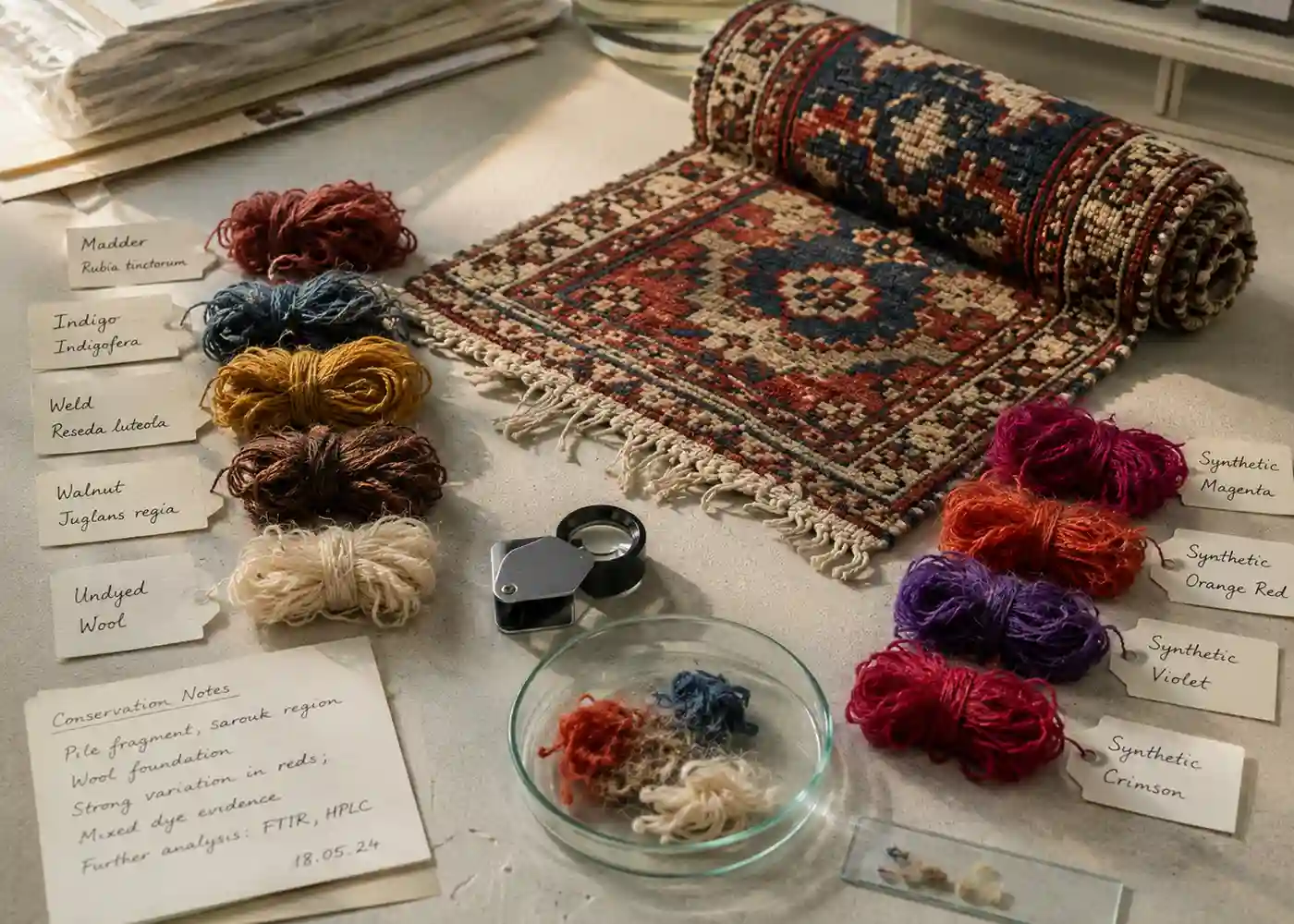
Analysts do not identify “red” or “blue” in the abstract. They search for diagnostic molecules and characteristic profiles. The following examples are simplified: actual attribution depends on the complete pattern of major compounds, minor compounds, degradation products, and historical context.
Madder and related Rubiaceae roots
- Common analytical markers: Alizarin, purpurin, and other anthraquinones
- Interpretive caution: Relative profiles matter; degradation and extraction can modify the pattern
Cochineal
- Common analytical markers: Carminic acid with associated minor compounds
- Interpretive caution: Species and processing attribution may require a fuller marker profile
Lac insect dye
- Common analytical markers: Laccaic acids
- Interpretive caution: Mixtures and degradation may complicate identification
Indigoid dyes
- Common analytical markers: Indigotin and indirubin
- Interpretive caution: These markers may not always distinguish the exact indigo-producing plant
Weld and other luteolin-rich yellow plants
- Common analytical markers: Luteolin and related flavonoids
- Interpretive caution: Luteolin occurs in many plants; one molecule alone may not identify a species
Early synthetic azo or acid dyes
- Common analytical markers: Specific parent dyes, characteristic ions, and degradation products
- Interpretive caution: Commercial formulations and aging products may overlap
How Experts Interpret Dye Results
A positive result is not automatically a date
If a laboratory identifies a synthetic dye whose earliest manufacture date is known, the finding may establish a terminus post quem—the rug or sampled yarn cannot predate that dye’s introduction. But this inference is valid only if the sampled yarn belongs to the original construction. A later re-piled area, inserted knot, overcast side, or repaired fringe can contain a modern dye without changing the age of the entire rug. Laboratory evidence should therefore be compared with the physical indicators discussed in our guide to estimating the age of a Persian rug.
A natural dye does not prove great age
Natural dyes continued to be used after synthetic dyes became available and are still used today. Identifying madder or indigo can support a technical interpretation, but it cannot independently prove that a rug is eighteenth- or nineteenth-century.
Mixed results may be historically meaningful
A rug can contain natural and synthetic dyes in its original palette, particularly during transitional periods. It may also contain original natural dyes plus synthetic restoration yarns, or natural and synthetic colorants mixed in one dye bath. The laboratory must interpret the spatial distribution of each result.
Absence of evidence is not evidence of absence
A dye may be too degraded, too dilute, poorly extracted, absent from the reference library, or masked by contamination. A non-detection should be reported as “not identified under the conditions used,” not automatically as proof that no dye was present.
Sampling strategy controls the quality of the conclusion
A technically advanced instrument cannot rescue a poorly chosen sample. Analysts should avoid contaminated, heavily faded, chemically treated, or visibly restored yarns unless those areas are the subject of the research. Whenever possible, samples from protected and exposed sections should be compared.
What Scientific Studies of Iranian Carpets Have Revealed
A peer-reviewed study of eighteen red wool samples from seven twentieth-century Iranian carpets used reversed-phase HPLC-DAD, SEM-EDX, and colorimetry. The researchers detected natural madder-related compounds in some samples, while synthetic Acid Red 88 and/or Acid Orange 7 were associated with many others. One carpet contained both natural and synthetic colorants.
This case is important because it demonstrates why simple assumptions fail. A hand-knotted Iranian carpet can be historically authentic and still contain synthetic dyes. It also shows the value of combining molecular analysis with elemental and color measurements rather than relying on appearance alone.
In a separate museum example, The Metropolitan Museum of Art used HPLC to identify natural plant- and insect-derived dyes in the sixteenth-century Iranian Emperor’s Carpet, including madder, weld, indigo, lac, and redwood-related sources. This does not mean that all early Persian carpets used the same palette; it illustrates how scientific analysis can document the actual materials of a specific masterpiece.
Best-practice interpretation: Dye analysis is most persuasive when the laboratory connects chemistry to the exact knot or yarn sampled, the rug’s structure, known repairs, historical dye availability, and a transparent statement of uncertainty.
Can Dye Analysis Authenticate an Antique Rug?
It can contribute strongly, but it should not be marketed as a universal yes-or-no authentication test. The strongest conclusions arise when dye results agree with structural examination, fiber identification, condition analysis, provenance, and art-historical evidence.
Dye analysis is particularly useful in four situations:
- Testing whether a supposedly early rug contains a colorant introduced much later.
- Distinguishing original pile from restoration or re-piling.
- Investigating a rare or unusual color that may affect attribution.
- Planning conservation or wet cleaning when dye behavior is uncertain; owners should also avoid the damaging practices covered in our handmade-rug care guide.
Even then, the laboratory should avoid unsupported claims such as “100% natural dyes,” “museum age confirmed,” or “origin scientifically proven” unless the scope of analysis genuinely supports them. Testing three red fibers, for example, cannot establish the chemistry of every color in a large carpet.
What a Professional Rug Dye Report Should Contain
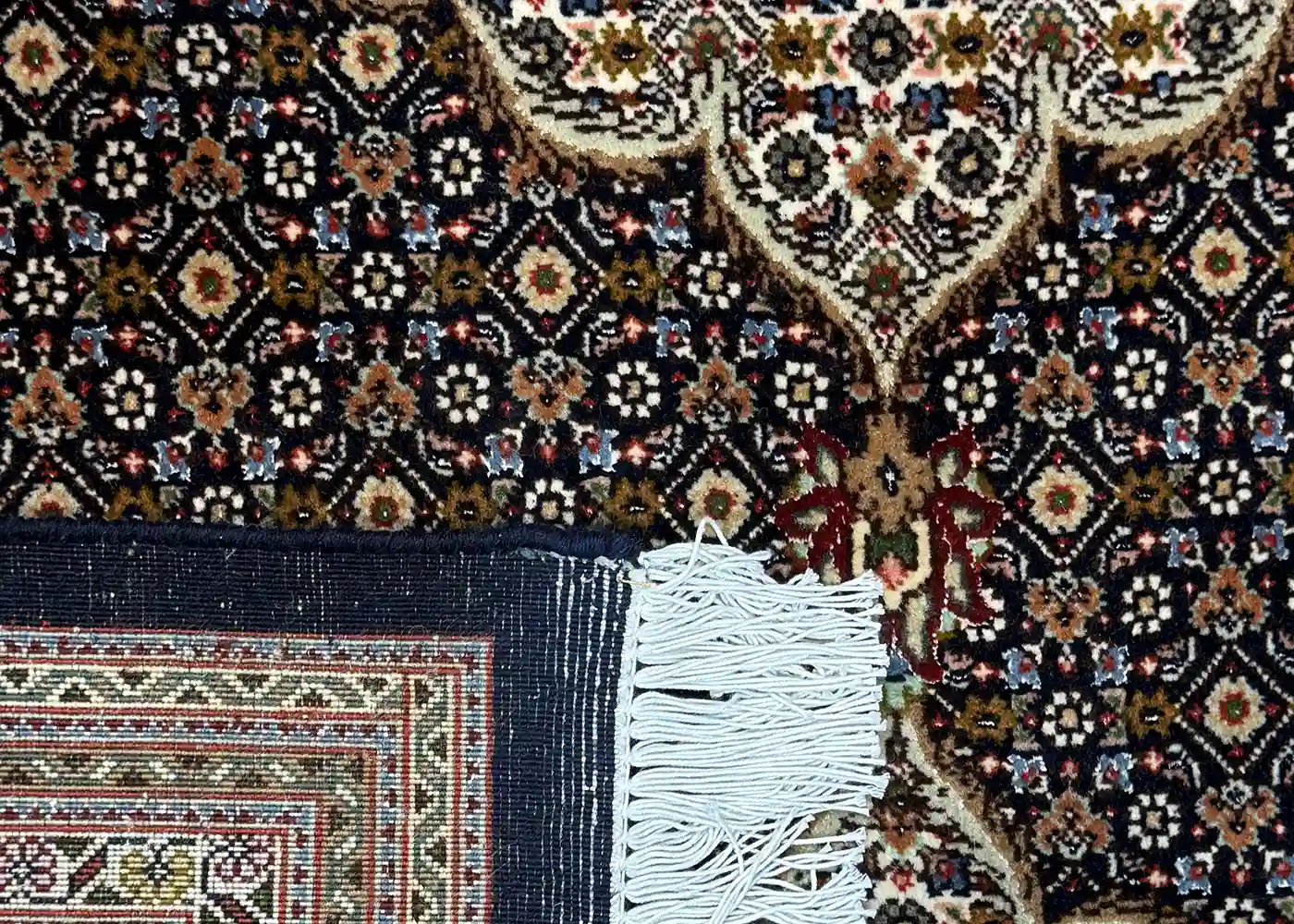
- Object documentation: rug dimensions, construction, proposed region and date, condition, and known restoration.
- Sampling map: exact photographs showing every sampled knot, pile yarn, warp, weft, or repair.
- Chain of custody: who collected, handled, stored, and analyzed each sample.
- Analytical method: instrument, detector, extraction protocol, calibration, and reference materials.
- Raw and processed evidence: chromatograms, spectra, mass-to-charge values, elemental spectra, and quality-control data as appropriate.
- Identification confidence: confirmed, probable, possible, dye family only, or unidentified.
- Limitations: degradation, sample size, contamination, restoration risk, missing references, or ambiguous markers.
- Conservation statement: whether the analysis suggests special sensitivity to light, water, pH, or treatment.
Common Myths About Natural and Synthetic Rug Dyes
Myth 1: Natural dyes always look soft.Aging, abrasion, washing, and photography can soften synthetic colors; concentrated natural dyes can appear intense.
Myth 2: Every antique rug must contain only natural dyes.Genuine hand-knotted rugs from later periods may contain synthetic dyes, mixtures, or later synthetic repairs.
Myth 3: XRF can identify madder or cochineal.XRF primarily detects elements. It may reveal mordant-related metals but generally cannot identify the organic colorant molecule.
Myth 4: One tested knot proves the entire palette.Different colors and even visually identical areas may have different dye histories. Sampling must reflect the research question.
Myth 5: Natural dye automatically means valuable.Value also depends on age, rarity, design, weave, condition, provenance, artistic quality, market demand, and the extent and quality of restoration. Our specialist guide to valuing an old Persian rug explains how these factors interact.
Frequently Asked Questions
What is the most reliable laboratory method for identifying rug dyes?
HPLC-DAD/PDA and LC-MS-based methods are among the most informative for molecular identification because they separate dye components and compare them with reference data. The best choice depends on the sample, dye class, research question, and available reference library.
Can a laboratory test a rug without removing any fibers?
Yes, non-invasive methods such as FORS, XRF, ultraviolet imaging, multispectral imaging, and some Raman measurements can provide valuable information. They may not always deliver a definitive dye identification, so a micro-sample may still be needed.
How large must a dye sample be?
Modern methods can work with very small fibers, sometimes fractions of a milligram or less. The required amount depends on the instrument, dye concentration, fiber condition, extraction method, and number of analyses planned.
Does a synthetic dye prove that an antique rug is fake?
No. Synthetic dyes were used in authentic hand-knotted rugs, and a synthetic result may also come from a later repair. The exact dye, sampled location, and structural context must be evaluated together.
Does madder prove that a rug is old?
No. Madder is historically important but is still used. Its identification supports a material study; it does not independently determine age.
Can laboratory analysis identify the exact plant used?
Sometimes, when a diagnostic combination of markers and strong reference data exists. In other cases, shared compounds, aging, mixtures, and regional variation allow identification only to a dye family or group of possible plants.
Can dye analysis determine where a rug was woven?
Dye evidence may support provenance when combined with historical records, local dye practices, structural features, and comparative objects. By itself, the same dye source may occur across multiple regions and trade networks.
Final Conclusion
The distinction between natural and synthetic dyes in antique rugs cannot be made reliably from brightness, fading, abrash, or intuition alone. Scientific analysis begins with documentation and non-invasive screening, then uses targeted micro-sampling when necessary. HPLC-DAD and LC-MS provide molecular evidence; Raman and SERS can offer diagnostic fingerprints; FORS and spectral imaging map color behavior; FTIR supports material characterization; and XRF or SEM-EDS reveal elemental information associated with mordants and fiber condition.
The most credible conclusion is rarely a single-word label. It is a documented interpretation explaining what was detected, how confidently it was identified, where the sample came from, what alternative explanations remain, and how the result relates to the rug’s structure, restoration, proposed date, and cultural history.
Explore related Arghavan Rugs resources: Study real examples in our curated old and antique rug collection, or compare weaving regions, sizes, runners, kilims, and other categories through the complete handmade rug collections.
Scientific References and Further Reading
- Shibayama, N., Phipps, E., & Commoner, L. “Identifying Natural Dyes to Understand a Tapestry’s Origin.” The Metropolitan Museum of Art. View source.
- The Metropolitan Museum of Art. “Making the Invisible Visible: Conservation and Islamic Art”—technical study of the Emperor’s Carpet. View source.
- Chahardoli, Z. et al. “Twentieth century Iranian carpets: investigation of red dye molecules and study of traditional madder dyeing techniques.” Heritage Science 7, 57 (2019). View DOI.
- Otłowska, O. et al. “Case Study of a 16th Century Carpet with Chintamani Motifs: Multi-Analytical Characterization.” Molecules 23(2), 339 (2018). View DOI.
- Margariti, C. et al. “Exploring the provenance of a Byzantine excavated assemblage of textile and leather finds by the application of instrumental analysis.” Heritage Science 12 (2024). View DOI.
- Tamburini, D. “An Introduction and Recent Advances in the Analytical Study of Early Synthetic Dyes and Organic Pigments in Cultural Heritage.” Heritage 7 (2024). View DOI.
- Tamburini, D. et al. “Dye Identification in Mounting Textiles of Traditional Korean Paintings from the Late Joseon Dynasty.” Heritage 6 (2023). View DOI.
- Tamburini, D. et al. “Mass Spectrometry for Investigation of Natural Dyes in Historical Textiles: Unveiling the Mystery behind Safflower-Dyed Fibers.” Journal of the American Society for Mass Spectrometry 32 (2021). Open-access article.
- Science History Institute. “William Henry Perkin.” View source.
- Shahid, M. et al. “Analytical methods for determination of anthraquinone dyes in historical textiles: A review.” Analytica Chimica Acta 1083 (2019). View DOI.
Editorial note: This article explains analytical principles for education and collection care. Sampling culturally significant or valuable rugs should be performed only by qualified conservation scientists or textile conservators using documented, minimally destructive procedures.