

WINE-RED TURKMEN RUG 110CM X 160CM (3'61 X 5'25)
1 in stock
Secure international delivery can be arranged for selected handmade rugs, with careful handling from gallery to destination.
Each piece is selected for its origin, weaving quality, character, materials, and artistic value.
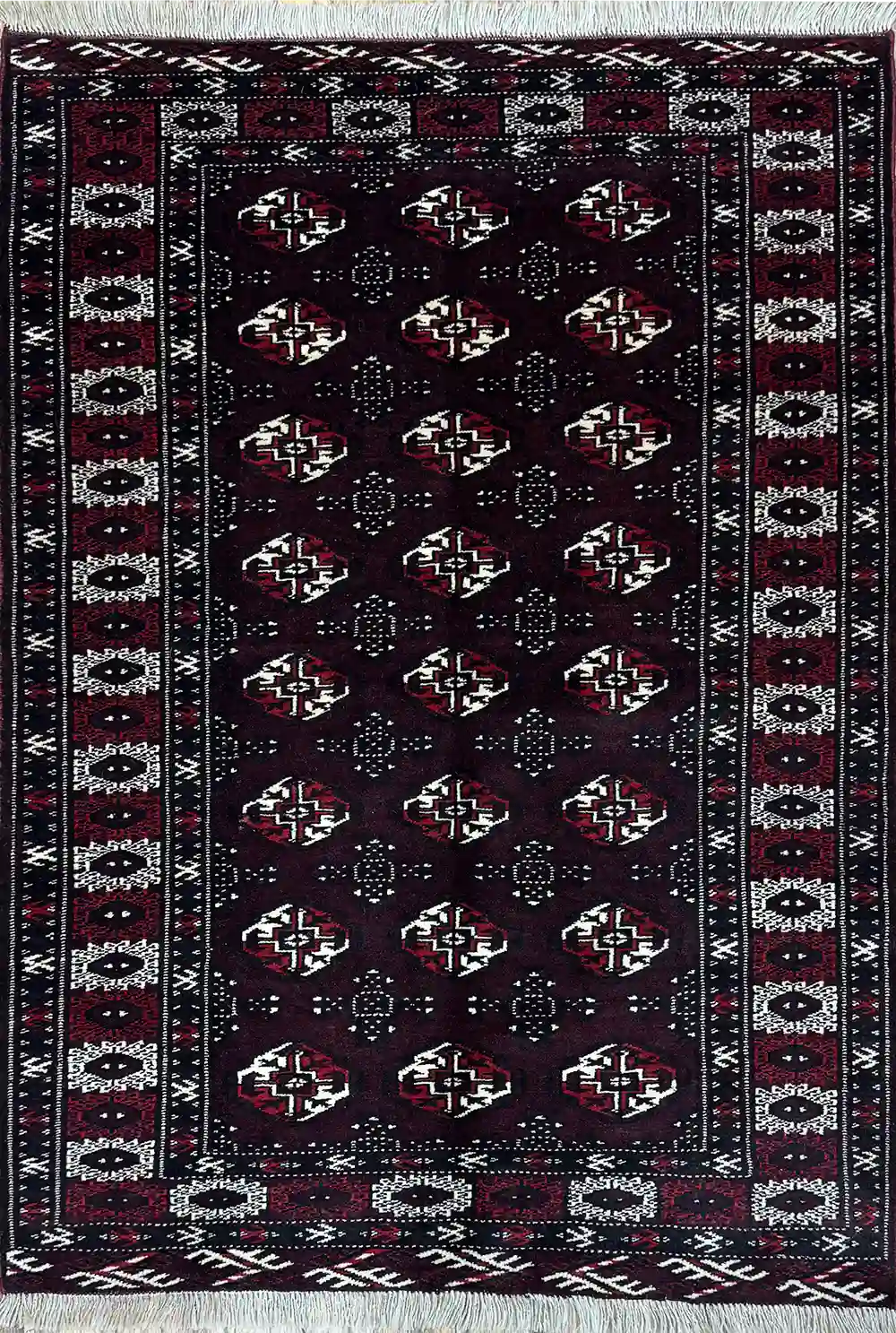
The rug shown is the exact piece available, with its own colors, texture, age, details, and story.
Follow us on Instagram for weekly rug offers, new arrivals, and selected collector pieces.
Handmade Details
Wine-Red Turkmen Rug is a one-of-a-kind handmade carpet woven in Golestan, Iran. Measuring
110 × 160 cm, approximately 3’7″ × 5’3″, it offers a practical size for bedrooms, reading corners, compact living rooms, home offices and entrance spaces.
The rug immediately stands out through its deep wine-red field, strong ivory details and dark geometric outlines. Its carefully repeated motifs create a disciplined visual rhythm, while the handwoven construction gives the surface a natural individuality that cannot be reproduced by a machine-made carpet.
With a wool pile and an approximate thickness of 5 mm, this Turkmen rug has a relatively low-profile construction. This makes it easier to place beneath lightweight furniture, beside a bed or in areas where a thick carpet might interfere with doors or surrounding furnishings.
Traditional Turkmen-Inspired Gul Design
The central field is organised around repeated geometric medallions inspired by the traditional Turkmen gul. In Turkmen weaving, the word gul is commonly used to describe the repeated octagonal, circular or polygonal motifs that form the main structure of many tribal carpet designs.
In this rug, the primary medallions are arranged in regular horizontal and vertical rows. Each medallion contains an angular cross-like form highlighted in ivory, dark brown and wine-red. The repeated layout gives the carpet a strong sense of order and symmetry without making the design feel rigid or mechanical.
Smaller dotted diamonds, crosses and geometric fillers appear between the larger motifs. These secondary elements occupy the negative space and connect the principal medallions visually. Their smaller scale creates contrast and prevents the central field from becoming too heavy.
The overall composition reflects the visual language associated with traditional Turkmen rugs: repetition, controlled geometry, contrasting colours and clearly defined borders. While the exact tribal identity or symbolic meaning of an individual motif should not be determined from appearance alone, the rug clearly carries the aesthetic character of Turkmen weaving.
A Distinctive Wine-Red Colour Palette
The dominant colour is a deep wine-red with burgundy and plum undertones. This darker shade gives the carpet a more refined and atmospheric appearance than a bright red rug. Depending on the direction and intensity of the light, the field may appear closer to dark burgundy, black cherry or deep aubergine.
Ivory details provide the strongest contrast, making the central motifs and border elements clearly visible. Dark brown and near-black outlines define the shapes, while smaller red accents create depth within the design. The combination is bold enough to attract attention but restrained enough to work in both traditional and contemporary interiors.
This palette pairs especially well with walnut, oak and dark wood furniture. It can also complement black metal, aged brass, leather, cream upholstery, warm grey fabrics and natural linen. In a minimalist room, the rug can become the main source of colour and pattern. In a more traditional interior, it can connect existing wood tones, textiles and decorative objects.
Detailed Multi and decorative objects.
Detailed Multi-Border Composition
Several decorative borders surround the central field, creating a layered frame around the rug. The widest border alternates between ivory geometric medallions and smaller wine-red motifs set against a dark background. This repeated contrast distributes the lighter colours evenly around all four sides.
Narrower guard borders separate the main border from the central field. These contain smaller angular marks, diagonal forms and repeating tribal details. Along the outer edge, a strong zigzag pattern adds movement and gives the rug a distinctive finish.
The border system performs an important visual function. It contains the repeated central motifs, controls the intensity of the dark field and gives the carpet a complete appearance. Because the border is detailed on every side, the rug remains balanced whether it is viewed from the front, side or opposite end of the room.
Handwoven in Golestan
This rug was handwoven in Golestan, Iran, a region closely connected with Turkmen weaving traditions. Its handmade construction means that the design was developed gradually through the placement of individual knots rather than printed or mechanically reproduced.
Small variations in motif shape, line thickness, dimensions and symmetry are therefore natural. These differences should not be considered manufacturing defects. They are part of the individual character of a handmade rug and help distinguish it from a mass-produced floor covering.
The rug shown in the product photographs is the exact piece the buyer will receive. As a one-of-a-kind carpet, it is not produced as part of an identical series. Once sold, another rug may share a related Turkmen design or colour palette, but it will not be completely identical in pattern, dimensions and handmade details.
Wool Pile and Low-Profile Construction
The pile of this rug is made from wool, a material traditionally valued in handmade carpet weaving for its resilience, texture and ability to hold colour. Wool fibres can recover naturally from moderate pressure, making them suitable for rugs used in residential interiors.
With an approximate pile thickness of 5 mm, this piece has a relatively slim profile. The lower pile allows the intricate geometric drawing to remain clearly visible and makes the rug practical for compact spaces.
A suitable rug pad is recommended, particularly when the carpet is placed on hardwood, tile, laminate or polished stone. A rug pad can reduce movement, provide additional cushioning and help protect both the rug and the flooring beneath it.
Ideal Size for Compact Interiors
At 110 × 160 cm, the rug covers approximately 1.76 square metres. Its proportions make it versatile enough to define a small area without covering an excessive amount of flooring.
Recommended placements include:
- Beside a single, double or queen-size bed
- At the foot of a bed
- Under a compact coffee table
- In a reading corner with one chair and a side table
- In a small home office or private study
- In a wide entrance or foyer
- Between two accent chairs
- In front of a cabinet, console or fireplace
- Layered over a larger neutral floor covering
In a compact seating arrangement, the rug can be positioned beneath the coffee table with the front legs of nearby chairs resting close to or slightly over its edges. In a bedroom, it can be placed beside the bed so that the wool surface is the first thing touched when getting up.
Suitable for Traditional and Modern Décor
Although the design is rooted in a traditional tribal aesthetic, the clean repetition of geometric forms also works well in modern interiors. The rug can introduce warmth into a room with plain walls, simple furniture and neutral materials without disturbing the overall simplicity of the space.
In rustic, bohemian or eclectic interiors, it can be combined with woven cushions, wooden furniture, ceramic objects and natural fabrics. In a more formal room, pairing it with cream upholstery and dark wood can emphasise the richness of its wine-red colour.
Care and Maintenance
To preserve the colour and structure of this handmade wool rug, rotate it periodically so that foot traffic and light exposure remain evenly distributed. Vacuum gently without using an aggressive rotating brush, and avoid pulling the fringe into the vacuum cleaner.
Blot accidental spills immediately with a clean, absorbent cloth. Do not rub the stained area, as rubbing may push moisture deeper into the pile. Avoid household bleach, strong chemicals, steam cleaners and unsuitable carpet shampoos. Professional cleaning should be carried out by a specialist familiar with handmade wool rugs.
For additional maintenance guidance, read the
Arghavan Rugs handmade rug care guide
.
Explore More Handmade Tribal Rugs
To compare this piece with other geometric tribal carpets, visit the
Turkmen and Baluch rug collection
.
You can also browse the
complete handmade rug collection
to explore additional sizes, colours and weaving regions.
For more photographs, close-up details or assistance with placement, contact the
Arghavan Rugs team
before ordering.
Product Details
- Product Name: Wine-Red Turkmen Rug
- Type: Handmade tribal rug
- Country of Origin: Iran
- Weaving Region: Golestan
- Dimensions: 110 × 160 cm
- Approximate Imperial Size: 3’7″ × 5’3″
- Approximate Area: 1.76 m²
- Pile Material: Wool
- Approximate Pile Thickness: 5 mm
- Design: Repeating gul-inspired geometric medallions
- Main Colours: Wine-red, burgundy, ivory and dark brown
- Shape: Rectangular
- Availability: One-of-a-kind piece
Please note: The colours visible on a screen may differ slightly from the actual rug because of lighting, photography and display settings. Minor variations in measurements, pattern alignment, texture and symmetry are natural features of handmade weaving.