

Handmade Tabriz Rugs: The Timeless Art of Persian Weaving
Among the many artistic traditions woven into the history of Iran, few have achieved…
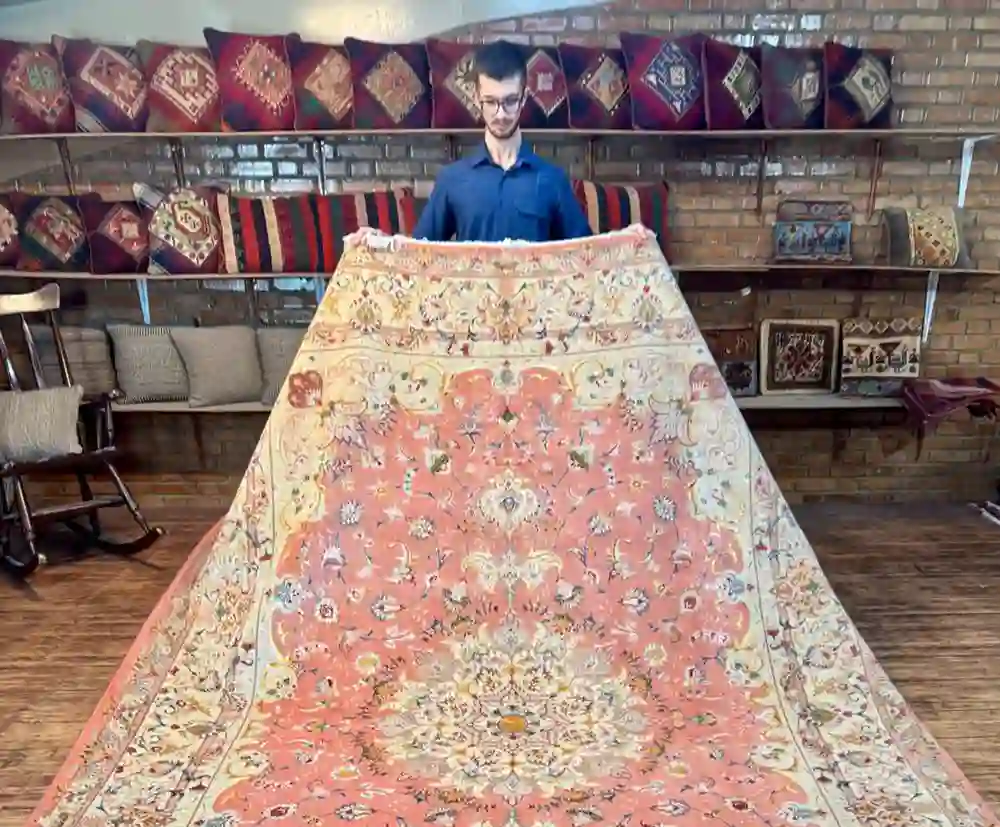
HANDMADE PERSIAN RUGS COLLECTIONS
Among the many artistic traditions woven into the history of Iran, few have achieved the same global admiration as handmade Tabriz rugs. Known for their extraordinary craftsmanship, intricate patterns, and remarkable durability, these rugs are not simply decorative objects. They are reflections of a city that has stood at the crossroads of culture, trade, art, and history for centuries.
The story of Tabriz rugs begins with the city itself. Located in northwestern Iran, Tabriz has long been one of the country’s most important cultural and commercial centers. For generations, merchants, poets, artists, and craftsmen traveled through its historic bazaars, bringing with them influences from Central Asia, Anatolia, the Caucasus, and Persia itself. Over time, this exchange of cultures shaped a unique artistic identity that became deeply visible in the rugs woven by the people of Tabriz.
Today, handmade Tabriz rugs are considered among the finest Persian rugs in the world. Collectors admire them for their artistic precision, interior designers value them for their timeless elegance, and homeowners appreciate their ability to bring warmth and sophistication into a space. Yet behind every authentic Tabriz rug lies a much deeper story one connected to the history of a city and the traditions of the people who have preserved this art for centuries.
The Historical Importance of Tabriz

Tabriz is one of the oldest continuously inhabited cities in Iran. Throughout history, it served as a major commercial center along the Silk Road, connecting East and West through trade and cultural exchange. Because of its strategic location, the city became an important meeting point for merchants traveling between Persia, the Ottoman Empire, Central Asia, and Europe.
This constant movement of people and ideas helped Tabriz evolve into one of the artistic capitals of Persia. During the Safavid era, especially in the sixteenth century, Tabriz gained enormous importance as a center of art, architecture, miniature painting, calligraphy, and carpet weaving.
The Artistic Identity of Handmade Tabriz Rugs
One of the most fascinating aspects of handmade Tabriz rugs is their versatility. Unlike some Persian rug styles that follow highly specific visual traditions, Tabriz rugs display remarkable diversity in design while maintaining a recognizable sense of balance and sophistication.
Many authentic Tabriz rugs feature central medallions surrounded by floral motifs, curving vines, and intricate borders. Others incorporate geometric compositions, garden scenes, or even pictorial storytelling inspired by Persian literature and historical imagery.
The Culture Behind the Craft
To truly understand handmade Tabriz rugs, it is important to understand the culture of the people who create them. In Tabriz, carpet weaving has historically been more than a profession. It has been part of family life, artistic identity, and cultural continuity.
For centuries, weaving skills were passed from one generation to the next. Children often grew up watching parents and grandparents work at looms, gradually learning the patience, discipline, and artistic sensitivity required to create fine rugs by hand.
Why Handmade Tabriz Rugs Are Considered Valuable
Several factors contribute to the reputation and value of handmade Tabriz rugs. One of the most important is craftsmanship. High-quality Tabriz rugs are woven with exceptional technical precision, often using dense knotting techniques that improve durability and visual detail.
Materials also play a major role. Traditional handmade Tabriz rugs commonly use high-grade wool, silk, or combinations of both. Wool provides softness, resilience, and durability, while silk allows for greater detail and luminosity in the patterns.
Handmade Tabriz Rugs in Modern Interiors
TABRIZ RUG CARE : 7 MISTAKES THAT REDUCE LIFE SPAN
One reason handmade Tabriz rugs remain relevant today is their remarkable compatibility with contemporary interior design. While many people associate Persian rugs with highly traditional spaces, modern designers increasingly use Tabriz rugs to create contrast and warmth in minimalist interiors.
In contemporary homes filled with clean lines, neutral palettes, and modern furniture, a handmade Persian rug introduces texture, history, and artistic richness.
The Enduring Legacy of Tabriz Weaving
The global admiration for handmade Tabriz rugs is not simply about decoration. It is about preserving one of the world’s most respected artistic traditions. Every authentic rug represents countless hours of skilled labor, artistic knowledge, and cultural memory passed through generations.
Owning a handmade Tabriz rug is not simply about purchasing a carpet. It is about bringing a piece of history, culture, and enduring craftsmanship into your home.