

Handmade Nain Rugs: The Refined Beauty of Persian Weaving
Among the world’s most elegant Persian carpets, handmade Nain rugs hold a special place…
Article Guide
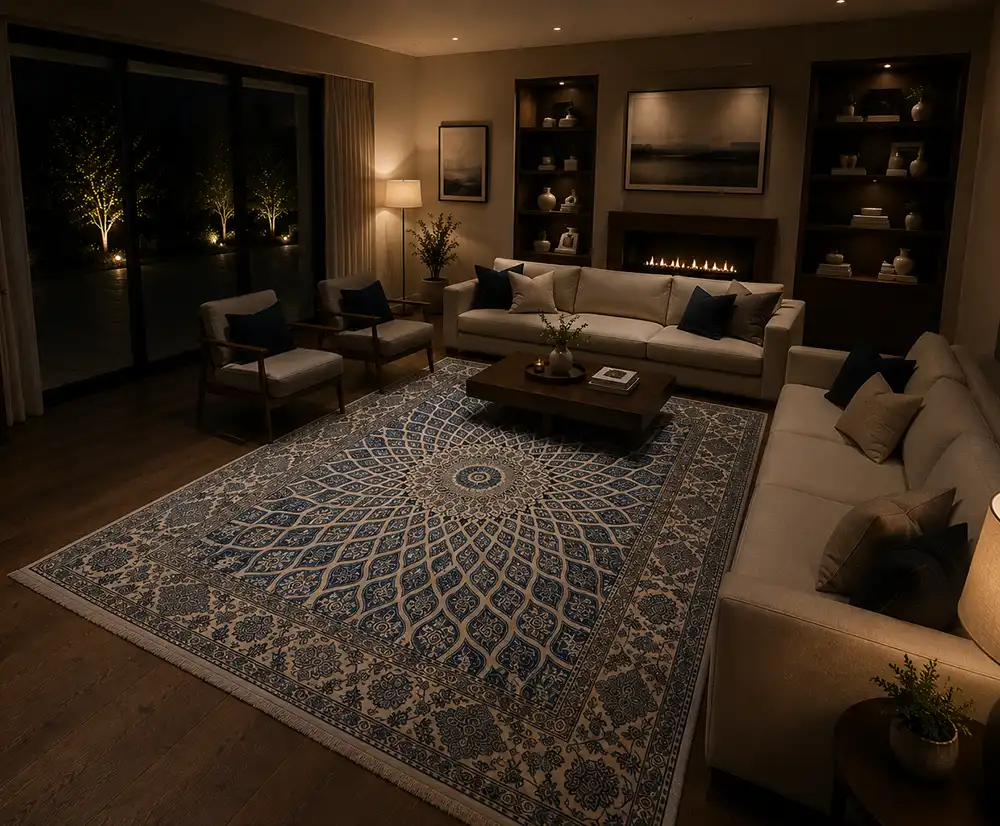
Among the great city-weaving traditions of Iran, handmade Nain rugs are immediately recognizable for their calm elegance, disciplined drawing, fine construction, and restrained use of color. An ivory field, deep navy medallion, pale blue arabesques, and carefully placed silk highlights can give a Nain carpet a luminous appearance without making it visually loud. This balance is one of the main reasons Nain rugs work so naturally in classic homes, contemporary interiors, formal rooms, and sophisticated minimalist spaces.
Yet the term “Nain rug” is often used too loosely. Not every cream-and-blue carpet is woven in Nain, not every rug described as 6La has been graded correctly, and a lower La number does not automatically make a rug more beautiful or more valuable. To understand a genuine Nain carpet, buyers need to look beyond color and examine its history, knot structure, foundation, materials, La classification, design quality, condition, and provenance.
This complete guide explains the Nain weaving tradition from the foundation upward. It is designed for homeowners, collectors, designers, and first-time buyers who want to understand what separates an authentic handmade Nain rug from a machine-made imitation or a general Nain-style carpet. You can also browse our current
handmade Nain rug collection
to compare real examples in different colors, sizes, patterns, and grades.
What Is a Handmade Nain Rug?
A true handmade Nain rug is a Persian carpet created through traditional hand-knotting rather than mechanical production. Individual pile knots are tied onto a structural foundation of warp and weft threads. Row by row, the design develops slowly until the entire composition is completed, clipped, washed, and finished.
Nain belongs to the category of refined Persian city rugs. Its design language is usually more formal and controlled than the expressive geometry seen in many village or tribal carpets. Symmetry, precise curving lines, clear borders, balanced medallions, and delicate floral ornament are central to its identity. The pile is often clipped relatively short so that the drawing remains crisp and the silk details can catch the light.
The word “Nain” should describe origin, not simply appearance. Carpets woven elsewhere may copy Nain colors and motifs and may be marketed as “Nain style.” These pieces can still be handmade and attractive, but they should not be represented as rugs woven in Nain unless their origin can be supported. This distinction is similar to the wider difference between a genuine regional Persian rug and a reproduction inspired by that region. Our
guide to Persian rug styles and regional types
explains how origin shapes design, construction, and character across Iran.
The History of Nain Rug Weaving
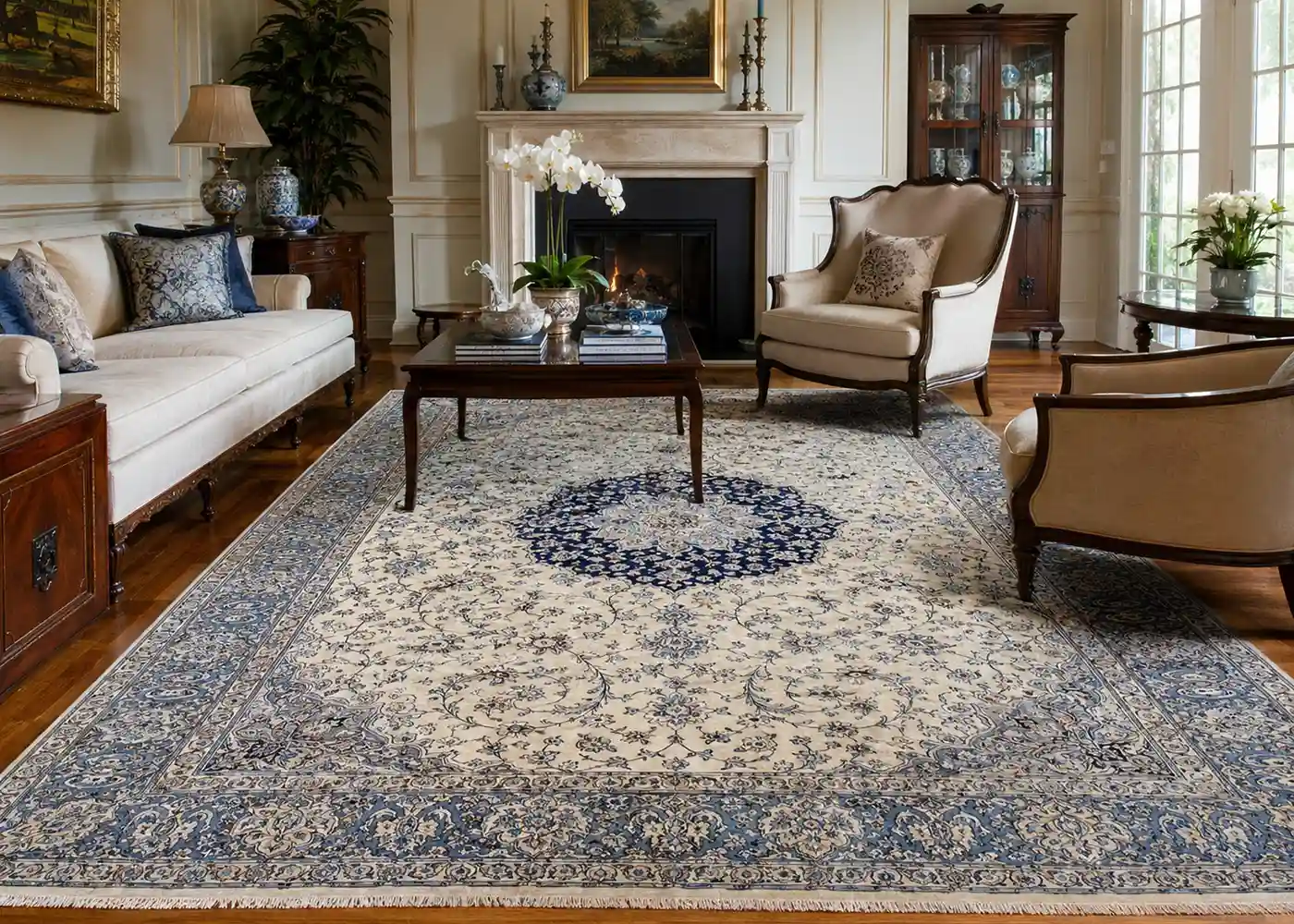
Nain is an ancient city in central Iran, located in Isfahan Province near the edge of the central desert. Its architecture, mosques, qanats, textiles, and traditional crafts reflect a long-established urban culture. However, the commercial Nain carpet tradition is considerably younger than the carpet histories of cities such as Tabriz, Kashan, or Kerman.
Before Nain became internationally known for rugs, the area had an established textile tradition, particularly the production of finely woven cloth and aba garments. During the early twentieth century, changes in demand affected this textile economy. Skilled craftspeople who already understood fine fibers, spinning, dyeing, and disciplined workshop production increasingly turned toward carpet weaving.
Nain’s proximity to Isfahan strongly influenced the new carpet tradition. Early designers and weavers drew on the curvilinear vocabulary associated with central Persian court and city carpets: medallions, Shah Abbasi flowers, arabesques, scrolling vines, and balanced formal layouts. Nain workshops did not merely duplicate Isfahan carpets, however. Over time they developed a recognizable identity based on lighter fields, controlled blue palettes, fine wool, silk outlining, and a distinctive local grading system.
The Influence of Fathollah Habibian
No serious discussion of twentieth-century Nain weaving is complete without mentioning Fathollah Habibian. His name is closely associated with the development, refinement, and international reputation of high-grade Nain carpets. The Habibian workshop helped establish demanding standards for design, materials, knotting, and finishing, and genuine workshop pieces are especially respected by collectors.
A signature alone, however, is not enough to prove that a rug is an authentic Habibian. Famous workshop names are sometimes copied or woven into unrelated carpets. Attribution should be supported by the rug’s construction, age, design vocabulary, quality, materials, and documented history. This is one reason provenance and expert inspection matter when a seller makes a significant workshop claim.
How Handmade Nain Rugs Are Constructed
The technical character of a Nain rug is created by the relationship between its foundation, knots, pile, materials, tension, and finishing. Fine appearance is not produced by knot count alone. Each element must work together.
Warp and Weft Foundation
Most Nain rugs are built on a cotton foundation. The warp threads run lengthwise through the rug and continue beyond the body to form the fringes. The weft threads travel across the rug between rows of knots, locking the structure together. Cotton is well suited to fine city weaving because it can provide a stable, regular foundation that supports controlled lines and symmetry.
Some very fine or special pieces may use silk in parts of the foundation, but buyers should not assume that every expensive Nain carpet has a silk foundation. A well-made cotton foundation can support exceptionally fine weaving. What matters is the quality, consistency, alignment, and condition of the structure.
The Persian or Asymmetrical Knot
Nain rugs are generally associated with the asymmetrical Persian knot. In this structure, the pile yarn wraps fully around one warp and passes under or partly around the adjacent warp. This knot supports fluid curving lines and fine floral drawing, making it suitable for the detailed medallions, arabesques, and blossoms typical of Nain design.
A knot type does not automatically determine quality. The skill of the weaver, consistency of tension, quality of yarn, precision of the pattern, and strength of the foundation remain essential. When inspecting the back, look for controlled rows, visible design clarity, and a structure that corresponds logically with the front.
Fine Wool and Short Pile
High-quality Nain rugs commonly use fine wool for most of the pile. The wool should feel resilient, smooth, and natural rather than plastic or excessively shiny. Because Nain designs rely on precise outlines, the pile is often clipped lower than the pile of a thick village rug. A shorter pile allows small motifs and curved lines to remain visible.
Low pile should not be confused with wear. Intentional clipping is even across the surface and supports the drawing. Wear is usually irregular, appearing more strongly in traffic lanes, near ends, or in raised areas of the design. In severe wear, the foundation may become exposed.
Silk Highlights
Silk is frequently used as an accent rather than as the entire pile. It may outline petals, medallion edges, leaves, arabesques, inscriptions, or selected motifs. These highlights reflect light differently from wool, creating subtle movement as the viewing angle changes.
More silk does not automatically mean a better rug. Silk should strengthen the design rather than overwhelm it. The quality of the wool, precision of the drawing, and harmony of the materials are more important than a simple percentage. For a broader material comparison, read
Wool vs Silk Persian Rug.
What Does La Mean in Nain Rugs?
The La system is one of the most useful features of Nain classification, but it is also widely misunderstood. It is not simply another name for KPSI, and it does not directly state the exact number of knots per square inch. Two rugs identified as 6La can still differ in actual knot density, wool quality, silk use, design complexity, condition, and workshop execution.
To examine La, a specialist may carefully separate or untwist a small section of fringe and count the component plies. This should be done cautiously. Pulling, cutting, or aggressively unraveling a fringe can damage the foundation. For valuable carpets, grading should be confirmed by an experienced rug professional.
| Nain Grade | General Position | Typical Visual Effect | Important Buyer Note |
|---|---|---|---|
| 12La | Coarser commercial Nain category; terminology is not always standardized | Larger motifs, heavier drawing, less miniature detail | Judge the actual rug; the label may be used differently by different sellers |
| 9La | Good to fine Nain quality and one of the most commonly encountered grades | Clear floral drawing, attractive medallions, practical refinement | A well-made 9La can be an excellent handmade rug and should not be dismissed as low quality |
| 6La | Fine to very fine Nain weaving | Sharper curves, smaller motifs, more controlled outlines and silk detailing | Confirm material, condition, actual density, and origin rather than relying only on the label |
| 4La | Exceptionally fine and rare | Miniature-like detail, delicate lines, sophisticated workshop execution | Claims require careful verification because true 4La examples are uncommon |
Is 6La Always Better Than 9La?
A genuine 6La rug usually has a finer foundation and greater potential for detail than a comparable 9La rug. But “better” depends on the whole object. A beautiful 9La Nain with excellent wool, balanced colors, strong construction, and outstanding condition may be more desirable than a poorly executed or heavily damaged rug presented as 6La.
The correct comparison should include actual knot density, consistency, materials, design, dimensions, age, condition, repairs, and provenance. La is a meaningful technical clue, not a complete appraisal.
Why Exact KPSI Ranges Can Be Misleading
Online charts often assign a fixed KPSI range to every La grade. In practice, these ranges vary considerably between sources. La describes yarn construction, while KPSI measures knots over an area. The relationship is real—finer foundation yarn generally permits denser knotting—but it is not perfectly fixed.
For an accurate knot-density assessment, both horizontal and vertical counts should be measured directly on the back of the rug in more than one area. This is especially important when a high knot count is being used to justify a premium price.
Signature Designs and Motifs in Nain Rugs
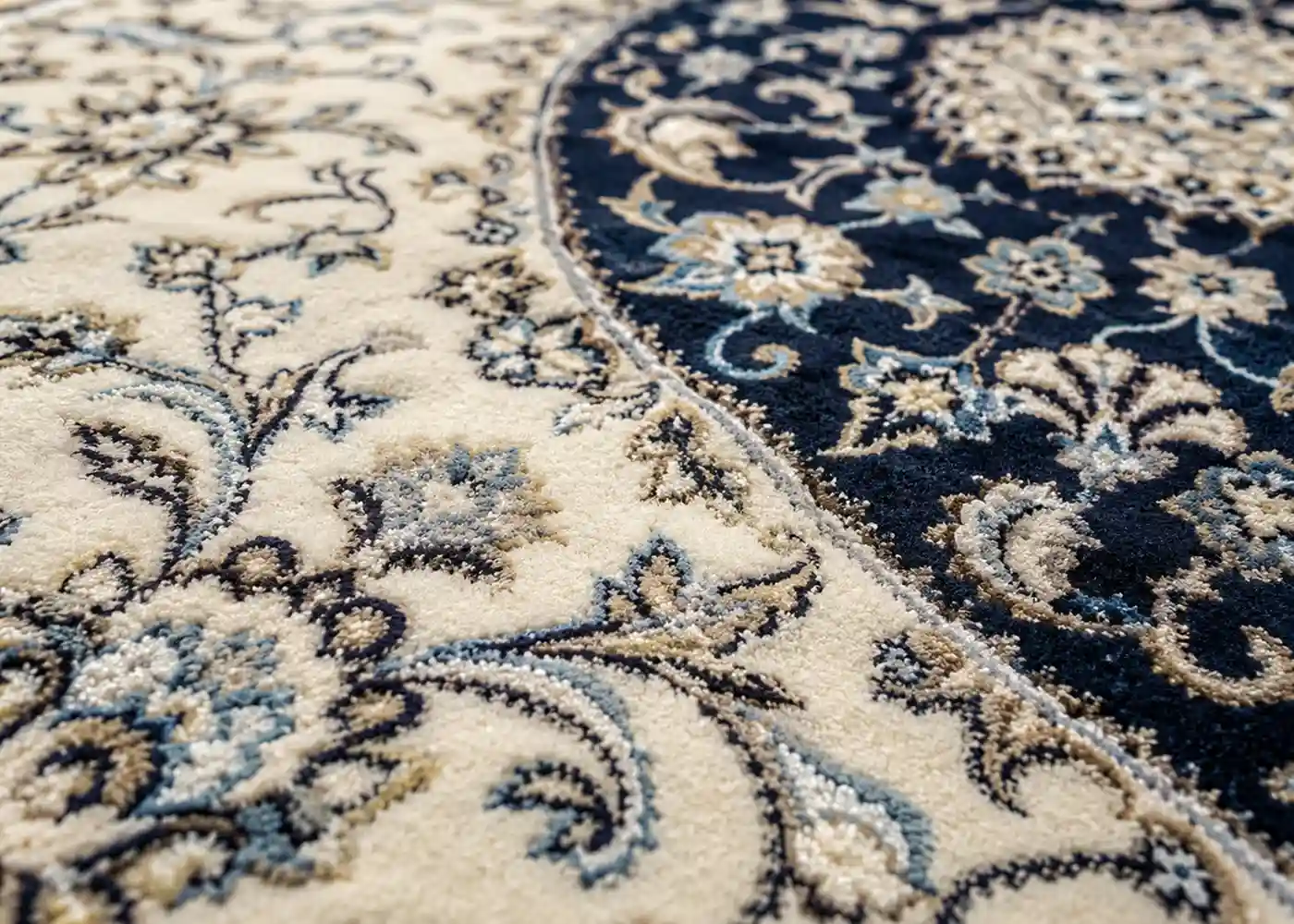
Nain designs belong to the formal curvilinear family of Persian carpet art. Their strength comes from disciplined composition and the ability to create complexity without visual chaos.
Central Medallion Designs
The classic Nain composition often features a central medallion surrounded by floral vines and balanced corner elements. The medallion may be circular, oval, star-shaped, or layered with multiple outlines. Deep navy or blue commonly defines the central form against an ivory field, while silk is used to sharpen selected edges.
Shah Abbasi Flowers and Arabesques
Stylized Shah Abbasi palmettes, blossoms, leaves, and scrolling arabesques are among the most familiar elements. These motifs are connected through a network of curved stems that creates rhythm across the field. In a strong design, the vines guide the eye rather than competing with the medallion and borders.
All-Over Floral Patterns
Not every Nain rug has a dominant central medallion. Some use an all-over arrangement of repeating flowers, vines, and arabesques. These designs can be particularly effective beneath a dining table because the composition remains readable even when the center is partly covered.
Gonbadi and Architectural Designs
Gonbadi, or dome-inspired, designs translate Persian architectural geometry into carpet form. Radiating sections, layered ornament, and carefully balanced curves can suggest the interior of a decorated mosque dome. These pieces demonstrate the close relationship between Persian architecture, tilework, manuscript design, and carpet composition.
Tree, Hunting, and Pictorial Designs
Although less common than floral medallion layouts, Nain weaving can also include tree-of-life compositions, hunting scenes, birds, animals, gardens, or detailed pictorial subjects. These designs demand precise drawing and are especially dependent on the skill of the designer and weaver.
The Nain Color Palette
Nain rugs are widely associated with ivory, cream, beige, navy, cobalt, and pale blue. This restrained palette helps distinguish them from the intense reds and strong contrasts found in many other Persian traditions. Brown, tan, gray, green, muted red, burgundy, and occasional warmer colors may also appear.
It is a mistake to assume that every authentic Nain must be blue and cream. Red, green, and darker-field Nain rugs exist, and some can be extremely attractive. Origin should be judged through structure, materials, drawing, and provenance—not by palette alone.
Color harmony is more important than the presence of a specific shade. A high-quality Nain rug usually controls contrast carefully. Dark outlines provide definition, light fields create openness, and silk highlights introduce luminosity. The result should feel layered and refined rather than flat.
How to Identify an Authentic Handmade Nain Rug
Authenticity begins with two separate questions: Is the rug handmade, and was it actually woven in Nain? A carpet may be hand-knotted but produced elsewhere in a Nain-inspired design. Conversely, a machine-made rug may imitate Nain colors while having no traditional hand-knotted structure.
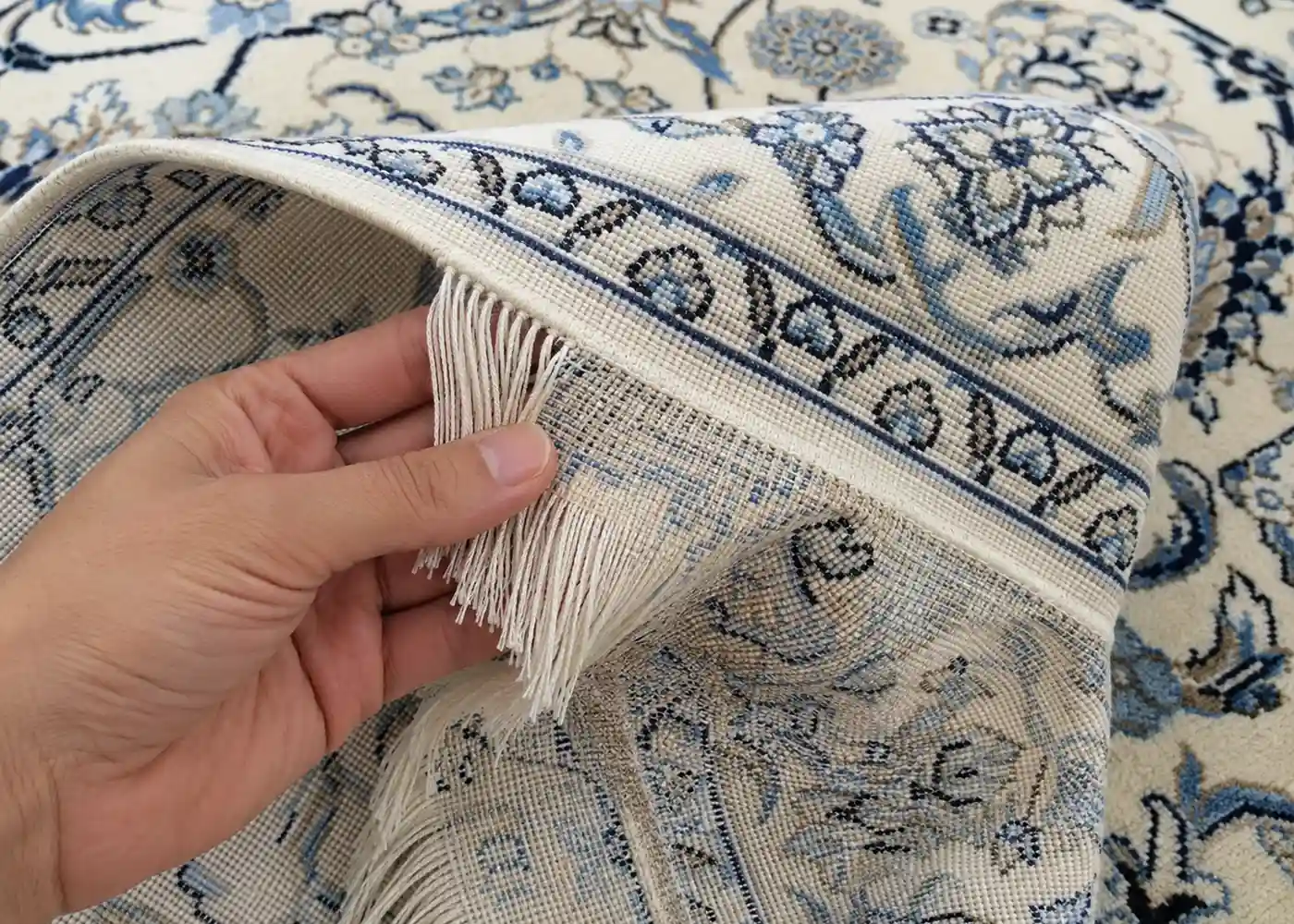
The design should be formed by the knot structure and remain visible from the reverse. Avoid rugs with glued, latex, synthetic mesh, or fabric-covered backs.
In a hand-knotted rug, the fringes are the ends of the warp foundation, not decorative tassels sewn onto a finished edge.
Fine Nain weaving should appear controlled, but slight human variation is natural. Mechanical perfection can indicate machine production.
Fine wool, cotton foundation, and real silk highlights are common. Synthetic shine, stiffness, or glued construction requires caution.
Look for balanced medallions, smooth curves, controlled borders, and details that remain clear rather than crowded or blurry.
Ask whether the rug is Nain, Nain-area, or Nain-style. Honest descriptions should separate geographic origin from design influence.
For a complete structural checklist, use our guide on
how to identify an authentic Persian rug.
You can also compare the construction differences in
Handmade vs Machine-Made Rugs.
What Determines the Quality and Value of a Nain Rug?
The market value of a handmade Nain rug is determined by a combination of characteristics. No single feature—including La grade, silk content, or age—can establish value by itself.
- Authentic origin: A documented Nain origin generally supports stronger value than an unidentified Nain-style reproduction.
- La grade and actual knot density: Finer construction can increase labor, precision, and rarity, but the grade should be verified.
- Quality of wool: Fine, resilient, lustrous wool improves touch, clarity, durability, and long-term appearance.
- Silk use: Well-placed silk highlights can enhance detail and luminosity. Silk should be evaluated for quality and artistic purpose.
- Design quality: Strong proportions, clear borders, elegant curves, and a well-resolved medallion are signs of superior artistic execution.
- Color harmony: A balanced palette and attractive aging can influence desirability more than a simple list of colors.
- Workshop or maker: Credible attribution to a respected workshop can add collector interest, but signatures require verification.
- Age: Older Nain rugs may be desirable, particularly when they reflect early workshop standards, but age adds value only when combined with quality and acceptable condition.
- Condition: Wear, foundation damage, color run, moth activity, missing ends, reduced borders, stains, and poor repairs can substantially affect price.
- Size and rarity: Large, unusual, or highly usable dimensions may command a premium, especially when fine quality is maintained across the entire carpet.
- Provenance: Original invoices, family history, workshop documentation, exhibition records, or previous professional appraisals can strengthen confidence.
- Current demand: Market value depends on what comparable rugs are actually selling for, not only on old insurance figures or optimistic asking prices.
For a deeper appraisal framework, read our updated guide on
how to value an old Persian rug.
Nain Rugs Compared with Isfahan and Tabriz Rugs
Nain, Isfahan, and Tabriz are all associated with sophisticated city weaving, but each has its own visual and technical identity.
| Feature | Nain Rugs | Isfahan Rugs | Tabriz Rugs |
|---|---|---|---|
| Typical palette | Ivory, cream, navy, pale blue, beige, restrained accents | Often rich but controlled palettes with fine contrasts and silk detail | Extremely diverse, ranging from subtle formal palettes to strong reds and pictorial colors |
| Design character | Calm, balanced, floral, medallion-based, architectural | Elegant court-style drawing, refined medallions, highly controlled floral work | Broad variety: Mahi, medallion, floral, pictorial, hunting, architectural, and more |
| Common materials | Fine wool with silk highlights on a cotton foundation | Fine wool and silk, often on a fine foundation | Wool, wool-and-silk, or silk across many grades |
| Local grading term | La system: commonly 9La, 6La, and rare 4La | Usually evaluated through structure, materials, workshop, and density | Raj is commonly used to communicate fineness |
| Interior effect | Light, refined, quiet luxury | Formal, artistic, highly elegant | Can range from understated to dramatic depending on the design |
Are Handmade Nain Rugs Suitable for Everyday Use?
Many Nain rugs can be used on the floor, but placement should match the materials and fineness of the individual piece. A good wool-based 9La Nain may perform well in a carefully maintained living room, bedroom, home office, or formal dining area. A very fine 4La or silk-rich workshop carpet is better suited to controlled, low-traffic use.
Avoid placing a fine Nain rug in an entrance exposed to outdoor grit, wet shoes, or constant heavy traffic. Dirt particles can settle into the foundation and act abrasively against the fibers. Direct, uneven sunlight may also fade one side more quickly than the other.
Furniture can be placed on a Nain rug when the layout is appropriate. Use protective furniture cups beneath narrow or heavy legs and rotate the rug periodically to distribute light and wear. A suitable rug pad can reduce movement, cushion the structure, and prevent friction against hard flooring.
How to Style a HandmadeNain Rug in Modern and Classic Interiors
One reason Nain rugs remain internationally popular is their unusual flexibility. Their light fields and controlled blue tones can bring Persian detail into a room without making the space feel dark or visually crowded.
Modern and Minimalist Living Rooms
In a modern room with white walls, pale wood, beige seating, or a gray sofa, a cream-and-blue Nain rug adds pattern while preserving a calm atmosphere. It works particularly well when the rug is large enough to connect the front legs of the sofa and chairs. Our
guide to Persian rugs for modern living rooms
offers more detailed placement and color advice.
Classic and Formal Rooms
In a classic interior, a central-medallion Nain rug can reinforce symmetry and formal furniture placement. Carved wood, cream upholstery, brass, crystal, dark blue textiles, and traditional art can all connect naturally with the rug’s palette.
Bedrooms
The visual softness of Nain design is well suited to bedrooms. Ivory and pale blue can create a quiet foundation beneath a bed without removing the warmth and individuality of handmade work. Choose a size that extends far enough beyond the bed to remain visible and comfortable underfoot.
Dining Rooms
For dining areas, an all-over design may be practical because the pattern continues around the table even when the center is covered. The rug should be large enough for the chairs to remain on the surface when pulled back. See our
Persian rug size guide for dining rooms
before choosing dimensions.
How to Buy a Handmade Nain Rug Online
A trustworthy online listing should provide enough information to evaluate the individual rug rather than relying on generic claims such as “luxury,” “high quality,” or “museum grade.”
- Exact measurements in both centimeters and feet
- A complete front photograph taken square to the rug
- A clear image of the back showing knot structure
- Close-ups of pile, silk highlights, fringes, corners, and side finishes
- Material details for pile, warp, and weft
- The claimed La grade and how it was verified
- Origin: Nain, Nain-area, or Nain-style
- Approximate age and any supporting evidence
- A complete disclosure of repairs, wear, stains, or color issues
- Shipping, return, and inspection conditions
Do not buy solely from a heavily edited room mockup. Interior photographs are useful for scale and styling, but they should be supported by accurate, evenly lit product images. Color can change between screens, and pile direction can make the same rug appear lighter or darker from opposite ends.
Our guide to
buying authentic Persian rugs online
covers photography, measurements, seller transparency, materials, condition, shipping, and return policies in greater detail.
How to Care for a Handmade Nain Rug
Nain rugs require gentle, consistent care. The combination of fine wool, short pile, silk detail, and a precise cotton foundation can last for generations when protected from abrasion, moisture, harsh chemicals, and careless cleaning.
- Vacuum with suction only. Avoid aggressive rotating brushes and beater bars, especially over fringes and silk details.
- Rotate the rug periodically so that sunlight and walking patterns are distributed more evenly.
- Blot spills immediately with a clean absorbent cloth. Do not rub, scrub, or flood the area.
- Keep the rug away from persistent dampness and never place it on a floor that is not completely dry.
- Use furniture protectors beneath concentrated heavy legs.
- Inspect edges, fringes, and low-pile areas regularly so small problems can be repaired before they spread.
- Use a professional cleaner experienced with hand-knotted wool-and-silk Persian rugs for full washing.
Avoid steam cleaners, household carpet shampoo machines, bleach, strong stain removers, and uncontrolled home washing. Incorrect pH, excess moisture, and uneven drying can cause dye movement, stiffness, shrinkage, or foundation distortion. Read
seven handmade rug care mistakes that reduce lifespan
and our guide to
professional washing intervals for handwoven Persian rugs.
Are Handmade Nain Rugs a Good Investment?
A Nain rug should first be purchased because its design, craftsmanship, scale, and materials suit the buyer. Certain early, rare, exceptionally fine, well-documented, or workshop-attributed carpets can have strong collector value, but not every Nain rug will appreciate financially.
Resale value depends on authenticity, grade, actual quality, condition, rarity, age, provenance, market demand, and the channel through which the rug is sold. Retail price, insurance replacement value, auction estimate, dealer purchase value, and private-sale value are different figures.
The safest approach is to avoid guaranteed-investment language. Buy the best documented and best preserved rug within the budget, keep invoices and condition records, maintain it properly, and treat financial appreciation as a possibility rather than a promise.
Frequently Asked Questions About Handmade Nain Rugs
What makes a Nain rug special?
Nain rugs combine fine city weaving, disciplined floral drawing, restrained ivory-and-blue palettes, quality wool, and carefully placed silk highlights. Their visual character is detailed but calm, which makes them suitable for both traditional and modern interiors.
What is the difference between 9La and 6La Nain rugs?
La refers to the number of plies in a foundation yarn. A 6La foundation is generally finer than a 9La foundation and can support denser, more detailed weaving. However, actual knot density, materials, design, condition, and workmanship must also be compared.
Is 4La the best Nain grade?
Four-La is generally considered the finest and rarest commonly discussed Nain classification. Still, a 4La claim must be verified, and the grade does not replace evaluation of artistic quality, structure, materials, condition, or provenance.
Are all Handmade Nain rugs made with silk?
No. Many Nain rugs use a fine wool pile with silk highlights, while others may use little silk or more extensive silk detailing. The foundation is commonly cotton, although exceptional pieces may use other constructions.
Are Nain rugs always blue and cream?
Blue, navy, ivory, cream, and beige are signature colors, but authentic Nain rugs may also include red, green, brown, gray, burgundy, and other accents. Color alone cannot prove or disprove origin.
How can I tell whether a Handmade Nain rug is handmade?
Check the back for individually formed knots and visible pattern structure, confirm that the fringes continue from the warp, inspect the natural fibers, and look for controlled handmade variation. Glued backing, synthetic mesh, or sewn-on fringe can indicate machine production.
Can a 9La Nain rug be high quality?
Yes. A well-woven 9La Nain can offer fine detail, quality materials, strong durability, and excellent artistic value. It is inaccurate to treat every 9La rug as low grade simply because 6La and 4La classifications are finer.
Can I place a Nain rug in a living room?
Yes, especially when the rug has a durable wool pile and the room is maintained carefully. Extremely fine, silk-rich, antique, or rare examples are better placed in controlled lower-traffic spaces.
Is a signed Habibian rug automatically authentic?
No. A woven signature can be copied. Genuine attribution should be supported by construction, design, materials, age, workshop characteristics, and credible provenance.
What should I check before buying a Nain rug?
Verify origin, dimensions, materials, La grade, back structure, actual condition, repairs, fringe and edge integrity, color accuracy, seller reputation, shipping terms, and return conditions.
Final Thoughts
Handmade Nain rugs represent one of the most refined achievements of modern Persian city weaving. Their history may be younger than that of several famous Iranian carpet centers, but their technical discipline, fine wool, silk detailing, balanced medallions, architectural curves, and quiet color harmony have earned them an important place in homes and collections around the world.
Understanding Nain requires more than recognizing a cream field and blue medallion. The informed buyer studies the foundation, Persian knot structure, pile, silk use, La grade, actual density, design, condition, workshop attribution, and origin. This complete evaluation protects against misleading labels and also reveals why two visually similar Nain rugs may differ greatly in quality and value.
Whether you choose a practical 9La wool-and-silk carpet, a finer 6La piece, or a rare collector-grade example, the best rug is one whose craftsmanship is honestly described and whose scale, materials, colors, and condition fit its intended setting.
Explore Handmade Nain Rugs
Discover individually selected Nain rugs in refined ivory, blue, navy, red, green, and neutral palettes. Each available piece includes its own dimensions, materials, design character, and product photographs.