

Artificial Aging in Antique Rugs: Detection Guide
Discover how newer rugs are made to look antique through chemical washing, fading, clipping,…
Article Guide
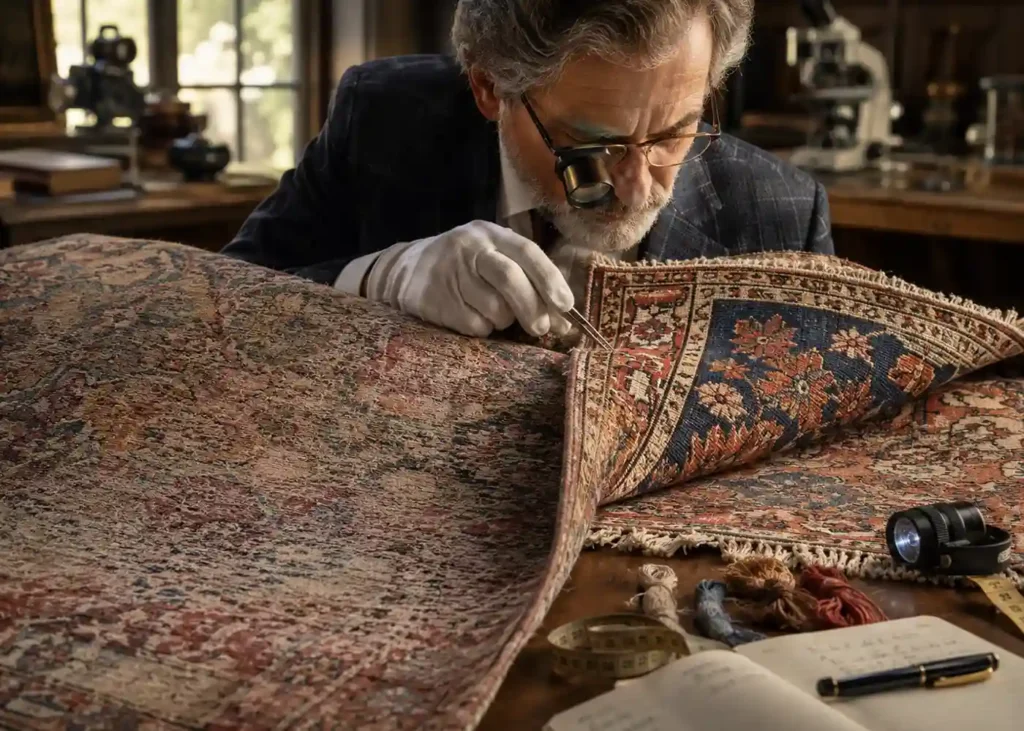
Antique Rug Authentication & Buyer Protection
Artificial aging in antique rugs can make a newly woven or relatively recent rug appear decades older than it actually is. Muted colors, low pile, softened wool, darkened fringes, irregular wear, and a dusty-looking surface can all be produced or intensified after weaving. Some of these finishes are openly sold as “antiqued,” “distressed,” or “vintage style.” The serious problem begins when a newer rug is represented as a genuinely antique textile without clear disclosure.
Artificial Aging in Antique Rugs: What It Means
Artificial aging in antique rugs is a broad term for post-weaving treatments intended to make a rug appear softer, older, more worn, or more visually subdued than it looked when it left the loom. In the contemporary interiors market, this may be a legitimate decorative finish. A new hand-knotted rug described accurately as antiqued, distressed, stone-washed, vintage inspired, or chemically washed is not automatically fraudulent.
Misrepresentation occurs when the treatment is concealed and the altered appearance is used as evidence for a false age, origin, condition, or market value. A seller may also create confusion through vague language—calling a rug “old world,” “heritage,” “museum style,” or “antique finish”—while avoiding a clear statement of when it was woven. The buyer should therefore separate two questions:
- Was the rug intentionally finished to look aged?
- Is the claimed date and history supported by independent evidence?
For United States customs classification, an antique under Chapter 9706 must be more than 100 years old, and proof of age may be required. Commercial rug terminology is less consistent: “vintage” and “semi-antique” are commonly used by the trade but do not have one universal legal definition. For a practical overview of age categories and structural dating clues, see how to tell the age of a Persian rug.
How Genuine Aging Develops in a Hand-Knotted Rug
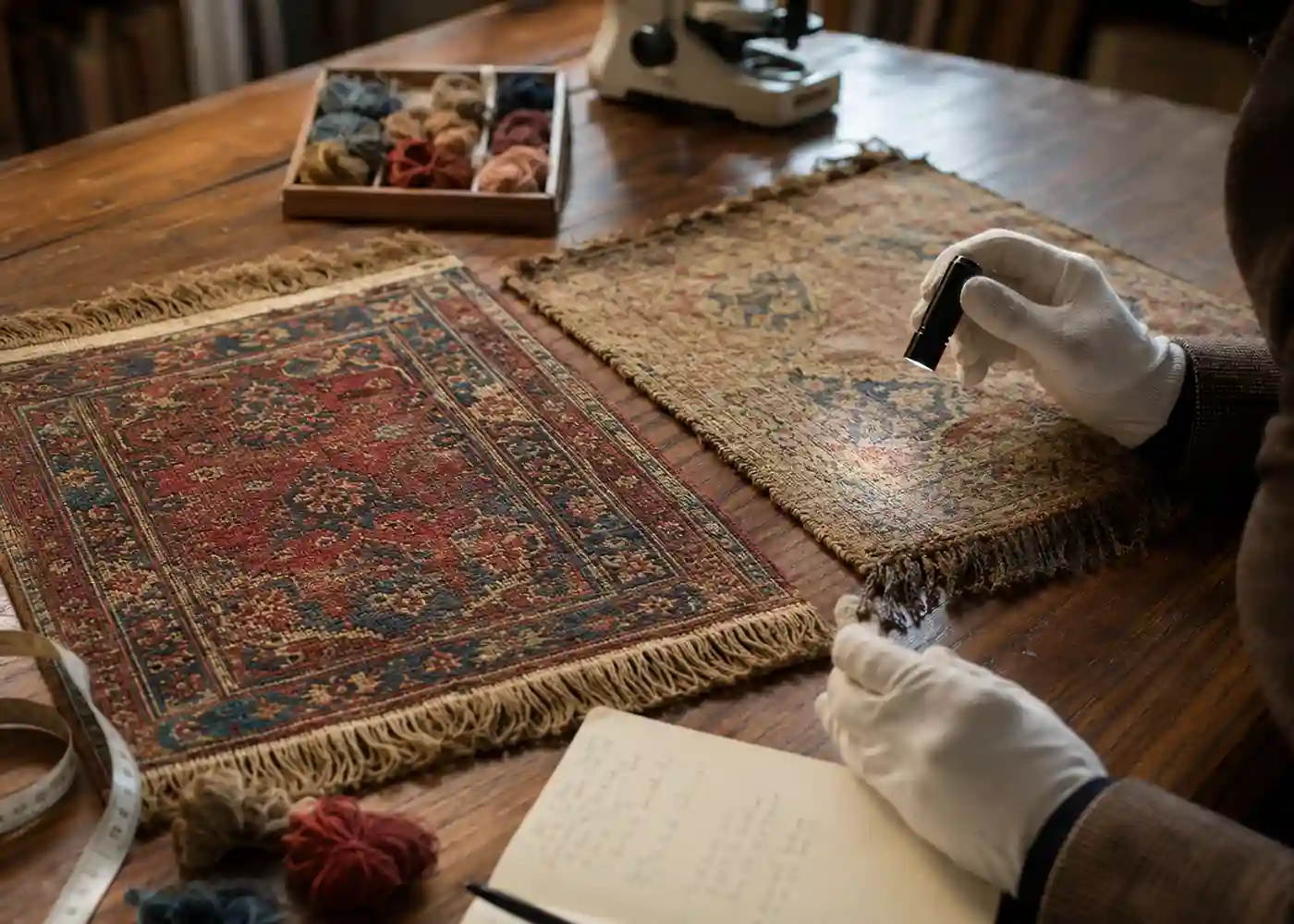
Natural aging is not one visual effect. It is the cumulative result of light exposure, foot traffic, dust, cleaning, humidity, oxidation, storage, repairs, fiber chemistry, dye chemistry, and the rug’s original construction. These processes do not act uniformly.
Wear follows use and construction
In a genuinely used rug, pile loss normally corresponds to how the rug was walked on, placed, rotated, folded, or covered by furniture. High-traffic zones may wear faster, but borders, corners, protected areas, and spaces under furniture can retain more pile. The exact pattern depends on the room and history of use. Genuine wear also develops in relation to knot direction, pile height, wool quality, foundation tension, and earlier repairs.
Natural wear is therefore usually structurally coherent. The pile, knot collars, exposed foundation, side finishes, ends, and back should tell a compatible story. A low surface alone is not proof of age: a new rug can be woven with a low pile, clipped after weaving, or mechanically distressed.
Light causes cumulative and irreversible change
Light can fade dyes and chemically degrade textile fibers. Museum conservation guidance treats light damage as cumulative and irreversible, which is why vulnerable carpets and textiles are displayed at controlled light levels or rotated. Fading may be stronger near windows or on exposed sections and weaker under furniture, folds, or overlapping textiles.
Sunlight does not simply create an attractive “antique palette.” It can also weaken wool, alter yellowing, reduce tensile properties, and produce different responses among dyes. Natural dyes are not uniformly lightfast: studies of dyed wool have shown substantial differences among sources such as weld, madder, and turmeric. A believable old rug may therefore show color-specific fading rather than one evenly muted filter across every yarn.
Patina is more than shine
Collectors use patina to describe the mature surface character of an older textile: a combination of softened color, fiber polish, low or compressed pile, subtle variation, and evidence of use. Patina is not equivalent to gloss. Chemical or mechanical treatment can make wool unusually shiny, slick, fuzzy, dry, or soft, but these effects do not reproduce the rug’s full structural history.
The back ages differently from the face
The back is usually protected from direct abrasion and receives less light than the face. It preserves knot structure, weft configuration, yarn spin, old repairs, foundation oxidation, and differences between original and replacement materials. For that reason, a rug that looks convincingly old from the front may become much less convincing when turned over.
Before any discussion of age, confirm that the object is truly hand-knotted rather than mechanically produced. The guide to handmade vs machine-made rugs explains the foundational differences visible on the back, fringe, edges, and pattern structure.
How Newer Rugs Are Made to Look Old
Artificial aging in antique rugs may involve several post-weaving treatments, including color-suppressing washes, surface staining, pile clipping, mechanical abrasion, accelerated fading, and artificial darkening of fringes or foundations. The appearance produced by these methods can be convincing, but it does not establish genuine age.
1. Color-suppressing or “antique” washes
Commercial finishing services openly advertise antique washes that mute bright colors and create a faded appearance. Industry descriptions commonly refer to controlled bleaching, oxidation, or chemical washing in light, medium, or heavy levels. Historically, “chemical conditioning” was also used to subdue intense colors and change the surface character of modern Oriental rugs.
The visual result may be attractive: reds become dusty rose or brick, blues become grayer, and contrast is reduced. The treatment does not establish age. Depending on the chemistry, fiber, dye, rinsing, and aftercare, aggressive processing may also alter the wool surface or reduce mechanical durability. Research on harsh alkaline damage to wool has shown that chemical processing can remove or damage outer fiber layers and reduce strength.
2. Tea, henna, gold, or brown over-washes
A translucent brown, gold, or greenish surface tone may be applied to soften the palette, darken pale foundations, or create the impression of accumulated age. In the rug-care trade, these finishes are often called tea wash, henna wash, gold wash, or antiquing. The name does not guarantee that actual tea or henna was used; commercial formulations vary.
Because some coatings behave more like stains than fiber-bound dyes, they may fade, migrate, bleed, or wash out unevenly during later cleaning. Fringes can become mottled when a superficial tone is removed. A brownish fringe is therefore not reliable evidence of age, and a cleaning-related color change does not necessarily mean the cleaner damaged an original antique dye.
3. Pile clipping and surface shearing
After chemical finishing or as a separate design choice, the pile may be clipped lower to sharpen the pattern, remove fuzziness, or imitate long-term wear. Historical descriptions of rug conditioning mention mechanical shearing after chemical baths. Modern low-pile and distressed rugs may also be intentionally shaved during production.
Clipping differs from natural wear. Cutting shortens fibers from above; walking gradually bends, polishes, breaks, and removes fibers in a use-related pattern. Under magnification, cut ends, broken ends, flattened fibers, and chemically altered surfaces can present different morphologies, although interpretation requires expertise and comparative samples.
4. Mechanical distressing and abrasion
Surface abrasion can reduce pile height, expose small areas of foundation, soften outlines, and create apparent traffic paths. The effect may be applied broadly or concentrated in selected zones. Some modern decorative rugs are legitimately sold with this finish.
Artificial abrasion often becomes suspicious when the “wear” looks visually dramatic but does not continue logically into the sides, ends, back, knot collars, or foundation. Repeated decorative patches, evenly distributed bald spots, and abrasion that ignores the geometry of actual use deserve closer examination.
5. Accelerated light exposure or deliberate fading
Light exposure can be used to lower color saturation, but real photodegradation is chemically complex. Different dyes and fibers respond at different rates; exposed and protected locations also diverge. A rug that has been faded rapidly may show strong face-to-back color contrast, uneven fiber condition, or fading that does not match its supposed use history.
Light exposure alone does not create credible age. It may change color while leaving the back, foundation, edge construction, repairs, and weaving materials unmistakably recent. It can also cause real, permanent damage rather than a harmless cosmetic effect.
6. Artificially darkened fringes, ends, and foundations
Fresh white cotton can make a newer rug look obviously recent. Surface toning, staining, dirtying, or coating may therefore be used to make fringe and foundation yarns look cream, gray, tan, or oxidized. The same treatment may be placed on the back to reduce brightness.
Genuine foundation aging is normally more complex than a uniform color. It may include differential oxidation, old dust within the structure, abrasion at contact points, localized repairs, compression, and changes in yarn strength. A surface coating can imitate color but not automatically reproduce these structural relationships.
7. Simulated repairs, missing areas, and altered finishes
Repairs can be genuine evidence of an object’s life, but they can also be added, exaggerated, or cosmetically arranged to imply a longer history. New side overcasting may be toned to look old; fringes may be cut, replaced, reduced, or stained; patches may be inserted; and intentionally irregular finishing can be presented as age.
Equally important, a genuinely old rug may contain substantial later restoration. The Metropolitan Museum of Art has documented historic carpets with hundreds of old patches and tight repair stitches that distorted the original structure. A repair is therefore not proof of either authenticity or fraud. Its materials, technique, location, and relationship to the original structure must be evaluated.
8. Luster and texture conditioning
Some treatments alter the wool’s surface to increase sheen, reduce harshness, or create a silky handle. A glossy surface can be mistaken for naturally polished old wool or even for silk. Conversely, aggressive finishing may leave wool dry, brittle, fuzzy, unnaturally slick, or directionally shiny.
Touch and sheen are useful observations but not definitive tests. Wool type, spinning, pile direction, cleaning history, lanolin, chemical finishing, and photography all affect appearance. When material identification matters, compare the observations with the technical distinctions in wool vs silk Persian rugs.
| Artificial-aging effect | What it tries to imitate | Possible red flags | Why the clue is not conclusive alone |
|---|---|---|---|
| Muted chemical wash | Decades of color mellowing | Uniform suppression, altered handle, sharp front/back contrast | Some authentic old rugs were historically washed or treated |
| Brown or gold over-wash | Oxidation, dust, warm patina | Surface-only tone, mottling, color transfer, stained fringe | Natural soiling and old cleaning can also change tone |
| Pile shearing | Long-term pile loss | Evenly clipped surface, cut fiber ends, preserved structure beneath | Some weaving traditions originally used low pile |
| Mechanical abrasion | Traffic wear | Decorative or repeated bald areas, wear unrelated to edges and foundation | Unusual room use can create unexpected natural wear |
| Accelerated fading | Long light exposure | Extreme face/back difference, color changes without structural age | Genuine rugs can also fade dramatically near windows |
| Darkened fringe/back | Foundation oxidation and embedded age | Uniform coating, protected inner fibers remain bright, unstable stain | Replacement fringes can exist on genuine antiques |
| Added “old” repairs | A long history of use | Repairs with identical materials, artificial placement, inconsistent wear | Real antiques may contain both old and new repairs |
How Experts Detect Artificial Aging in Antique Rugs
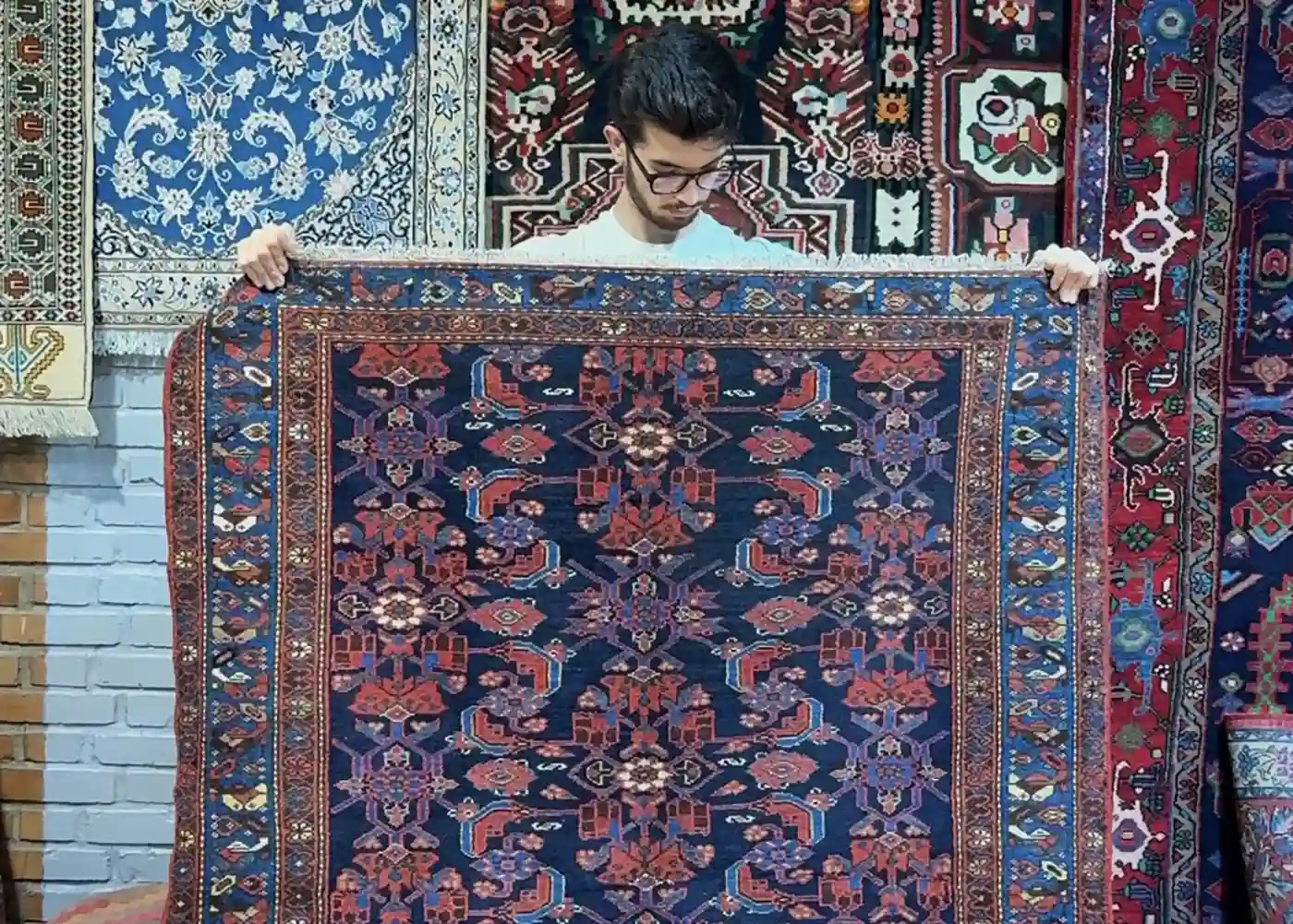
Detecting artificial aging in antique rugs requires more than judging color, softness, or apparent wear. An expert tests whether independent features agree with the proposed date, origin, condition, and history. The most reliable approach is comparative and evidence-based.
Step 1: Demand a precise claim
“Antique style” is not a date. Ask the seller for a written age range, country and region of origin, material description, construction method, known restoration, and disclosure of any distressing, over-dyeing, chemical washing, resizing, re-piling, or fringe replacement.
In high-value transactions, the invoice should distinguish fact from opinion. “Circa 1920” is an attribution; “more than 100 years old” is a specific age claim; “antiqued finish” is a treatment description. These statements should not be blurred together.
Step 2: Read the rug from the back first
The back reveals knot structure, warp and weft materials, yarn spin, tension, repairs, replaced sections, and how deeply colors penetrate. Compare the brightness of the back with the front. A difference is normal because the back is protected, but an extreme or chemically abrupt difference can be informative.
Look for a consistent relationship between front wear and back structure. If the face is heavily distressed while the back, edges, foundation, and knots appear exceptionally fresh, the rug may have been cosmetically aged rather than naturally worn.
Step 3: Map wear instead of merely noticing it
Document the location of low pile, exposed foundation, holes, edge wear, end loss, and repairs. Genuine wear often relates to pathways, furniture, doors, folding, rotation, and pile direction. Artificial wear may be visually balanced for design purposes rather than connected to a plausible use pattern.
Do not treat irregularity as automatic proof of handwork or age. Modern distressing is often intentionally irregular. The question is whether the irregularity continues through the object’s construction and history.
Step 4: Compare exposed and protected fibers
Examine pile beside borders, under folded ends, within knots, near old repairs, and in any protected recess. Surface treatments may affect only exposed fiber tips, while original color remains deeper in the pile. This can also happen through natural fading, so the pattern and chemistry of the difference matter.
Step 5: Examine ends and sides
The side cords, overcasting, end finishes, kilim bands, and fringes are vulnerable and frequently repaired. A rug presented as heavily used but retaining untouched, bright, perfectly uniform ends deserves scrutiny. The opposite is also true: deliberately damaged fringes do not prove age.
Step 6: Separate original pile from restoration
Later re-piling can contain different wool, dyes, knotting, pile height, or fluorescence. A synthetic dye in a repaired knot does not date the original rug. Conversely, natural dye in one sampled area does not prove that the entire rug is old. This is why sampling location must be documented.
Step 7: Evaluate color as a system
Experts compare hue, saturation, abrash, fading, dye penetration, and color-specific deterioration. Genuine abrash usually follows batches of dyed yarn and therefore tends to run along weaving progression rather than appear as random decorative clouds. Artificial fading may cross unrelated colors uniformly or create a generalized gray-brown veil.
For a deeper understanding of how age, dyes, condition, materials, and provenance affect market judgment, see the guide to valuing an old Persian rug.
Step 8: Check the claimed design history and origin
A rug may be hand-knotted and artificially aged yet still be a modern reproduction of an older design. Compare knot type, foundation, palette, border system, drawing style, dimensions, and workshop conventions with securely dated examples. Design alone is not enough because historic patterns have been copied for generations.
Step 9: Verify provenance
Useful provenance may include old invoices, dated photographs, estate records, exhibition history, customs documents, collection labels, restoration reports, and earlier appraisals. Provenance should be tested, not merely admired. A recent certificate that repeats the seller’s unsupported claim is not independent evidence.
Laboratory Methods: What Science Can and Cannot Prove
When visual and structural evidence remains uncertain, laboratory testing can help investigate artificial aging in antique rugs by identifying fibers, dyes, coatings, residues, repairs, and incompatible modern materials. Scientific data are strongest when the laboratory records the exact sampling location and interprets the result alongside the rug’s construction and condition.
Microscopy
Stereomicroscopy and polarized-light microscopy help identify fibers, inspect pile tips, document deposits, compare original and restored yarns, and select samples. Scanning electron microscopy can reveal wool cuticle condition and surface damage at much higher magnification.
Microscopy may support a conclusion that fibers were cut, abraded, chemically altered, or degraded, but surface appearance is rarely a unique fingerprint of one specific aging process. Cleaning, use, moth damage, previous conservation, and manufacturing can create overlapping effects.
Ultraviolet, infrared, and spectral imaging
Ultraviolet-induced fluorescence can reveal repair yarns, coatings, residues, stains, and differences among visually similar areas. Infrared and multispectral techniques may map changes across a large surface without removing samples. These methods are valuable for locating anomalies, not for assigning age automatically.
Dye analysis by HPLC or LC-MS
Chromatography and mass spectrometry can identify natural colorants, early synthetic dyes, modern synthetic dyes, mixtures, and restoration yarns. An anachronistic dye in original pile may establish that the rug cannot predate the dye’s introduction. However, the conclusion depends on proving that the sampled yarn is original.
Natural dye identification does not prove age because natural dyes continue to be used today. Likewise, synthetic dyes do not automatically prove fraud: authentic hand-knotted rugs have contained synthetic dyes since the late nineteenth century, and old rugs frequently contain later repairs.
Elemental analysis
X-ray fluorescence and SEM-EDS can detect elements associated with mordants, pigments, residues, deposits, and fiber deterioration. These methods usually do not identify the organic dye molecule directly. A detected element may come from original dyeing, soil, treatment, contamination, or conservation materials, so context is essential.
FTIR and related material analysis
Fourier transform infrared spectroscopy can support fiber identification and detect some coatings, adhesives, degradation products, or treatment residues. Weak dye signals may be masked by wool, silk, cotton, dirt, and conservation materials. FTIR is therefore often complementary rather than decisive.
Radiocarbon dating
Natural textile fibers can be radiocarbon dated, and accelerator mass spectrometry has been used in carpet authentication. The method dates the organic material sampled—not automatically the moment of weaving. Old stock wool, replaced yarns, contamination, coatings, and sampling errors can complicate interpretation.
Radiocarbon testing is destructive and requires a larger sample than many dye analyses. For relatively recent objects, calibrated date ranges may also be broad, while post-1950 “bomb-pulse” carbon can be useful for identifying modern material. A responsible laboratory should explain pretreatment, contamination controls, calibration, confidence intervals, and exactly where the sample came from.
| Method | Useful question | Potential contribution | Major limitation |
|---|---|---|---|
| Stereomicroscopy / PLM | Are fibers, repairs, and pile tips consistent? | Fiber context, cut ends, damage, sample selection | Usually cannot establish a date by itself |
| SEM | Is the wool surface altered or degraded? | High-resolution fiber morphology | Different processes can create similar damage |
| UV / spectral imaging | Where are coatings, repairs, or anomalous yarns? | Non-invasive mapping | Signals are not uniquely age-specific |
| HPLC / LC-MS | Which dye molecules are present? | Detects natural, synthetic, mixed, or restoration dyes | Requires sampling and historical interpretation |
| XRF / SEM-EDS | Which elements or mordant-related materials occur? | Elemental evidence and residue mapping | Does not usually identify organic dye directly |
| FTIR | Are coatings, fibers, or degradation products present? | Material characterization | Complex mixtures may be ambiguous |
| Radiocarbon dating | When did the sampled organism stop exchanging carbon? | Objective age range for organic material | Dates material, requires destructive sampling, contamination matters |
A Buyer’s Checklist for a Rug Claimed to Be Antique
Because artificial aging in antique rugs can imitate several familiar signs of age, buyers should verify the seller’s claim before relying on muted color, low pile, darkened fringes, or visible distressing.
- Get the age claim in writing. Ask for a date range, not only words such as “old,” “vintage,” “heritage,” or “antique style.”
- Request photographs of the entire back. Include close-ups of knots, warps, wefts, sides, ends, fringes, low-pile areas, and repairs.
- Ask about post-weaving treatments. Chemical washing, tea or gold wash, over-dyeing, distressing, clipping, resizing, bleaching, re-piling, and fringe replacement should be disclosed.
- Compare wear with structure. Heavy face wear should have a believable relationship to knot collars, foundation, ends, sides, and use history.
- Identify restoration separately. Ask which portions are original and which have been re-knotted, rewoven, overcast, patched, or replaced.
- Check the material claim. Wool, silk, cotton, and artificial silk require different tests and have different aging behavior.
- Review provenance critically. Look for dated records and independent documentation, not only a new certificate produced at sale.
- Use an independent specialist for expensive purchases. The appraiser or conservator should not have a financial interest in the transaction.
- Do not authorize cleaning before documentation. Treatment can remove residues, alter coatings, mobilize unstable stains, or erase evidence relevant to the examination.
- Match price to certainty. An uncertain attribution should not be priced as a fully documented antique masterpiece.
Questions worth asking the seller
- What is the estimated weaving date, and what evidence supports it?
- Is “antique” being used to describe actual age or only the finish?
- Has the rug been chemically washed, over-dyed, tea-washed, clipped, bleached, distressed, or artificially faded?
- Are the fringes and side finishes original?
- Which areas have been restored or re-piled?
- Are any parts assembled from another rug or later material?
- Can the age and condition statements be included on the invoice?
- Can I obtain an independent condition report before purchase?
- What is the return policy if the stated age or material is disproved?
Explore Arghavan Rugs’ old and antique rug collection, where each available rug can be evaluated as an individual object rather than selected from a generic stock image.
What a Professional Artificial-Aging Examination Should Contain
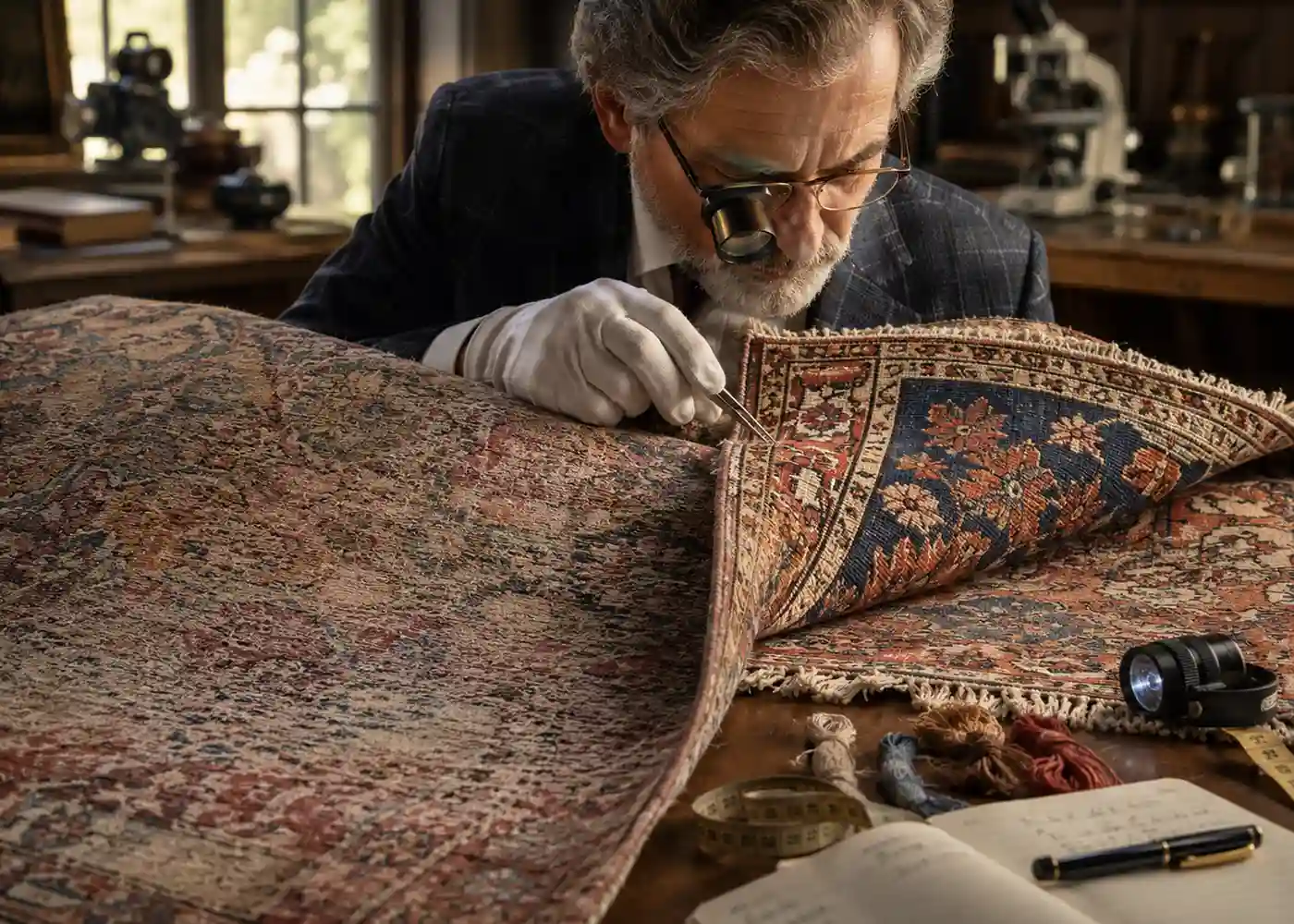
- Object identification: dimensions, materials, construction, claimed region, claimed date, seller’s description, and ownership history.
- Photography: overall front and back, raking light, pile-direction views, sides, ends, fringes, repairs, stains, holes, and sampling locations.
- Structural analysis: knot type, knot count where relevant, warp and weft materials, yarn spin, ply, end finishes, side finishes, and evidence of alteration.
- Condition map: pile loss, exposed foundation, fading, corrosion, moth damage, distortion, re-piling, inserted patches, coatings, and unstable areas.
- Treatment assessment: evidence consistent with clipping, over-washing, staining, bleaching, coating, artificial fading, or mechanical distressing—while distinguishing observation from confirmed process.
- Scientific methods: instrument, sample size, sample location, preparation, reference materials, spectra or chromatograms, and limitations.
- Dating language: confirmed date, probable period, broad attribution, or unresolved result—not false precision.
- Restoration statement: original versus replacement materials and whether restoration affects interpretation or value.
- Conclusion with confidence level: what is supported, what remains uncertain, and which additional tests would be meaningful.
Condition and authenticity also affect financial judgment. A chemically distressed newer rug may still have decorative value, but it should not receive an antique premium. Conversely, a genuine antique can remain valuable despite wear when rarity, design, craftsmanship, provenance, and restoration quality justify it. For a broader market framework, read whether Persian rugs can be a smart investment.
Common Myths About Artificially Aged Rugs
Frequently Asked Questions
Can an artificially aged rug still be handmade?
Yes. A rug may be genuinely hand-knotted and still receive chemical washing, clipping, over-dyeing, distressing, or artificial fading after weaving. Handmade construction and antique age are separate questions.
Is an “antique wash” always deceptive?
No. It is a legitimate decorative finish when disclosed accurately. It becomes misleading when the finish is used to support a false claim that the rug itself is genuinely antique.
Can I identify chemical washing by smell?
Odor may suggest residues, storage problems, mold, cleaning products, or treatment, but it is not a reliable authentication test. Some treated rugs have little odor, and genuine old rugs may smell because of storage or contamination.
Does artificial aging damage wool?
It can. The risk depends on chemistry, concentration, duration, temperature, rinsing, fiber quality, and later cleaning. Research confirms that harsh alkaline and oxidative processing can damage wool’s surface structure and mechanical properties. A visually successful finish is not proof that the fiber remains undamaged.
What is the strongest visual warning sign?
There is no single strongest sign. A major inconsistency—such as heavily worn-looking pile combined with exceptionally fresh foundation, ends, sides, and back—is more meaningful than one isolated clue.
Can laboratory testing prove that distressing occurred?
Sometimes it can identify coatings, residues, altered fibers, modern dyes, replacement yarns, or recent organic material. In many cases, the result is a weight of evidence rather than identification of one exact treatment recipe.
Should an antique rug be cleaned before appraisal?
Usually it should be documented and examined first. Cleaning may remove unstable surface tones, residues, dust patterns, or coatings that are relevant to condition and treatment history. Valuable rugs should be handled according to professional conservation principles; see handmade rug care mistakes that reduce lifespan.
Can a genuine antique have an unusually uniform surface?
Yes. A rug may have been displayed with little foot traffic, stored for long periods, professionally restored, or evenly used. Uniformity is a clue to investigate, not proof of artificial aging.
Does age automatically increase value?
No. Value also depends on origin, artistic quality, materials, rarity, condition, provenance, size, restoration, collector demand, and market context. A newer exceptional rug can be more valuable than an ordinary or severely compromised antique.
Final Conclusion
Artificial aging in antique rugs can be highly convincing because many buyers associate muted color, soft wool, low pile, dark fringe, visible wear, and irregularity with genuine age. Yet each of these characteristics can be produced, intensified, repaired, replaced, or photographed in a misleading way. The solution is not a single trick or home test. It is disciplined examination.
A credible age attribution begins with the back and foundation, maps wear across the structure, distinguishes original material from restoration, studies dyes and fibers in context, verifies provenance, and states uncertainty honestly. Scientific methods can strengthen the conclusion, especially when they detect anachronistic dyes, modern material, coatings, or inconsistent repairs, but science must be tied to the exact yarn and location tested.
The clearest ethical standard is simple: an antiqued finish should be sold as an antiqued finish. A true antique claim should be supported by coherent structural, material, historical, and documentary evidence.
Scientific and Technical References
- U.S. Customs and Border Protection. “Duty on Personal and Commercial Imports of Antiques and Artwork.” Defines antiques for U.S. customs purposes as objects over 100 years old and notes the need for proof of age. View source.
- United States International Trade Commission. Harmonized Tariff Schedule, Chapter 97, heading 9706: “Antiques of an age exceeding 100 years.” View source.
- Feller, Robert L. Accelerated Aging: Photochemical and Thermal Aspects. Getty Conservation Institute, 1994. Discusses accelerated-aging research, including the effects of light, oxygen, heat, and moisture on wool, dyes, and organic materials. View publication.
- Victoria and Albert Museum. “The Conservation of the Bullerswood Carpet.” Documents controlled display and rotation to reduce cumulative color fading in a fragile historic carpet. View source.
- Victoria and Albert Museum. “Clothworkers’ Fellowship—Completed.” Reports research into dry soil removal and wet-cleaning methods for knotted carpets in the museum collection. View source.
- Museum Conservation Institute, Smithsonian Institution. “Textile Conservation.” Overview of professional examination, documentation, treatment, preventive care, and research for carpets and other textiles. View source.
- Museum Conservation Institute, Smithsonian Institution. “Tips on How to Handle Antique Textiles and Costumes.” Advises against improvised treatment of fragile historic textiles and recommends consultation with a textile conservator. View source.
- Ghosh, A., Grosvenor, A. J., and Dyer, J. M. “Improving the Properties of Chemically Damaged Wool Fabrics with Carbohydrate Polymers.” Journal of Applied Polymer Science 130 (2013): 3105–3111. Reports that harsh alkaline processing can damage wool’s outer layers and reduce strength and durability. View DOI.
- Steenken, I., and Zahn, H. “Determining the Dehydroalanine and Amide Contents of Wool as a Means of Estimating Damage Caused by Alkaline Treatments.” Textile Research Journal 54 (1984). View DOI.
- Yoshizumi, K., and Crews, P. C. “Characteristics of Fading of Wool Cloth Dyed with Selected Natural Dyestuffs on the Basis of Solar Radiant Energy.” Dyes and Pigments 58 (2003): 197–204. Demonstrates dye-specific differences in photofading. View DOI.
- Solazzo, C. et al. “Application of Redox Proteomics to the Study of Oxidative Degradation Products in Archaeological Wool.” Journal of Cultural Heritage 16 (2015): 896–903. Notes that UV-induced damage in historical wool can include yellowing, dye fading, and loss of physical properties. View DOI.
- Gilberg, M., Preusser, F., and McLean, C. “Authenticating an Anatolian Carpet at the Los Angeles County Museum of Art.” Textile Specialty Group Postprints 17. Describes a multi-method carpet authentication study using imaging, spectrometry, x-radiography, weave and dye analysis, and radiocarbon dating. View record.
- Hajdas, I. et al. “Textiles and Radiocarbon Dating.” Radiocarbon 56 (2014): 637–643. Discusses the suitability and treatment of natural textiles for radiocarbon dating. View DOI.
- Margariti, C. et al. “Radiocarbon Dating of Archaeological Textiles at Different States of Preservation.” Heritage Science 11, 44 (2023). Open-access article.
- Smith, G. D., Esson, J. M., Chen, V. J., and Hanson, R. M. “Forensic Dye Analysis in Cultural Heritage: Unraveling the Authenticity of the Earliest Persian Knotted-Pile Silk Carpet.” Forensic Science International: Synergy 3 (2021): 100130. Explains why dye analysis can be a less destructive first step than radiocarbon sampling and why natural-dye results alone do not settle date. View DOI.
- The Metropolitan Museum of Art. “Making the Invisible Visible.” Documents examination and removal of more than 700 historic patches and damaging tight stitches from a carpet, illustrating why repairs must be interpreted rather than assumed to prove age. View source.
- The New Yorker. “About the House” (October 20, 1956). A historical journalistic account of commercial “chemical conditioning,” color suppression, pile shearing, and treatment-related damage in the Oriental rug trade. View archive.
- Rug Wash Inc. “Antique Wash.” A current commercial example openly marketing chemical/oxidative finishing that transforms newer carpets toward an aged, muted appearance. Used here as evidence of disclosed industry practice, not as a conservation recommendation. View source.
- ABC Oriental Rug & Carpet Cleaning Co. “Chemically Washed Rugs” and “Tea Washing.” Trade guidance describing antique washes, luster washes, and unstable surface toning encountered during rug cleaning. Used as practitioner evidence and interpreted cautiously. Chemical treatments; tea washing.
Editorial note: This article is written for buyer education, authentication, and collection care. It does not provide operational instructions for artificially aging rugs. High-value or culturally significant rugs should be examined by an independent specialist and, when treatment is considered, by a qualified textile conservator.