

Handmade Kashan Rugs: Quality, Design & Value Guide
Discover handmade Kashan rugs, including their history, designs, materials, quality signs, value factors, care…
Article Guide
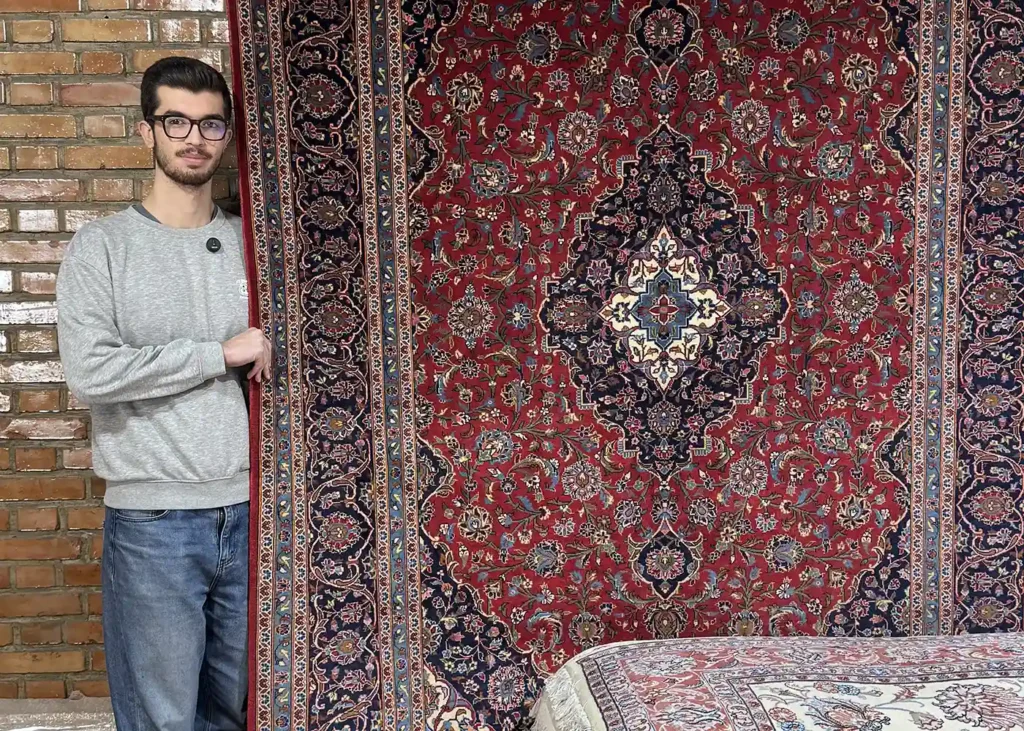
Handmade Kashan rugs are among the most recognizable expressions of classical Persian carpet design. Known for balanced floral compositions, elegant central medallions, rich reds, deep blues and refined wool craftsmanship, these rugs bring together beauty, durability and a strong regional identity.
However, not every rug described as “Kashan” offers the same quality or value. Materials, knotting, wool quality, condition, age, design clarity and previous restoration can all change what a rug is worth and how suitable it is for daily use.
This complete guide explains how handmade Kashan rugs are made, how to recognize their traditional designs, what separates an excellent example from an average one and what buyers should examine before choosing a rug. You can also browse the current
handmade Kashan rug collection
at Arghavan Rugs.
A genuine handmade Kashan rug is generally recognized by its hand-knotted construction, curvilinear floral drawing, carefully organized borders and either a central medallion or an all-over floral layout. Quality should be judged through the whole rug—not knot count alone.
What Is a Handmade Kashan Rug?
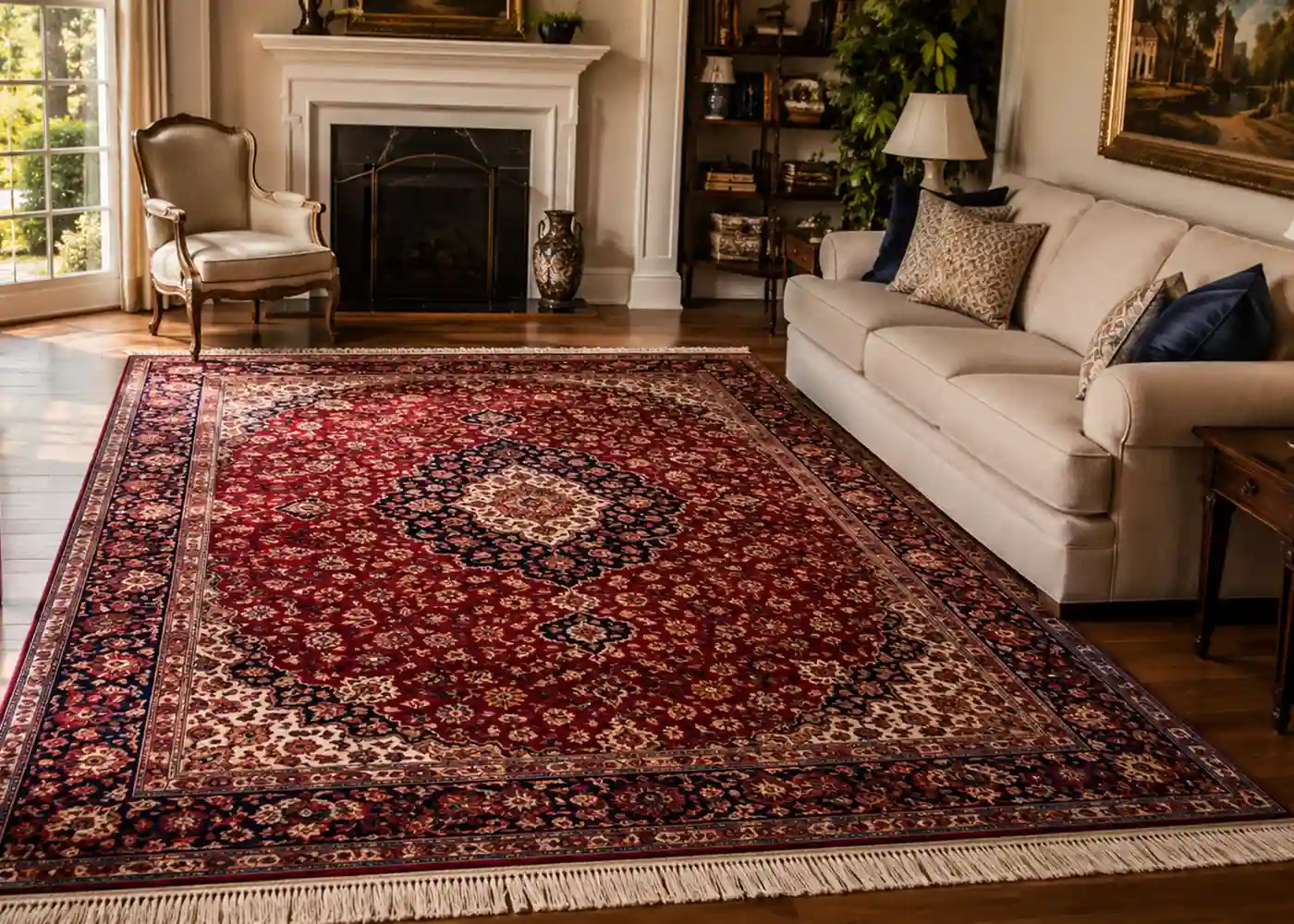
A handmade Kashan rug is a Persian pile rug associated with the historic weaving city and surrounding region of Kashan in central Iran. In the modern rug market, the name usually describes rugs that follow the recognizable Kashan tradition: finely drawn floral patterns, disciplined symmetry, multiple borders and a sophisticated city-rug appearance.
Most traditional examples are hand-knotted rather than machine-produced. Every section of the design is created by tying individual pile knots around the rug’s foundation. This labor-intensive construction gives handmade rugs subtle variations and structural character that mass-produced carpets cannot reproduce.
If you are unfamiliar with the construction difference, read our comparison of
handmade vs machine-made rugs.
It explains why the back, fringe, pattern alignment and texture are important when examining a Persian rug.
Kashan rugs belong to the larger family of refined Persian city rugs. While village and tribal carpets may use bolder geometric forms, city rugs such as Kashan, Tabriz, Nain and Isfahan generally rely on carefully planned designs, curved floral drawing and greater technical precision. Our
complete Persian rug styles guide
provides a broader comparison of these regional traditions.
The History of Kashan Rug Weaving
Kashan has a long history as a center of luxury textile production. During the Safavid period, the region became associated with highly sophisticated silk weaving and court-level textile arts. Museum collections preserve a number of extraordinary sixteenth-century carpets attributed to Kashan, including silk examples woven with asymmetrical knots.
These early museum carpets should not be treated as identical to every modern Kashan rug. They represent an elite historical tradition, often produced with luxurious materials and complex figural or medallion compositions. Nevertheless, they demonstrate that Kashan had an important relationship with fine textile production centuries ago.
Kashan carpet weaving experienced different periods of development, decline and revival. By the late nineteenth century, exceptionally refined workshop rugs associated with the name “Mohtasham” helped reinforce Kashan’s reputation in the international antique carpet market. Today, the term Mohtasham is commonly connected with particularly fine antique Kashan rugs, although attribution should always be handled carefully and supported by structure, age, condition and expert examination.
a dealer’s label is not enough to establish age, workshop or maker. An important antique Kashan rug should be assessed through its construction, materials, repairs, documented history and comparison with recognized examples.
Kashan Rug Designs and Patterns
The visual identity of a Kashan rug usually comes from order, refinement and rhythmic floral movement. The design is often symmetrical and organized around a clear central structure.
Central medallion and corner design
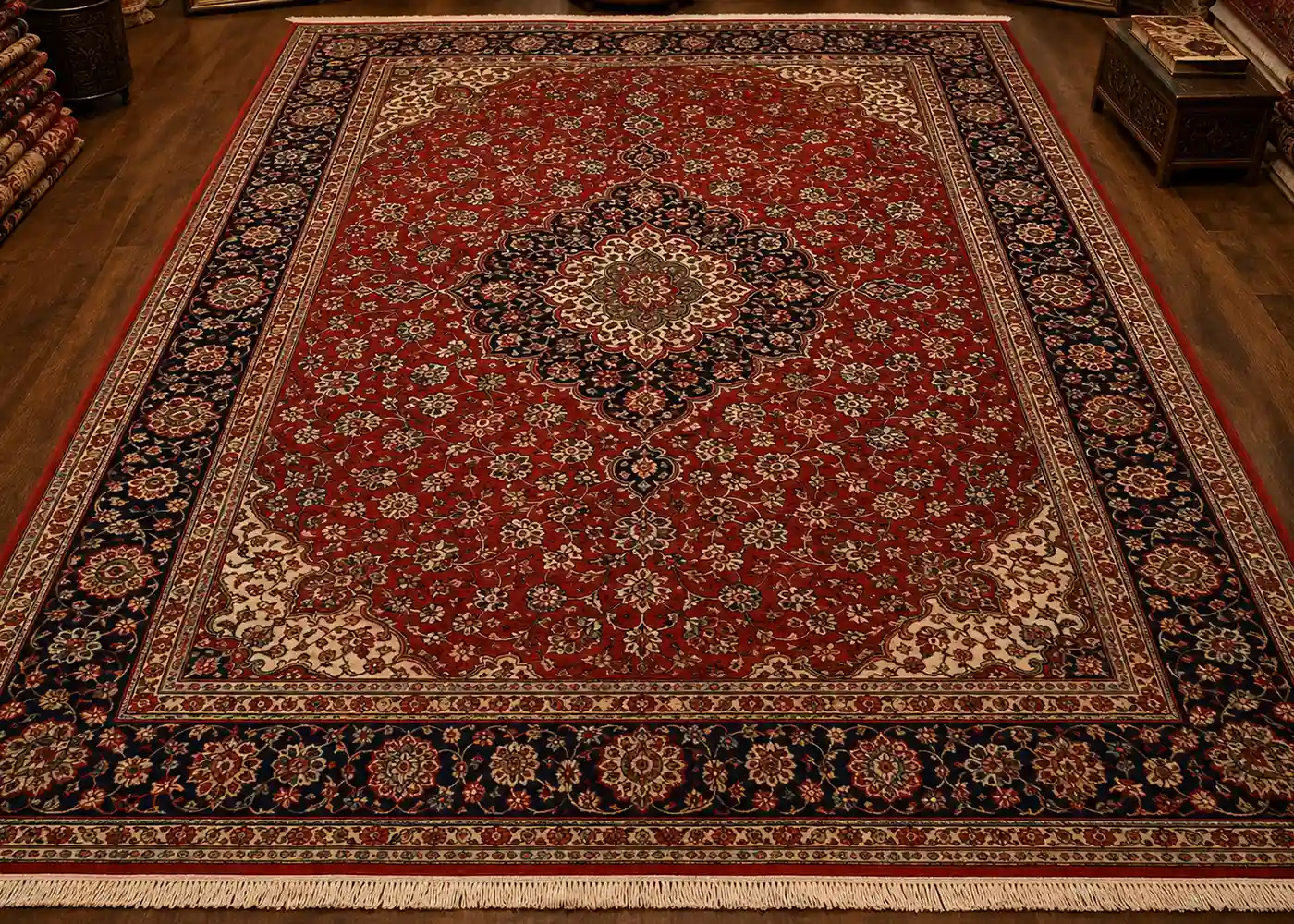
The best-known Kashan layout features a central medallion surrounded by scrolling vines, flowers, palmettes and smaller decorative elements. Four corner sections repeat or visually respond to the medallion, creating a balanced medallion-and-corner composition.
The medallion may be circular, oval, lobed or star-shaped. Pendants can extend from its upper and lower points, helping connect the center with the surrounding field.
All-over floral design
Not every Kashan rug has a central medallion. Some use an all-over arrangement of repeating floral branches, palmettes or arabesques. An all-over design can be especially practical under dining tables because the composition does not depend on keeping one central motif fully visible.
Shah Abbasi flowers and palmettes
Many classical Persian carpets use stylized flowers and palmettes commonly associated with Shah Abbasi design traditions. In Kashan rugs, these motifs may appear throughout the field and principal border, connected by delicate curved vines.
Vase, tree and pictorial designs
Less common Kashan rugs may feature vase arrangements, trees, animals, hunting imagery or pictorial subjects. These pieces should be evaluated individually because rarity alone does not guarantee quality. The drawing must still be coherent, the weaving controlled and the condition appropriate for the rug’s age.
Traditional Kashan Rug Colors
Classic Kashan rugs are often associated with rich, confident colors. A deep red or lacquer-red field combined with navy, ivory, blue, green, rose and warm beige accents is especially recognizable.
Common Kashan color combinations include:
- Deep red field with navy medallion and border
- Ivory field with red, blue and floral accents
- Dark blue field with ivory and red detailing
- Warm beige or camel tones with muted floral drawing
- Soft blue, rose and green details within a red composition
Color should be evaluated as a complete palette. Strong colors are not automatically better, and pale colors are not automatically more valuable. What matters is harmony, clarity, dye stability and the way the colors have aged together.
Older rugs may display abrash—subtle changes in color caused by different dye batches or variations in hand-dyed yarn. Abrash can be part of a handmade rug’s character, but abrupt or unnatural discoloration may also result from fading, chemical treatment, staining or repair.
Materials and Construction of Kashan Rugs
Wool pile
Many handmade Kashan rugs use wool for the pile. Good wool should feel resilient, not lifeless or brittle. It should hold color well and recover reasonably after being pressed.
The quality of wool affects:
- Softness and surface sheen
- Durability under foot traffic
- Color depth and dye absorption
- Clarity after the pile is clipped
- The way the rug ages over time
Cotton foundation
A large number of Kashan rugs are woven on a cotton foundation. Cotton warps and wefts can provide a stable structure and allow the weaver to create controlled curves and detailed floral motifs.
The visible fringe should normally be an extension of the rug’s foundation rather than a decorative fringe sewn onto the finished carpet. Added fringe does not always mean the rug itself is machine-made, but it may indicate repair or later alteration.
Silk and silk highlights
Some fine Kashan rugs use silk details to emphasize flowers, outlines or sections of the medallion. Historical luxury Kashan carpets may be woven extensively or entirely in silk, but buyers should not assume every shiny fiber is natural silk.
For a practical comparison of performance, appearance and daily use, see our guide to
wool vs silk Persian rugs.
The Persian or asymmetrical knot
Kashan rugs are frequently associated with the asymmetrical knot, often called the Persian or Senneh knot in the rug trade. However, a rug should not be identified only by one knot type. Regional attribution requires examination of the entire structure, including warps, wefts, pile, sides, ends, design and color palette.
How to Judge the Quality of a Handmade Kashan Rug
Knot density can help describe the fineness of a rug, but it is not a complete quality grade. A dense rug with poor wool, weak colors or an unbalanced design may be less desirable than a slightly coarser rug with excellent materials and strong artistic character.
| Quality factor | What to examine | Why it matters |
|---|---|---|
| Design clarity | Curves, flowers, outlines and border details | Clear drawing demonstrates control and allows complex motifs to remain readable. |
| Knot consistency | Evenness and regularity on the back | Consistent knotting contributes to a stable structure and controlled design. |
| Wool quality | Resilience, softness, sheen and brittleness | Good wool improves durability, color and long-term appearance. |
| Pile condition | Low areas, exposed foundation and uneven wear | Wear can reduce visual clarity and may affect suitability for daily use. |
| Foundation | Distortion, stiffness, cracks and weak areas | The foundation carries the entire rug and can be costly to stabilize. |
| Edges and ends | Selvedges, fringe loss and unraveling | Damage can spread inward if not professionally secured. |
| Color | Harmony, fading, bleeding and retouching | Color condition strongly influences beauty and market appeal. |
| Repairs | Reweaving, patches, painted areas and replaced fringe | Professional restoration differs greatly from concealed or poor-quality repair. |
Look beyond knot count
A higher knot count may allow finer curves and smaller details, but it does not automatically make a rug more beautiful, older or more valuable. Knot density should be considered alongside wool, drawing, color, proportions, condition and rarity.
Check whether the rug lies flat
A well-structured rug should normally rest evenly on the floor. Minor irregularities can occur in handmade carpets, but significant rippling, curling or twisting may indicate foundation problems, uneven tension, improper washing or previous damage.
Examine the pile from different directions
Hand-knotted pile has direction. The rug may appear lighter from one end and darker from the other because light reflects differently across the pile. This is normal and should not be confused with fading.
How to Identify an Authentic Handmade Kashan Rug
There is no single test that proves a rug is an authentic Kashan. Use several observations together.
- Inspect the back: the pattern should be created by visible knots rather than printed onto a uniform backing.
- Check the fringe: original fringe should generally continue from the foundation.
- Look for natural variation: minor differences in knotting, line and color are normal in handmade rugs.
- Study the design: traditional Kashan drawing is usually curvilinear, floral and carefully organized.
- Examine the materials: determine whether the pile is wool, silk, a blend or another fiber.
- Review the sides and ends: modern binding, major reconstruction or hidden damage can change value.
- Request detailed photographs: front, back, fringe, corners, edges, close-ups and worn areas.
- Avoid relying only on labels: a certificate or dealer tag should support examination, not replace it.
For a more detailed authentication process, read
how to identify an authentic Persian rug.
What Determines the Value of a Kashan Rug?
The value of a Kashan rug is determined by the relationship between quality, age, condition, size, materials, artistic merit and market demand. Two rugs with similar dimensions can have very different values.
1. Age and period
An older rug may be more collectible when its age is genuine, its design is desirable and its condition remains appropriate. Age alone does not create value. A badly damaged old rug may be less valuable than a younger rug in excellent condition.
2. Condition
Condition is one of the most important value factors. Examine:
- Pile wear and exposed foundation
- Loss at the ends and sides
- Holes, tears and weak areas
- Moth damage
- Stains and color bleeding
- Rewoven sections and patched areas
- Painted or cosmetically retouched pile
3. Materials
High-quality resilient wool, well-used silk and a stable foundation can add desirability. However, the word “silk” should never replace a proper assessment of construction and condition.
4. Design and artistic quality
Collectors often respond to balanced proportions, sophisticated drawing, attractive negative space, unusual colors and coherent border systems. A technically fine rug can still feel visually crowded or poorly organized.
5. Rarity and attribution
A rare design, recognized workshop, signature or documented history may increase interest. These elements must be authenticated. Signatures can be copied, later added or misunderstood.
6. Size and usability
Large room-size Kashan carpets are often desirable for formal interiors, but demand also depends on whether the proportions fit contemporary homes. A rare size can be valuable when it is practical and visually successful.
7. Restoration
Professional conservation can stabilize an important rug, while heavy, poorly matched or concealed restoration may reduce buyer confidence. Always ask what has been repaired and request close-up images.
For more detail about valuation factors, see
how much a Persian carpet may be worth
and our overview of
valuable Persian handmade rugs.
no rug is guaranteed to increase in price. Buy a Kashan rug primarily for its craftsmanship, condition, beauty and suitability for your home. Treat potential appreciation as uncertain rather than promised.
Kashan Rugs vs Other Persian Rug Styles
| Rug style | Typical visual character | Often suitable for |
|---|---|---|
| Kashan | Rich classical colors, floral drawing and medallion compositions | Traditional, transitional and formal interiors |
| Tabriz | Extremely varied designs, refined drawing and diverse color palettes | Collectors, formal rooms and detailed interiors |
| Nain | Ivory, blue and beige palettes with delicate floral detail | Light, calm and understated luxury interiors |
| Heriz | Bold geometric medallions, strong outlines and robust character | High-traffic, rustic, eclectic and contemporary rooms |
| Isfahan | Fine drawing, elegant proportions and sophisticated detail | Formal spaces and collector-focused interiors |
Kashan and Tabriz rugs can both feature central medallions and floral patterns, but Tabriz production is especially diverse. Kashan rugs often have a more immediately recognizable classical red-and-navy identity. Read our
guide to handmade Tabriz rugs
for a closer comparison.
How to Choose a Kashan Rug for Your Home
Living room
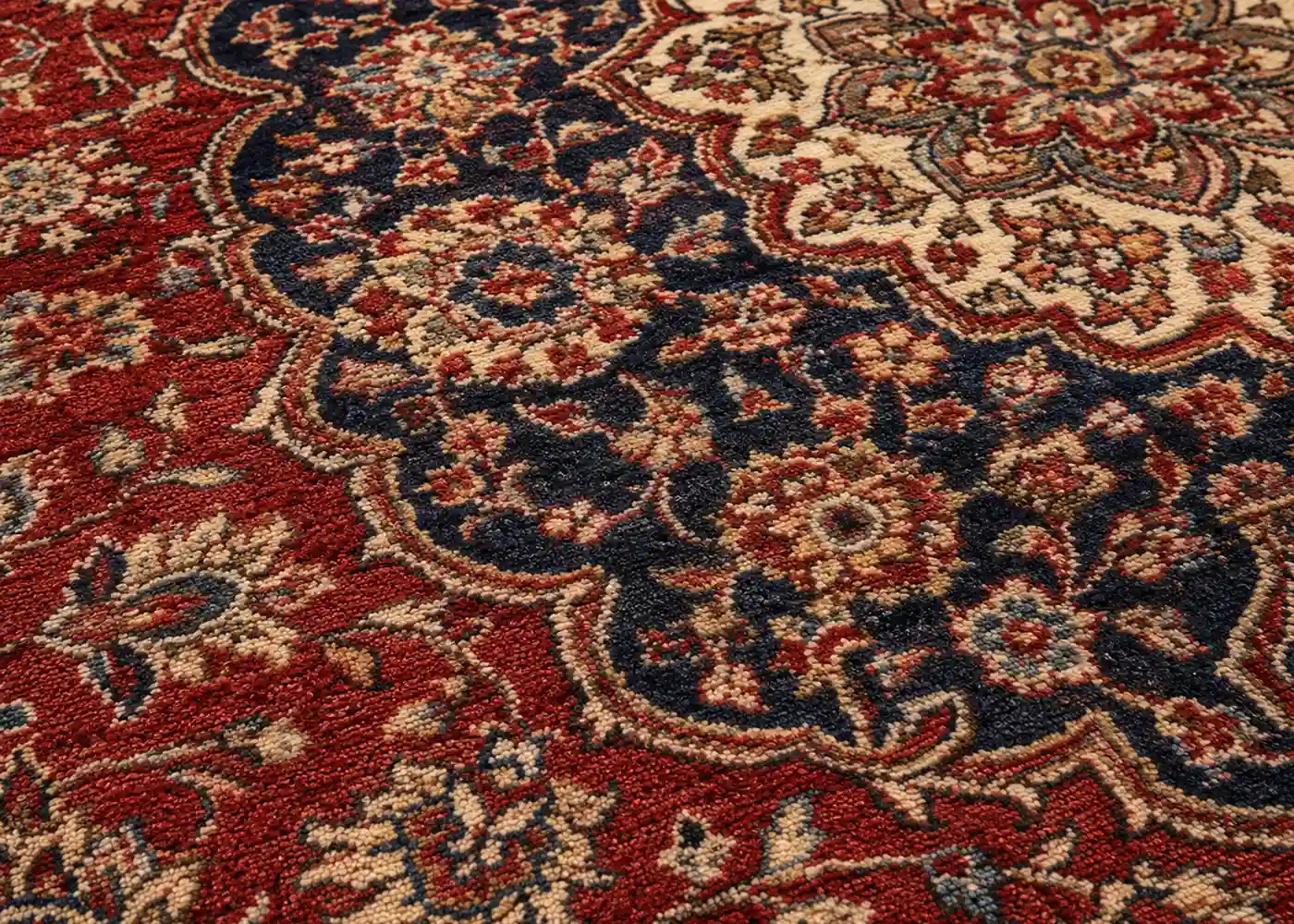
A Kashan rug can act as the visual center of a living room. In many layouts, the rug should be large enough to sit under at least the front legs of the main seating pieces. This connects the furniture instead of leaving the rug isolated in the middle of the room.
For room planning, use our
Persian rug selection guide
and explore available
large handmade rugs.
Dining room
Choose a rug large enough to keep the chair legs on the carpet when chairs are pulled away from the table. An undersized rug can catch chair legs and make the dining arrangement feel cramped.
See the complete
Persian dining room rug size guide
before ordering.
Bedroom
A Kashan rug can add warmth and structure to a bedroom, particularly when the rug extends beyond the sides and foot of the bed. A smaller piece can also be positioned beside the bed, near a reading chair or in front of a dresser.
Modern interiors
Traditional Kashan rugs can work surprisingly well in modern homes. Their complex detail creates contrast against clean furniture, neutral walls, wood flooring and simple architectural lines. To prevent the room from feeling heavy, repeat only one or two colors from the rug in cushions, artwork or accessories.
High-traffic rooms
For active family spaces, prioritize strong wool, sound edges, an intact foundation and a pile height appropriate for daily use. A highly delicate antique or silk-rich piece may be better suited to a lower-traffic room.
How to Care for a Handmade Kashan Rug
- Rotate the rug periodically to balance light exposure and foot traffic.
- Use a suitable rug pad to reduce movement and foundation stress.
- Vacuum gently without aggressively brushing the fringe.
- Blot spills immediately instead of rubbing them into the pile.
- Keep the rug away from prolonged moisture and uncontrolled humidity.
- Inspect hidden areas for moth activity, especially under furniture.
- Use a cleaner experienced with handmade Persian rugs.
- Never apply household bleach or harsh stain removers without professional advice.
For a complete routine, read
the ultimate rug care guide
and the article about
mistakes that reduce the lifespan of handmade rugs.
Checklist for Buying a Kashan Rug Online
Before purchasing, ask the seller for enough information to evaluate the exact rug rather than relying on a generic description.
- Confirm the exact dimensions in centimeters and feet.
- Request front and back photographs in natural, neutral lighting.
- Ask for close-ups of the pile, fringe, sides and corners.
- Confirm whether the rug is wool, silk, wool-and-silk or another material.
- Ask about age, origin and how those claims were determined.
- Request disclosure of repairs, stains, wear and color restoration.
- Ask whether the rug lies flat.
- Review delivery, tracking, insurance, duties and return conditions.
- Compare the rug’s proportions with your furniture layout before ordering.
- Ask for a video showing the rug from both pile directions.
Our guide to
buying authentic Persian rugs online
covers the full online purchasing process.
Available Kashan Rugs at Arghavan Rugs
Every handmade rug is a one-of-a-kind piece. Availability may change, so use the main Kashan collection page for the latest selection.
Large Kashan Rug
292 × 422 cm handmade Kashan rug suitable for a large living room, formal dining area or open interior.
Classic Room-Size Kashan
282 × 366 cm Kashan rug with the scale needed to anchor a substantial seating or dining arrangement.
Versatile Kashan Rug
205 × 295 cm handmade Kashan rug for living rooms, bedrooms and more compact formal spaces.
Explore Handmade Kashan Rugs
Browse the current Arghavan Rugs collection of authentic, individually selected Kashan rugs. Each product page shows the exact one-of-a-kind piece available.
Frequently Asked Questions About Handmade Kashan Rugs
Are Kashan rugs handmade?
Authentic traditional Kashan rugs are hand-knotted. However, machine-made carpets may copy Kashan patterns, so buyers should inspect the back, fringe, foundation and product description before purchasing.
How can I identify a Kashan rug?
Look for refined curvilinear floral drawing, a structured border system, traditional color combinations and hand-knotted construction. Regional attribution should be based on the rug’s complete structure rather than design alone.
What colors are common in Kashan rugs?
Deep red, navy, ivory, blue, green, rose and warm beige are common. Red fields with dark blue medallions and borders are especially recognizable.
Are Kashan rugs good for daily use?
A sound wool Kashan rug can be suitable for daily use when its foundation, pile and edges are in good condition. Delicate silk or heavily worn antique examples should be placed in lower-traffic areas.
Are all Kashan rugs valuable?
No. Value varies according to age, condition, materials, design quality, knotting, rarity, size, restoration and market demand.
Does a higher knot count mean a better Kashan rug?
Not automatically. Knot density can allow finer detail, but wool quality, design, color, condition and craftsmanship must also be considered.
What is a Mohtasham Kashan rug?
Mohtasham is a name associated in the antique market with particularly refined late nineteenth-century Kashan carpets. Because the term can be used broadly, attribution should be supported by expert structural and historical examination.
Can Arghavan Rugs ship Kashan rugs internationally?
International buyers should review the current shipping, tracking, insurance and delivery information on the Arghavan Rugs delivery page before ordering.
Review the current
worldwide rug delivery information
or
contact Arghavan Rugs
for questions about a specific Kashan rug.