

Abrash in Handwoven Rugs: Natural Dye Variation or Defect?
Abrash in handwoven rugs can reflect dye-lot variation, fiber differences, fading, or damage. Learn…
Article Guide
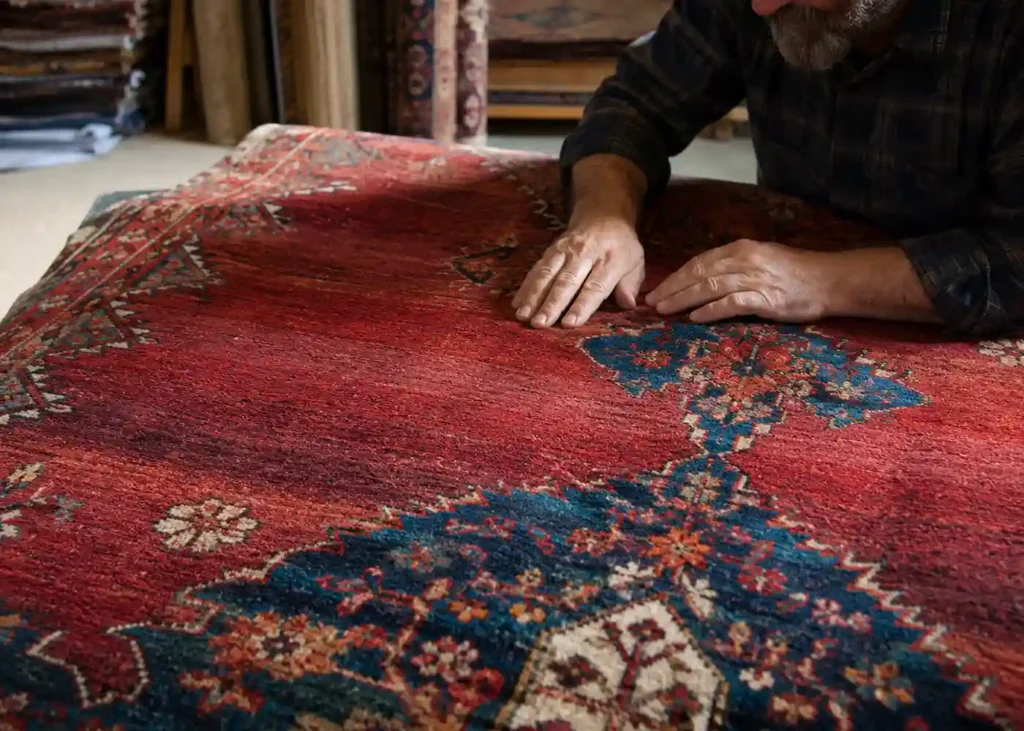
A broad red field that gradually becomes darker, a blue background interrupted by a softer horizontal band, or a brown motif that changes tone halfway through a handmade rug can easily raise concern. Is the rug faded? Was it poorly dyed? Has it been damaged during cleaning? Or is the variation an authentic feature of traditional weaving?
This phenomenon is commonly known as abrash.
Abrash in handwoven rugs is frequently described as evidence of natural dyes, age, authenticity, or superior craftsmanship. Although these claims may sometimes contain an element of truth, none of them is universally correct. Abrash is first and foremost a visible variation in color. Its meaning depends on how, when, and why that variation developed.
Some forms of abrash are inherent to the original yarn and weaving process. Others result from long-term light exposure, differences in wool, restoration, surface wear, chemical alteration, or intentional contemporary design. Abrash can even be imitated in machine-made and digitally printed rugs.
Understanding abrash also requires familiarity with the regional materials, structures, and design traditions discussed in our
complete guide to Persian rug styles and types
.
For this reason, a rug specialist does not classify every color difference as desirable abrash—and does not automatically treat every abrash band as a manufacturing defect.
This specialist guide explains what abrash really means, why it develops, how it relates to natural and synthetic dyes, how experts distinguish it from damage, and when it may increase, reduce, or have no effect on the value of a handwoven rug.
Quick Answer
Abrash in handwoven rugs is a variation in hue, lightness, saturation, or color intensity within an area that appears to have been woven in one color.
It commonly develops when yarn from different dye lots is used during weaving. It may also result from differences in wool, spinning, mordanting, dye concentration, water chemistry, temperature, exposure to light, restoration, or intentional design.
Traditional abrash is usually not considered a defect when it is visually harmonious, structurally integrated into the weaving, and consistent with the rug’s origin and production method.
However, abrash alone does not prove that a rug was dyed naturally, woven by hand, made in a particular region, or produced in a specific historical period.
What Is Abrash in Handwoven Rugs?
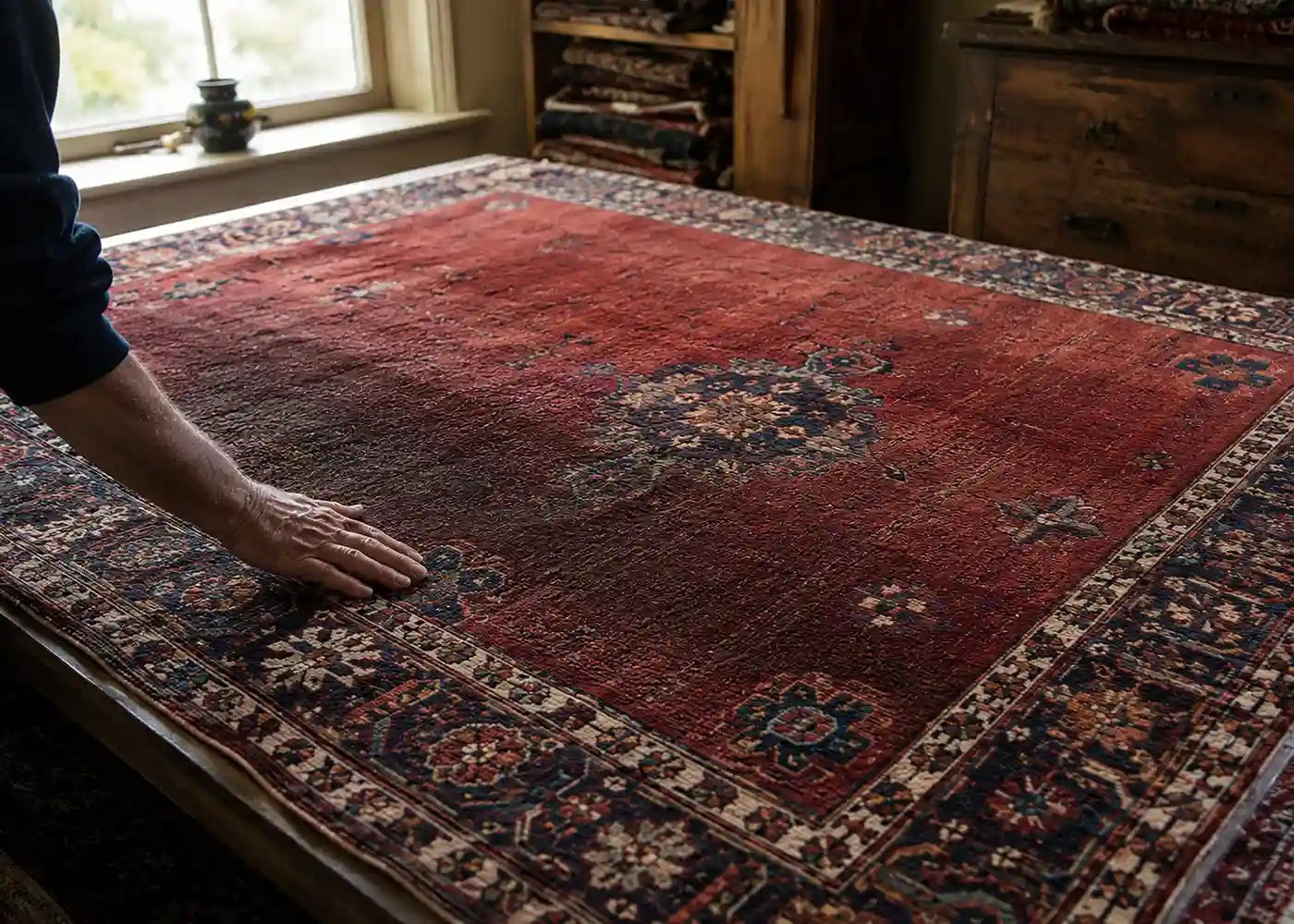
In technical terms, abrash is a visible deviation within a color area of a rug or textile. The change may involve hue, value, saturation, color temperature, or surface appearance.
In the Oriental rug trade, the term is commonly used for tonal variation that appears as horizontal bands, gradual transitions, irregular patches, or color changes within individual motifs.
Abrash may involve changes in:
- Hue: A red area may become slightly more orange, purple, or brown.
- Value: A color may become lighter or darker.
- Saturation: A color may become more muted or more intense.
- Temperature: A beige, red, or brown may shift from warm to cool.
- Surface appearance: Differences in wool, pile direction, yarn thickness, or light reflection may create an apparent color change.
The Metropolitan Museum of Art has used the term abrash to describe color gradation caused by differences between dye batches or by different degrees of fading in naturally dyed yarns. This distinction is important because abrash describes a visible condition, while its precise cause still requires examination.
The word entered English rug terminology through the Turkish word abraş, meaning mottled, speckled, or piebald. It should therefore not be translated too narrowly as “natural dye variation.”
Why Does Abrash Develop in Handwoven Rugs?
1. Different Dye Lots
The most familiar form of abrash develops when a weaver finishes one group of dyed yarn and continues weaving with yarn prepared in another dye bath.
In traditional village, tribal, and nomadic production, wool was often dyed in relatively small quantities. Reproducing an identical shade required precise control over many variables, including:
- The type, quality, and quantity of the dyestuff
- The weight and preparation of the wool
- The concentration of the dye bath
- The mineral content and acidity of the water
- The type and concentration of the mordant
- The dye-bath temperature
- The duration of dyeing
- The number of dyeing and oxidation cycles
- The rinsing and drying conditions
Even when the same recipe was followed, a new batch could emerge slightly lighter, darker, warmer, cooler, brighter, or more muted.
When yarn from the new batch entered the rug, the change became permanently incorporated into the sequence of knots.
2. Differences Within the Wool
Wool is not a perfectly uniform industrial material. Fibers from different animals—or from different parts of the same fleece—may vary in diameter, natural pigmentation, grease content, surface condition, previous exposure, and ability to absorb dye.
Handspun yarn can also vary in thickness and twist. A thicker or more tightly twisted section may absorb dye differently or reflect light differently from a finer, softer, or more loosely twisted section.
The relationship between fiber structure, durability, luster, and dye response is examined in greater detail in our comparison of
wool and silk Persian rugs
.
As a result, some forms of abrash are partly chemical and partly optical.
3. Changes in the Dyeing Process
Natural dyeing is a controlled craft, but natural raw materials are inherently variable. Two harvests of madder root, weld, pomegranate peel, walnut husk, cochineal, or another dye source may contain different concentrations of coloring compounds.
Changes in pH, mordanting, temperature, timing, water quality, and dye exhaustion can alter the final shade.
Indigo dyeing is particularly dependent on vat condition, reduction, immersion time, oxidation, and the number of dipping cycles. A yarn dipped several times may develop a deeper blue than yarn treated in fewer cycles.
This does not mean that natural dyes must be uneven. Skilled dyers can achieve remarkably consistent natural colors. It means that matching separate batches exactly is more difficult when the raw materials and production conditions vary.
4. The Sequence of Weaving
A piled rug is normally woven progressively along the loom. When a new dye lot is introduced across a large color field, the resulting abrash may follow the direction of the knot rows.
This is why traditional dye-lot abrash frequently appears as a horizontal band when the rug is viewed in its normal orientation.
Horizontal banding is not mandatory. If a different skein was used only for selected flowers, borders, leaves, or small sections, the color variation may appear locally rather than across the entire width of the rug.
5. A Long Interruption in Production
A large handmade rug may take months or years to complete. During that period, the weaver may need additional wool, the original dye material may no longer be available, or another dyer may prepare the next batch.
Seasonal changes may also influence the available plants, raw wool, water chemistry, temperature, and drying conditions.
Abrash can therefore record part of the chronology of a rug’s production.
6. Intentional Tonal Variation
Not every abrash effect is accidental. Traditional weavers and contemporary rug designers may deliberately alternate related shades to create visual depth, movement, softness, or an aged appearance.
Intentional abrash may be produced by combining several related yarn shades, alternating dye lots, using space-dyed yarn, or changing the shade according to a planned sequence.
This deliberate effect should not automatically be interpreted as spontaneous historical abrash, even though the visual result may appear similar.
Does Abrash Prove the Use of Natural Dyes?
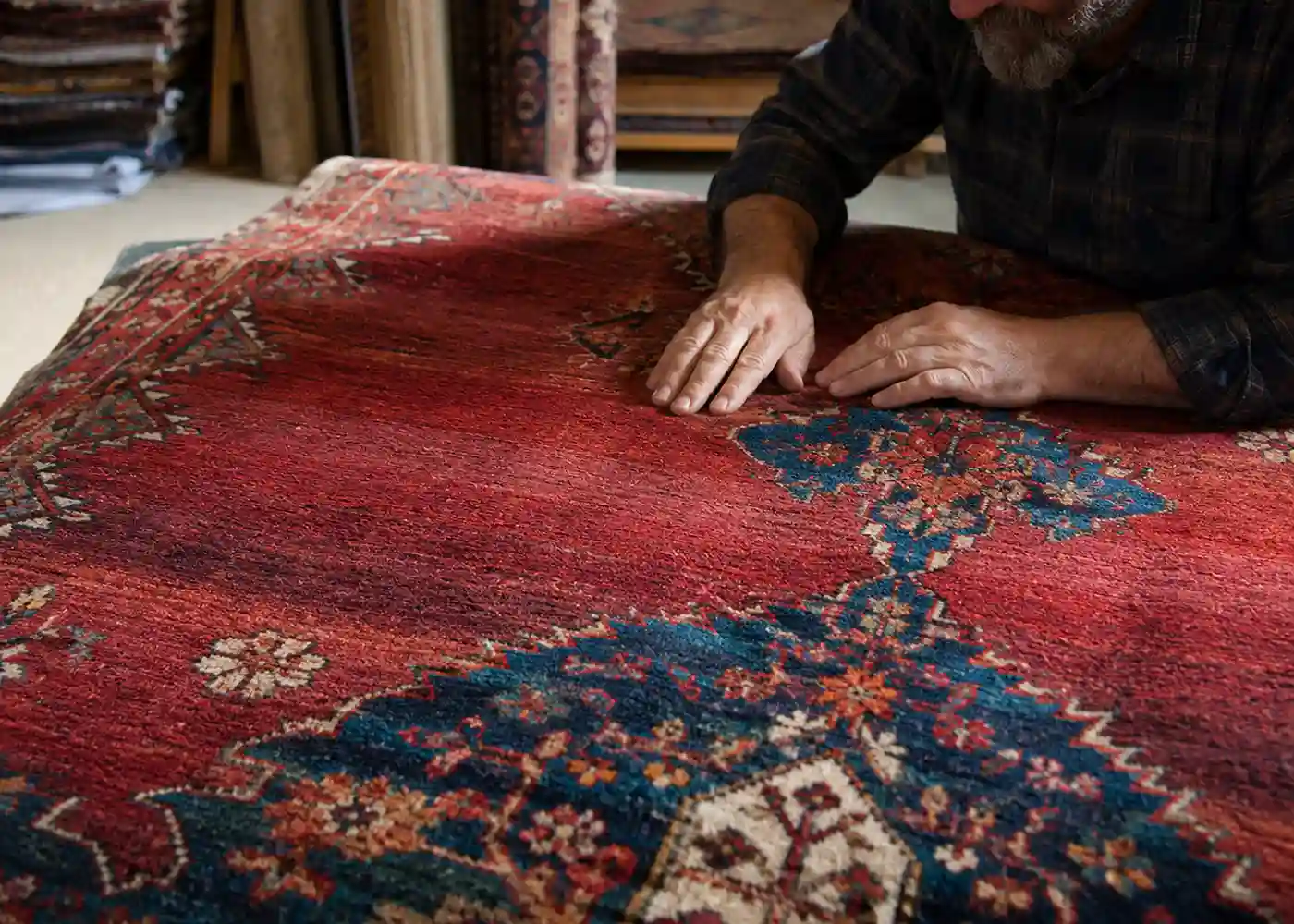
No. Abrash does not prove that natural dyes were used.
This is one of the most important corrections to common rug-market information.
Abrash is often associated with natural dyes because traditional hand-dyeing in small batches makes slight variation more likely. However, the presence of abrash does not scientifically identify the source or chemical composition of a dye.
A rug with abrash may contain:
- Plant-based dyes
- Insect-based dyes
- Natural and synthetic dyes used together
- Early synthetic dyes
- Modern acid dyes
- Metal-complex dyes
- Recolored or restored yarn
- Faded yarn that originally appeared uniform
Likewise, a rug dyed entirely with natural colorants may have a highly uniform field if enough yarn was prepared in one controlled batch.
Abrash describes the visible appearance of the color—not its molecular identity.
For historically important rugs and textiles, museums and conservation laboratories may use chromatography, mass spectrometry, Raman spectroscopy, or other instrumental methods to identify colorants.
The strengths and limitations of visual examination and scientific testing are explained in our specialist guide to
natural vs synthetic dyes in antique rugs
.
Visual inspection can provide useful evidence, but it cannot always identify a dye source with scientific certainty.
Can Synthetic Dyes Produce Abrash?
Yes. Synthetic dyes can produce abrash or abrash-like color variation.
Modern synthetic dyes are capable of producing highly repeatable colors under controlled industrial conditions. However, uneven shades may still occur when dyeing variables are not properly controlled.
Possible causes include:
- Different dye concentrations between batches
- Changes in pH or water chemistry
- Uneven heating or circulation
- Different dyeing durations
- Uneven penetration into the yarn
- Differences in wool preparation
- Variation in yarn thickness or twist
- Incomplete dye-bath exhaustion
- Different rinsing, drying, or finishing conditions
Early synthetic dyes used during the late nineteenth and early twentieth centuries could also vary in quality, application method, and lightfastness.
Therefore, the statement “natural dyes create abrash, while synthetic dyes are always uniform” is technically incorrect.
For a broader buyer-focused explanation of traditional and modern colorants, read our guide to
vegetable and chemical dyes in Persian rugs
.
A more accurate conclusion is that small-batch traditional dyeing makes color variation more likely, but abrash can occur with both natural and synthetic colorants.
Can a Machine-Made Rug Have Abrash?
A machine-made rug can imitate the appearance of traditional abrash.
Modern manufacturing can create tonal variation through:
- Digitally printed color gradients
- Programmed yarn changes
- Space-dyed yarn
- Mélange or heathered fibers
- Deliberately varied pile height
- Chemical finishing
- Artificial distressing
- Controlled fading effects
These effects may closely resemble traditional abrash when the rug is examined only from the front.
Consequently, abrash should never be used as the only test for determining whether a rug is handmade.
A detailed structural comparison can be found in our guide to
handmade vs machine-made rugs
.
To assess construction, examine the back of the rug, knot structure, foundation, side finishes, pile formation, and fringes.
In a genuinely hand-knotted rug, the fringe is normally an extension of the warp foundation rather than a decorative component sewn onto the completed rug.
Abrash may support an interpretation of traditional production, but structural evidence is considerably more reliable.
Buyers who need a complete inspection checklist should also review
how to identify an authentic Persian rug
.
Is Abrash a Manufacturing Defect?
The correct answer depends on the rug’s production context, intended specification, craftsmanship, and resulting appearance.
When Abrash Is Usually Not a Defect
Abrash is generally considered a normal characteristic when:
- The rug was woven in a village, tribal, nomadic, or small-workshop setting.
- The yarn was dyed by hand in separate batches.
- The variation is integrated into the original knot structure.
- The pile remains healthy, stable, and structurally intact.
- The color change does not result from staining or chemical damage.
- The tonal movement is visually harmonious with the design.
- The variation is consistent with the rug’s weaving tradition.
- The effect was intentionally incorporated into the design.
- The seller describes the variation accurately.
In these circumstances, abrash may add visual depth and preserve evidence of the handmade production process.
When Abrash May Be a Quality-Control Issue
Abrash may be commercially undesirable when:
- The rug was commissioned to match a precise and uniform color specification.
- A workshop promised identical color throughout a formal field.
- The tonal change is harsh, distracting, or poorly positioned.
- Poorly controlled dyeing produced visibly incompatible shades.
- The dye did not penetrate the yarn properly.
- The variation disrupts a highly formal city-rug composition.
- The feature was concealed or misrepresented by the seller.
A color variation can be natural in origin and still be commercially unacceptable for a particular order. “Natural” and “desirable” are not always the same thing.
When the Color Change Is Damage Rather Than Abrash
The term abrash should not be used to excuse or conceal:
- Bleach marks
- Chemical burns
- Dye bleeding
- Water stains
- Mold-related discoloration
- Pet urine stains
- Sun-faded areas
- Poor recoloring
- Incompatible restoration
- Severe surface abrasion
- Heat damage
- Residue from improper cleaning
These are condition issues and should be evaluated and disclosed separately.
How Specialists Identify Genuine Abrash
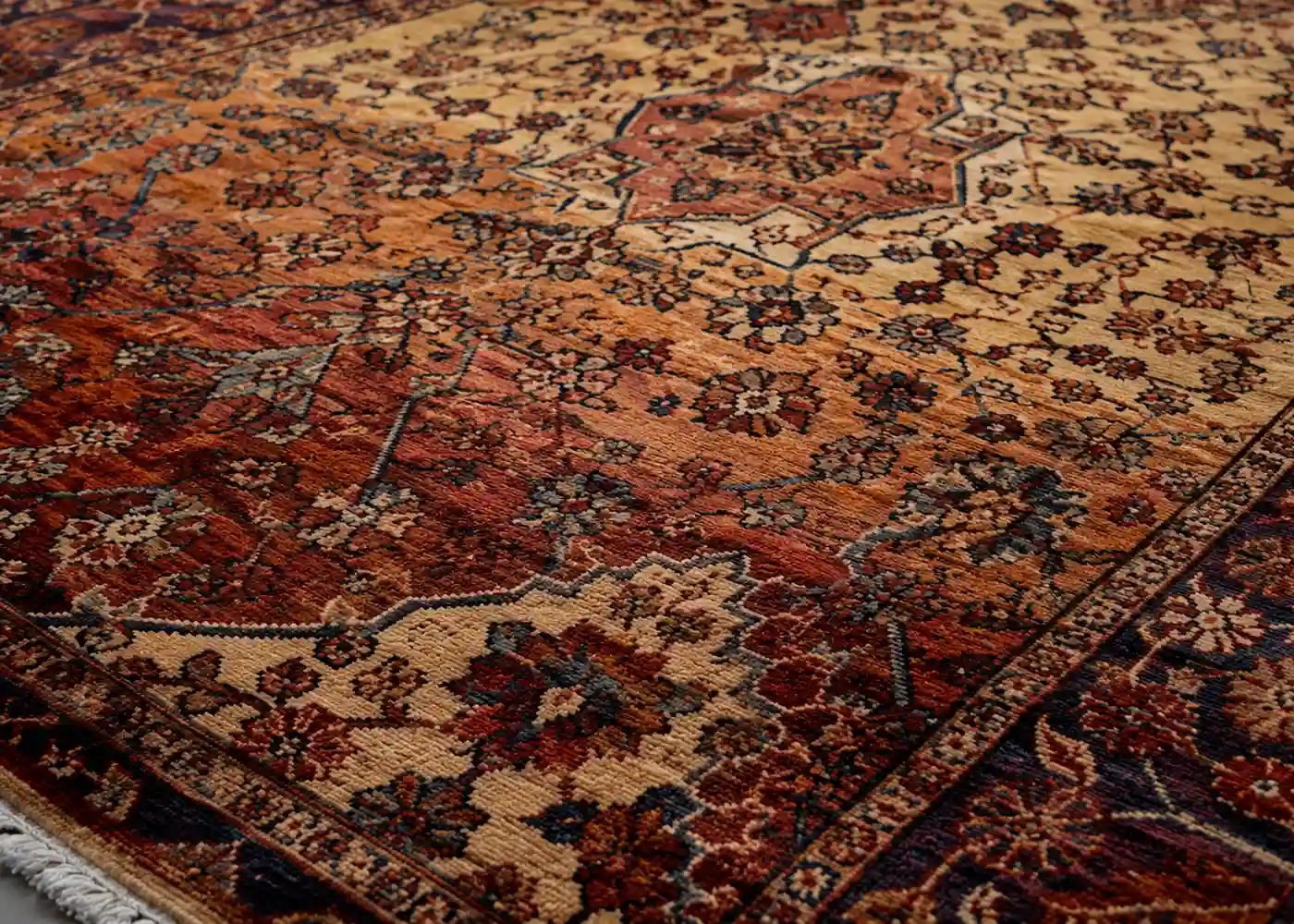
No single visual test is conclusive. Specialists evaluate several forms of evidence together.
Examine the Direction of the Color Change
Dye-lot abrash often follows the progression of weaving. A band that runs through a large section of the field and aligns with knot rows is more consistent with a yarn change during production.
Sun fading, spills, and chemical damage usually follow the geometry of exposure or contact rather than the weaving sequence.
View the Rug from Both Ends
The appearance of a piled rug changes according to the direction of the pile and the angle of light.
A section that appears darker from one end and lighter from the opposite end may be an optical pile effect rather than abrash.
True dye-related abrash normally remains visible when the rug is viewed from the opposite direction, although its intensity may change.
Rotate the Rug
Rotating the rug by 180 degrees can help determine whether the perceived color difference is caused primarily by pile reflection.
If the light and dark areas reverse dramatically after rotation, pile direction may be responsible. If the same color boundary remains visible, an actual difference in yarn or dye is more likely.
Separate the Pile Gently
By gently opening the pile, an examiner can compare the exposed tips with the less-exposed fibers closer to the knots.
If the tips are considerably lighter than the roots, the difference may indicate fading, wear, oxidation, or surface alteration.
If the changed tone continues through the depth of the pile, it is more likely to have been present in the yarn itself.
This examination should be gentle. Pulling, scratching, cutting, wetting, or applying chemicals can permanently damage the rug.
Inspect the Back of the Rug
The back may reveal whether the color change corresponds with a new section of yarn or a sequence of knot rows.
It may also expose:
- Reweaving
- Re-piling
- New foundation materials
- Painted or recolored knots
- Different knot density
- Changes in yarn thickness
- Repairs that are less visible from the front
Compare the Fiber Condition
Original dye-lot abrash normally changes color without causing a major change in the physical condition of the pile.
Chemical damage may produce:
- Stiffness
- Brittleness
- Sticky or powdery residue
- Loss of pile
- Weak or breaking fibers
- Unusual odor
- Surface crusting
- Reduced luster
Evaluate the Entire Composition
A specialist should not diagnose abrash from one close-up photograph alone.
The whole rug must be examined to determine whether the color variation corresponds with weaving, design, light exposure, traffic, cleaning, restoration, or accidental damage.
Abrash vs Sun Fading, Wear, Bleeding, and Other Lookalikes
Abrash vs Pile Shading
Pile shading is caused by the direction in which fibers lean and reflect light. It can change dramatically when the rug is rotated or viewed from another angle.
Abrash originates from a difference in the yarn, dye, fiber, or long-term condition. It does not normally disappear completely when the viewing angle changes.
Abrash vs Sun Fading
Sun fading often affects the side of a rug nearest a window or the part exposed to stronger daylight. It may cross borders, motifs, and different yarn colors according to the shape of the exposed area.
Traditional dye-lot abrash is more likely to follow the weaving structure and affect a particular yarn batch.
Visible light and ultraviolet radiation can fade textile dyes, alter undyed fibers, and weaken wool and other textile materials. Light-related damage is cumulative and generally irreversible.
Practical methods for reducing ultraviolet exposure, uneven wear, chemical damage, and fiber deterioration are covered in
seven handmade rug care mistakes that reduce lifespan
.
Abrash vs Surface Wear
Foot traffic compresses, polishes, breaks, or removes pile. A worn area may appear lighter because less pile remains or because the foundation has become visible.
Abrash can occur in a full, healthy pile with no measurable loss of material.
Abrash vs Dye Bleeding
Dye bleeding occurs when color migrates from one yarn into an adjacent area, usually after contact with moisture, flooding, unsuitable cleaning agents, or improper washing.
Typical signs of dye bleeding include:
- Colored halos around motifs
- Red or blue transfer into ivory sections
- Irregular tide marks
- Color appearing where no pile of that color exists
- A recent change following washing or water exposure
Abrash is normally incorporated into the original yarn sequence. Bleeding moves beyond the original boundaries of the colored yarn.
Abrash vs Chemical Discoloration
Bleach, alkaline cleaners, acids, oxidizing products, stain removers, and household chemicals can permanently alter wool and dyes.
Chemical marks are often abrupt, localized, asymmetrical, and unrelated to knot rows. The affected fibers may also feel harder, weaker, rougher, or more brittle.
Abrash vs Restoration
A restored area may initially match the surrounding rug but age differently because the replacement wool, dye, pile height, and exposure history are not identical.
Under magnification or from the back, a repaired section may show different knots, foundation threads, yarn twist, pile density, or color penetration.
A later restoration color difference should be described as restoration or re-piling—not automatically as original abrash.
Abrash Revealed After Washing
Correct professional cleaning may remove soil that previously concealed tonal variation. In this situation, washing did not necessarily create the abrash; it may simply have revealed an existing difference.
Improper washing, however, can cause fading, bleeding, chemical discoloration, pile distortion, or fiber damage.
Before cleaning an older or color-sensitive rug, review the professional recommendations in
how often a handwoven Persian rug should be washed
.
A sudden color change noticed after cleaning should be examined before being classified as abrash.
Abrash in Persian and Oriental Rug Traditions
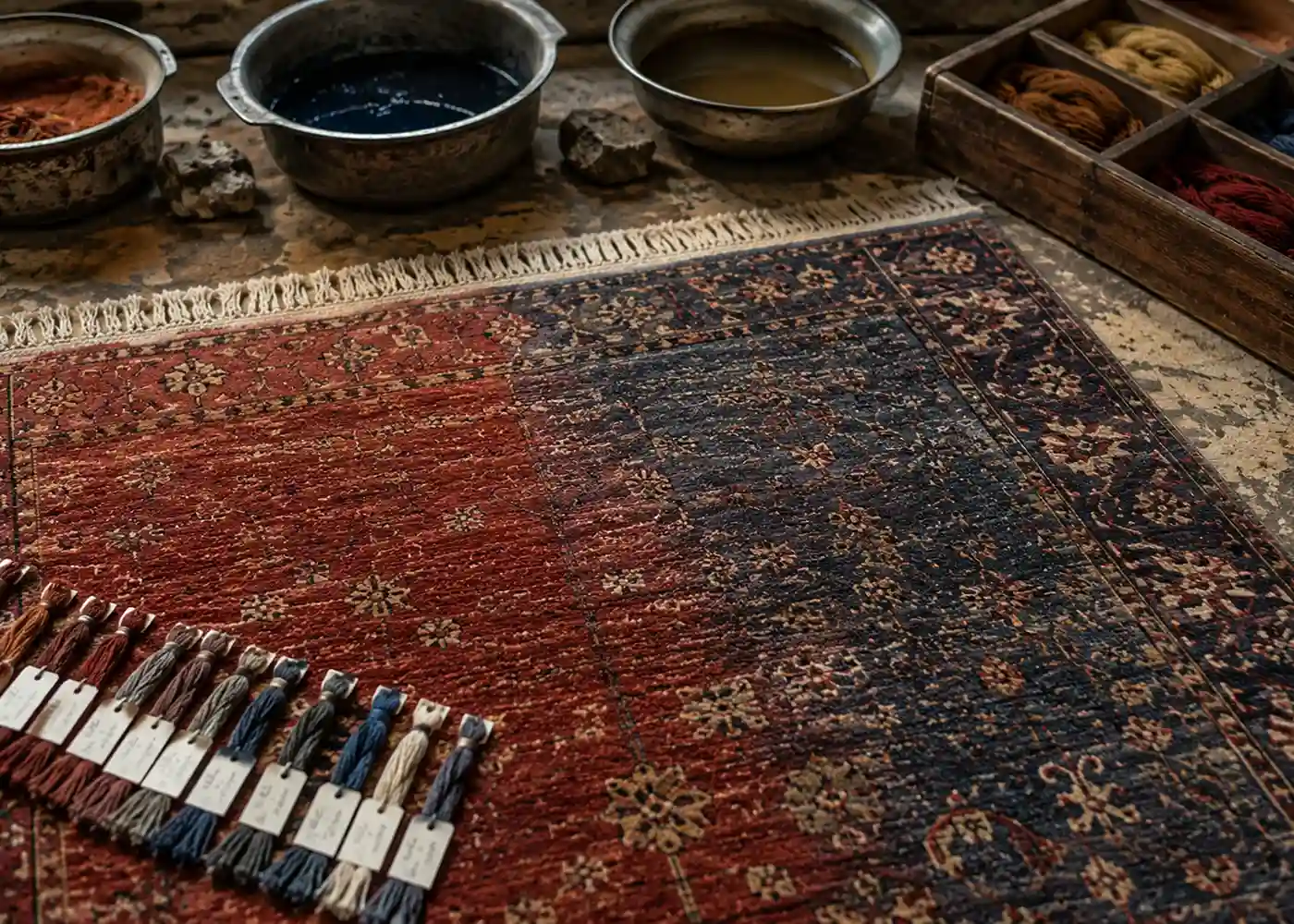
Abrash is especially associated with village, tribal, and nomadic rugs because their yarn was more likely to be handspun, dyed in smaller batches, and prepared gradually during the weaving process.
Abrash may be especially visible in broad color fields, where even a small change in tone becomes noticeable. Red, blue, brown, ivory, green, orange, and yellow areas can all display abrash.
Formal workshop and city rugs can also contain abrash, but their production was often more tightly organized. Larger quantities of yarn could be prepared in advance, and color matching might be supervised more carefully.
For this reason, strong abrash may appear visually natural in a bold village carpet but more disruptive in an extremely precise workshop rug with a tightly controlled floral field.
This is a contextual distinction—not a universal ranking of quality.
Abrash also cannot identify geographic origin on its own. Similar tonal variation appears in rugs from Iran, Anatolia, the Caucasus, Central Asia, Afghanistan, India, and other weaving regions.
Abrash should also not be used as an independent dating method. Age estimation requires a combined examination of fibers, foundation, wear, dyes, structure, and restoration, as explained in
how to tell the age of a Persian rug
.
Does Abrash Affect the Value of a Rug?
Abrash does not have a fixed positive or negative effect on rug value.
Abrash May Support Value When:
- It is visually attractive and harmonious.
- It is consistent with the rug’s weaving tradition.
- It contributes depth without damaging the composition.
- It is original to the rug.
- It appears in a desirable antique, village, or tribal piece.
- It supports—but does not independently prove—a traditional production history.
Abrash May Be Neutral When:
- The variation is minor.
- It does not alter the readability of the design.
- It is expected for the type of rug.
- Buyers consider it neither especially attractive nor distracting.
Abrash May Reduce Value When:
- It strongly interrupts a formal composition.
- The color change results from fading or chemical damage.
- It reveals a poorly matched repair.
- It was artificially exaggerated in an unconvincing way.
- It conflicts with the original commission or quality standard.
- The seller describes damage as desirable abrash.
Rug value must be assessed together with origin, age, materials, knotting, design, rarity, condition, restoration, size, provenance, and current market demand.
Our complete guide to
valuing an old Persian rug
explains how these factors are considered together during a professional appraisal.
Attractive abrash cannot compensate for major foundation damage, extensive re-piling, severe moth loss, unstable dyes, or significant structural weakness.
Buyers interested specifically in older pieces can compare current examples in the
old and antique Persian rug collection
.
What Buyers Should Examine Before Purchasing a Rug with Abrash
When a rug shows noticeable color variation, request clear and accurate visual documentation.
Useful photographs include:
- A full photograph taken from the pile direction
- A full photograph taken from the opposite direction
- Close-up photographs of the tonal transition
- A clear photograph of the back in the same area
- Photographs taken under neutral daylight
- Images of the fringes and side finishes
- Close-ups of any repaired or worn sections
Ask the seller whether the color change is believed to be:
- Original dye-lot abrash
- Intentional tonal variation
- Sun fading
- Surface wear
- Re-piling or restoration
- Dye bleeding
- Chemical alteration
- Unknown or not professionally assessed
Buyers should also request information about the rug’s cleaning history, restoration, sun exposure, water damage, stains, and previous repairs.
A responsible description distinguishes observation from certainty.
“The field displays horizontal tonal variation consistent with dye-lot abrash.”
This wording is more accurate than claiming:
“The abrash proves that the rug has natural dyes and is antique.”
The second statement requires additional technical, historical, and structural evidence.
For assistance assessing photographs, condition, materials, or a possible restoration, buyers can
contact the Arghavan Rugs team
.
How to Protect a Rug with Abrash
Original abrash does not normally require treatment. It is part of the rug’s appearance and production history.
Attempting to “correct” abrash through painting, bleaching, aggressive washing, chemical stripping, or unnecessary recoloring may reduce originality and cause permanent damage.
To protect the rug:
- Limit direct sunlight and strong ultraviolet exposure.
- Use curtains, blinds, or UV-filtering window treatments where necessary.
- Rotate the rug periodically to distribute light exposure and foot traffic.
- Use an appropriate rug pad beneath the rug.
- Vacuum carefully without aggressive beater-bar contact.
- Address spills promptly without rubbing or applying household chemicals.
- Avoid bleach, stain removers, alkaline detergents, and unknown cleaning products.
- Use a cleaner experienced in hand-knotted and naturally dyed rugs.
- Photograph the rug periodically under similar lighting conditions.
- Seek professional assessment if a sudden color change appears.
Frequently Asked Questions About Abrash in Handwoven Rugs
What does abrash mean in a rug?
Abrash means a visible variation in color within an area of a rug that appears to have been woven in one shade. It may result from different dye lots, differences in wool, intentional tonal variation, fading, restoration, or other causes.
Is abrash a defect in a handmade rug?
Not necessarily. In many village, tribal, nomadic, and traditionally produced rugs, original dye-lot abrash is considered a normal characteristic of handmade production. It may become a quality issue when it is visually disruptive, contradicts a commissioned specification, or results from poor dyeing, damage, or restoration.
Does abrash prove that a rug has natural dyes?
No. Abrash may occur in naturally dyed rugs, synthetically dyed rugs, restored rugs, machine-made rugs, and deliberately distressed rugs. Laboratory analysis may be required to identify a dye with scientific certainty.
Does abrash prove that a rug is handmade?
No. Machine-made and printed rugs can imitate abrash. The construction, back, foundation, knots, side finishes, and fringes provide more reliable evidence of whether a rug is hand-knotted.
Is abrash always horizontal?
No. Dye-lot abrash often appears horizontally because it follows the progression of weaving, but it can also appear as local patches, changes within motifs, gradual transitions, or irregular tonal areas.
Can abrash appear in new rugs?
Yes. A newly woven rug may display abrash when separate yarn batches differ slightly or when the designer intentionally creates tonal variation. Abrash is not limited to antique rugs.
Can synthetic dyes create abrash?
Yes. Synthetic dyes can produce uneven shades when dye concentration, temperature, pH, water chemistry, wool preparation, or processing conditions vary between batches.
Can professional cleaning remove abrash?
Original abrash is part of the dyed yarn and should not normally be removed. Attempts to eliminate it may damage the rug. Cleaning may sometimes reveal abrash that was previously hidden beneath soil.
Can washing create abrash?
Correct professional cleaning does not normally create original dye-lot abrash. Improper cleaning can, however, produce fading, bleeding, chemical discoloration, or uneven surface appearance that may be mistaken for abrash.
How can I distinguish abrash from sun fading?
Dye-lot abrash often follows knot rows or the sequence of weaving. Sun fading normally corresponds with the pattern of light exposure and may cross several motifs and colors. Examination from both sides and both pile directions is important.
Does abrash increase the value of a Persian rug?
Sometimes, but not automatically. Attractive original abrash may enhance the character of certain antique, village, or tribal rugs. Abrash caused by fading, chemical damage, or poor restoration may reduce value.
Should abrash be repaired or recolored?
Original abrash usually should not be altered. Recoloring can reduce originality and may age differently from the surrounding yarn. Treatment should only be considered after assessment by a qualified rug conservator or restoration specialist.
Final Thoughts: Natural Variation, Defect, or Damage?
Abrash in handwoven rugs is best understood as evidence of variation—not automatic evidence of natural dyes, age, authenticity, or damage.
In many traditional rugs, abrash records the use of different yarn batches, variable wool, small-scale dyeing, seasonal production, and the gradual rhythm of hand weaving. When visually harmonious and structurally original, it can contribute depth, movement, and individuality.
In other cases, an apparent abrash may actually be sun fading, pile shading, surface wear, dye bleeding, chemical alteration, or mismatched restoration.
The distinction cannot always be made from a single photograph or a simplified rule. Reliable assessment requires examination of the rug’s front, back, pile direction, fiber condition, weaving sequence, restoration history, and overall composition.
The most technically accurate conclusion is therefore:
Abrash is not inherently a manufacturing defect, but neither is every visible color variation a desirable or original feature.
Its significance must be evaluated within the complete technical, historical, and visual context of the rug.