

Original vs Added Fringe on Persian Rugs | Expert Guide
The fringe of a Persian rug may look like a decorative border, but in…
Article Guide
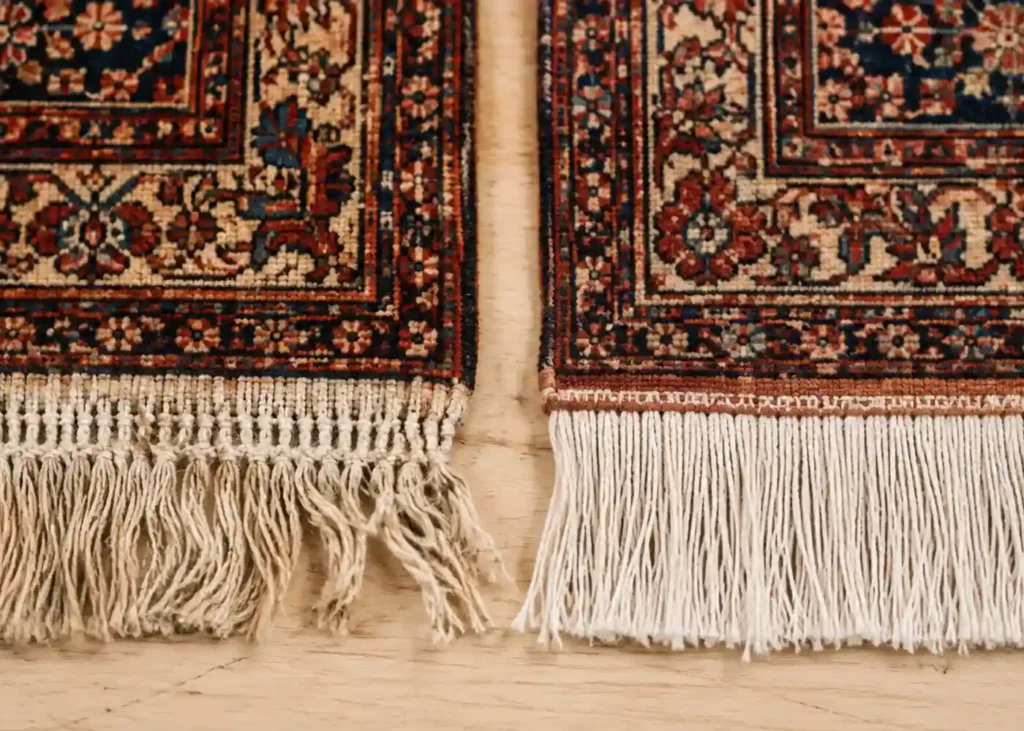
The fringe of a Persian rug may look like a decorative border, but in a traditional hand-knotted rug, it is usually part of the rug’s structural foundation. The visible fringe commonly consists of the free ends of the warp threads that run through the entire length of the rug.
However, not every fringe visible on an old, antique, or handmade rug is original. Some fringes are replaced after wear, some are sewn onto damaged ends, and others are added purely to improve appearance. A rug may also have reconstructed ends, protective overcasting, shortened warp ends, or a restored kilim finish.
This guide explains how to distinguish original fringe from added or replacement fringe by examining warp continuity, end finishes, sewing lines, fibers, repairs, wear patterns, and the back of the rug. It also explains how fringe restoration may affect authenticity, condition, and market value.
Fringe should never be examined in isolation. For a broader structural assessment, read our guide on
how to identify an authentic Persian rug
Quick Answer: How Can You Tell If Rug Fringe Is Original or Added?
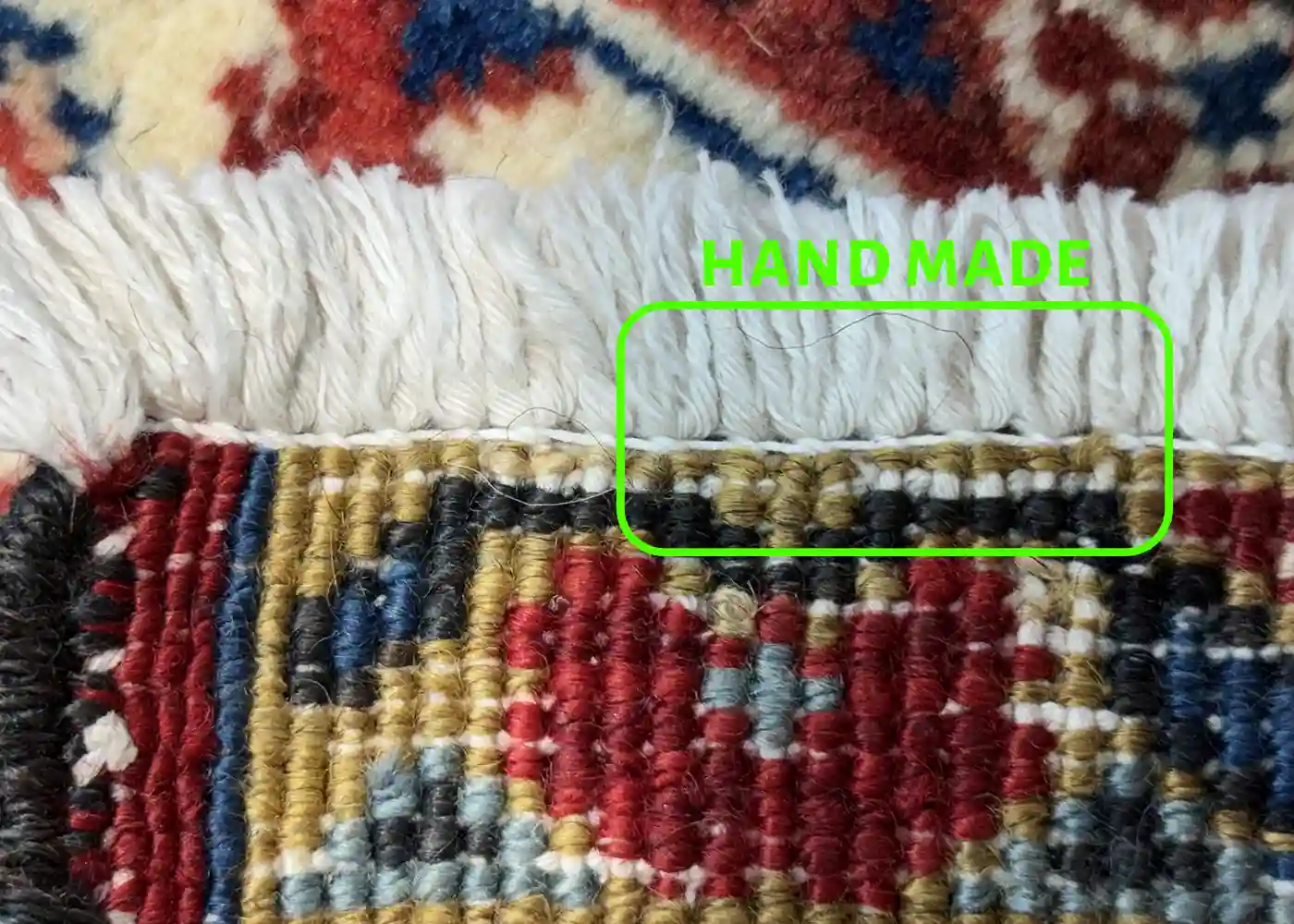
Original fringe normally continues directly from the warp foundation of a hand-knotted rug. When viewed from the back, the fringe threads should appear to emerge naturally from between the final rows of knots and wefts.
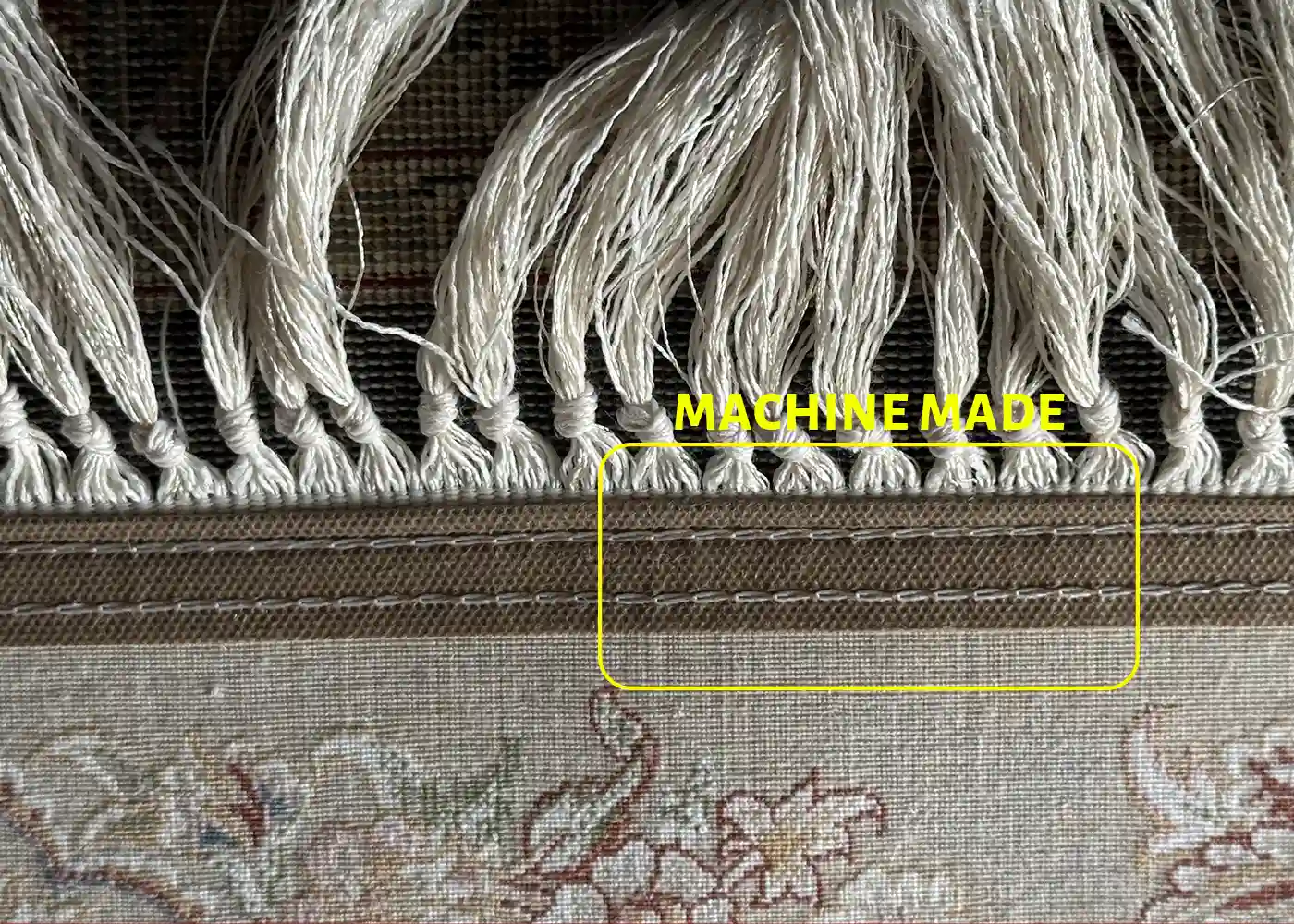
Added fringe is often attached separately. It may reveal a horizontal sewing line, support strip, cord, adhesive residue, unusually uniform spacing, or a visible difference in fiber, thickness, twist, color, or wear.
The most reliable inspection involves checking several features together:
- Continuity between the fringe and the warp foundation
- The presence or absence of a separate attachment line
- The condition of the end borders and final knot rows
- Fiber, ply, twist, thickness, and color consistency
- Differences between the two ends of the rug
- Evidence of end reduction, reweaving, or protective restoration
An added fringe does not automatically mean that the rug is fake. A genuine handmade Persian rug may have replacement fringe because its original warp ends were damaged or lost.
What Is the Fringe on a Hand-Knotted Persian Rug?
To understand fringe, it is necessary to understand the basic structure of a hand-knotted rug.
Warp Threads
Warp threads run vertically through the rug from one end to the other. They form the principal lengthwise foundation onto which the pile knots are tied.
Weft Threads
Weft threads run horizontally across the width of the rug. They pass over and under the warp threads and help secure each row of knots.
Pile Knots
The visible pile is created by tying wool, silk, or another pile fiber around the warp threads. After each row of knots, one or more wefts are normally inserted and compacted.
Fringe
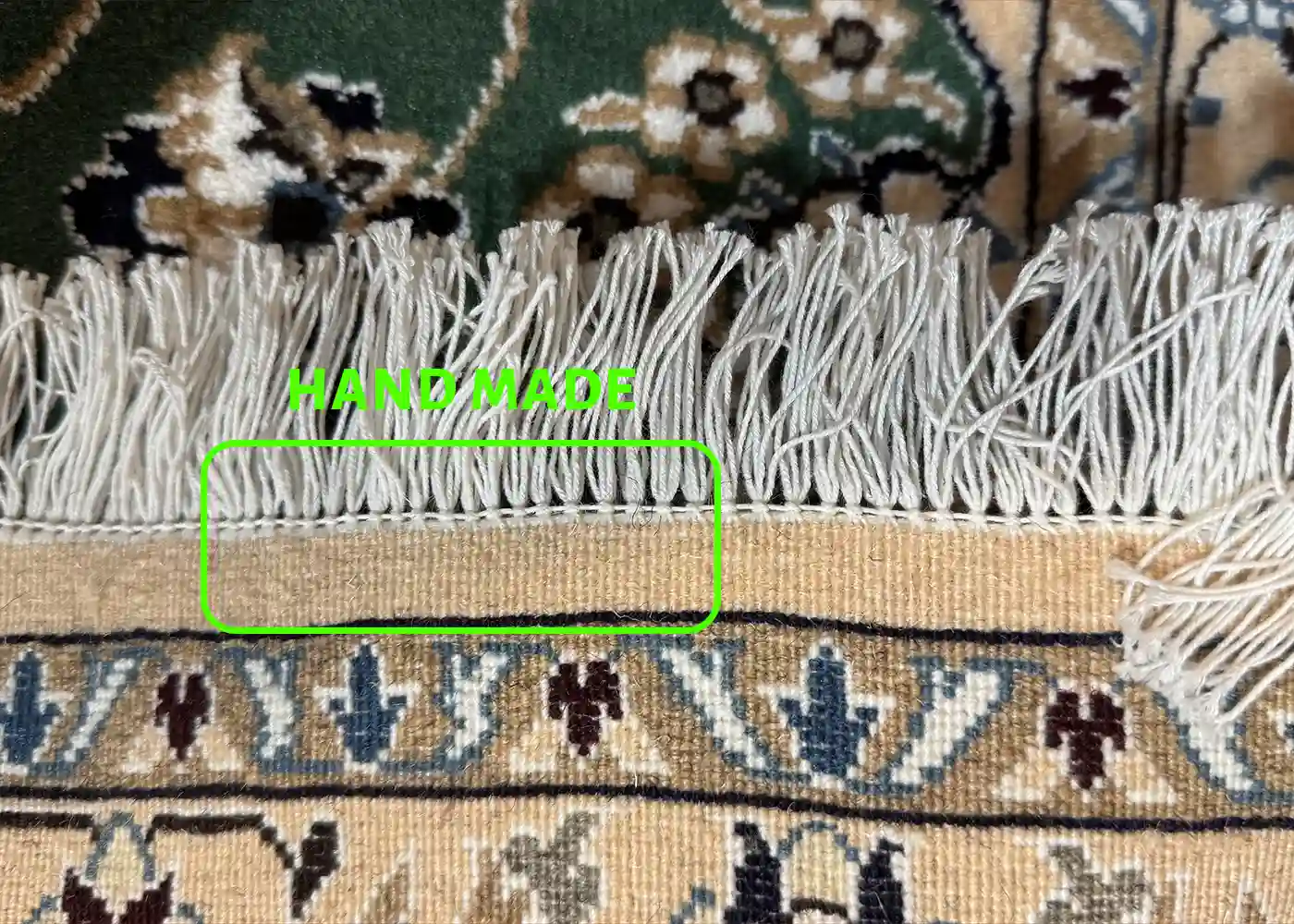
In many traditional Persian rugs, the fringe is formed by the exposed ends of the warp threads. These threads are not merely sewn onto the finished rug as decoration. They are connected to the foundation and may extend continuously through the entire structure.
This is one of the important
structural differences between handmade and machine-made rugs
.
In many machine-made rugs, decorative fringe may be attached after the main rug has been manufactured, although construction methods vary.
Because original fringe is connected to the foundation, damage at the ends may eventually affect the final rows of knots. For this reason, worn fringe should be treated as a structural issue rather than a purely cosmetic problem.
Original Fringe Does Not Always Mean Long, Loose Tassels
One of the most common misconceptions is that every authentic Persian rug must have long, white, loose fringe. In reality, traditional rug ends can be finished in many different ways.
Original end finishes may include:
- Loose warp ends
- Knotted or grouped warp ends
- Braided ends
- Twisted warp bundles
- Short clipped fringe
- Flat-woven kilim ends
- Decorative end bands
- Soumak-style wrapping
- Overcast or secured edges
- Warp ends folded or stitched back for protection
The appearance of the end finish may depend on the weaving region, workshop tradition, tribal group, intended use, date, materials, and later repairs.
Some genuine rugs were made with very short exposed warp ends. Others originally had a flat-woven section between the pile and the fringe. In certain rugs, the two ends may not be finished identically.
Therefore, the absence of long fringe is not evidence that a rug is machine-made, altered, or inauthentic.
Signs That the Fringe Is Original
No single visual clue can prove originality in every rug. A reliable conclusion should be based on several consistent structural observations.
1. The Fringe Continues into the Foundation
Turn back a small section of the rug’s end and examine it from the reverse side. Original warp ends should appear to enter the woven foundation naturally.
The threads should align with the warp system beneath the pile. They should not appear to sit on top of the rug or emerge from an independent fabric strip.
2. There Is No Separate Horizontal Attachment Line
Added fringe is frequently attached with a row of stitches running across the width of the rug. This sewing line may pass through the pile, the end band, the final knot rows, or a support tape.
Original fringe usually does not require a separate continuous sewing line because it is already part of the warp structure.
A sewing line does not always indicate deceptive alteration. Conservators may use protective stitching to secure a weakened end. The function and location of the stitching must therefore be considered carefully.
3. Fiber and Thread Construction Are Compatible
Compare the visible fringe with warp threads exposed in worn areas, damaged corners, or the reverse side of the rug.
Look for compatibility in:
- Fiber type
- Thread diameter
- Number of plies
- Direction of twist
- Surface texture
- Degree of stiffness
- Natural color
Exact visual matching is not always expected. Age, washing, floor contact, and environmental exposure may affect exposed fringe differently from protected warp threads.
4. Spacing Corresponds to the Warp Structure
Original fringe should normally relate logically to the spacing of the foundation warps. The number and position of visible threads should make structural sense when compared with the knot rows.
A perfectly regular curtain of new fringe that does not correspond to the rug’s underlying warp density may have been added later.
5. Wear Is Consistent with the Rug’s Overall Condition
Original fringe on an old rug may show thinning, oxidation, uneven length, splitting, abrasion, discoloration, and loss. These changes should be broadly compatible with the condition of the corners, end borders, pile, and back.
However, wear alone does not prove originality. Newly added fringe can be stained, abraded, chemically treated, or made from old thread to create an aged appearance.
6. The End Finish Makes Structural Sense
Examine the relationship between the pile, final rows of knots, flat-woven section, end band, and fringe. An original end should usually display a coherent sequence of construction.
Suspicion is justified when the pile ends abruptly, the border is incomplete, and fringe is attached directly to a cut edge without a structurally logical transition.
Signs of Added or Replacement Fringe
Replacement fringe may be installed for decorative, commercial, or conservation reasons. Some repairs are obvious, while others are designed to blend with the rug. Look for a continuous horizontal line of stitching on the reverse side. The thread may be visible as repeated loops, diagonal stitches, or small punctures across the end. In some repairs, the fringe is attached to a fabric tape, canvas strip, braid, or cord that is then sewn to the rug. Added fringe may appear to rest on top of the rug instead of continuing into it. When the end is gently lifted, the attachment may separate visually from the foundation. Never pull the fringe to test this. Pulling can loosen original warps, break weakened fibers, or disturb a previous repair. A cotton-foundation rug may have replacement fringe made from a noticeably different cotton yarn, synthetic cord, linen, rayon, or chemically whitened thread. Differences may be visible in gloss, twist, diameter, flexibility, color, or reaction to light. Brand-new replacement fringe is sometimes cut to an identical length across the entire width. It may also be spaced with mechanical regularity that does not correspond to the original warp system. Uniformity is not proof by itself. Workshop-made rugs can have carefully finished original fringe. The reverse-side connection remains more important than the front appearance. Bright, clean, strong fringe on a heavily worn rug may indicate recent replacement. Compare it with the pile, selvages, corners, foundation, and any exposed original threads. A difference in condition may also result from professional cleaning or earlier storage. Context matters. One end may retain original warp ends while the opposite end has replacement fringe or a reconstructed finish. Compare both ends for: Replacement fringe may be darkened with tea, dye, pigment, dirt, or chemical treatment to make it appear older. Artificial color may look concentrated near the surface, collect unevenly around knots, or differ from the natural ageing of protected foundation threads. A technical fringe examination should include the entire end finish, not only the loose threads. A kilim end is a pile-free woven section positioned between the knotted pile and the exposed warp ends. It may consist of plain weave, colored bands, narrow stripes, or more complex structures. Kilim ends help stabilize the final rows of knots. They may be narrow and almost hidden or form a clearly visible decorative band. Warp threads may be tied individually or in groups to prevent the end from opening. The knots may be simple, repeated, braided, or incorporated into a decorative finish. In some rugs, yarn is wrapped around grouped warp ends or along the final edge. This may be original, an early functional repair, or a later conservation treatment. Some rug ends were intentionally clipped close to the woven structure. A short fringe is not necessarily damaged or altered. Warp ends may occasionally be turned back and secured. This creates a neat edge with little or no loose fringe visible from the front. Regional attribution should never be based solely on one fringe style. End finishes can be altered, repaired, or replaced during the life of a rug. The phrase “replacement fringe” is often used too broadly. Several different interventions may be present, and they do not have the same effect on structure or value. Decorative fringe is attached mainly to improve the visual appearance of a rug. It may conceal a cut edge, missing warp ends, or an unattractive previous repair. This treatment does not necessarily restore structural continuity. A reconstructed end involves rebuilding part of the rug’s lost structure. A restorer may extend warps, recreate missing foundation areas, reweave a kilim section, replace lost knots, or reproduce part of the border. High-quality reconstruction requires considerable technical skill. Poor reconstruction may distort the end, introduce incompatible materials, or create excessive tension. Protective work is intended to stop further unraveling. It may involve overcasting, couching, securing loose warps, attaching a support, or stabilizing the final rows of knots. Protective stitching should not automatically be interpreted as evidence of fake fringe. Its purpose may be preservation rather than cosmetic alteration. When original warp ends have broken or disappeared, a restorer may attach new fringe to create a finished appearance. The new fringe may be clearly distinguishable or intentionally matched to the original materials. Ethical sellers and professional appraisers should disclose significant replacement and reconstruction when it affects the rug’s condition or value. Yes. A genuine handmade Persian rug can have replacement or added fringe. Fringe alteration describes the condition and restoration history of the rug’s ends. It does not, by itself, determine whether the entire rug is handmade or whether its stated origin is correct. Original fringe may be lost because of: A rug should therefore be evaluated as a complete object. Knot structure, materials, weaving technique, design, selvages, end finishes, condition, repairs, and provenance should all be considered together. Before purchasing remotely, review A rug with reduced ends has lost more than loose fringe. Part of the woven structure may have been removed, damaged, or reconstructed. End reduction is especially important in antique rugs because it may affect border completeness, design balance, structural stability, and collector value. A rug may retain its complete woven structure even when the exposed fringe has been trimmed short. The critical question is whether the final borders, knot rows, end bands, and foundation remain intact. Loss of loose warp ends is generally less serious than loss extending into the woven body of the rug. Compare the distance between the central field, main border, guard borders, and each end. A major imbalance may suggest that one end has been shortened. Asymmetry alone is not conclusive. Handmade rugs frequently contain natural design variation and may not be perfectly square.1. A Visible Sewing Line
2. Fringe Sitting on the Surface
3. Material That Does Not Match the Foundation
4. Unnaturally Uniform Length and Spacing
5. Fringe That Looks Much Newer Than the Rug
6. Different Construction at Each End
7. Artificial Staining or Aging
Traditional Persian Rug End Finishes
Flat-Woven Kilim Ends
Knotted Warp Ends
Wrapped or Overcast Ends
Short or Clipped Fringe
Folded-Back End Finishes
Added Fringe, Rebuilt Ends, and Protective Repairs Are Not the Same
Decorative Added Fringe
Reconstructed End
Protective End Securing
Fringe Replacement After Loss
Can an Authentic Handmade Persian Rug Have Added Fringe?
what to inspect when buying an authentic Persian rug online
and request clear photographs of both ends, corners, selvages, pile, and back.How to Detect a Reduced or Cut-Down Rug End
Signs of a Reduced End
Short Fringe Is Not the Same as a Reduced End
Check the Design Alignment
Does Fringe Color Prove a Persian Rug’s Age?
No. Dark, yellowed, brown, grey, or uneven fringe does not prove that a rug is old. Likewise, pale fringe does not prove that it is new.
Fringe color may be influenced by:
- Fiber type
- Natural oxidation
- Accumulated dust
- Floor contact
- Washing history
- Cleaning agents
- Sunlight
- Humidity
- Smoke
- Storage materials
- Tea staining
- Pigment or dye application
- Chemical ageing treatments
Age estimation must be based on a larger body of evidence. Our guide to
how experts estimate the age of a Persian rug
explains how structure, materials, wear, design, dyes, and restoration should be considered together.
It is also important to recognize
artificial aging in antique rugs
.
Fringe, foundation threads, repairs, and end finishes can all be altered to create the appearance of greater age.
Suspicious Color Patterns
Artificial staining may be suspected when the color is concentrated only on exposed surfaces, collects heavily around tied ends, or disappears where the thread enters the foundation.
However, visual inspection cannot always identify the cause of discoloration. Dirt, oxidation, old cleaning treatments, and intentional staining may look similar.
Can Fiber or Dye Testing Identify Replacement Fringe?
Scientific examination may help determine whether fringe materials differ from the rug’s original foundation, but laboratory results should be interpreted alongside structural evidence.
Fiber Identification
Microscopic examination may distinguish cotton, wool, silk, linen, rayon, polyester, and other fibers. It may also reveal differences in fiber processing, damage, surface coating, and deterioration.
If a rug has a cotton warp foundation but the attached fringe is synthetic, the fringe is clearly not a direct continuation of the original warp system.
Thread Analysis
Examination may compare:
- Thread count
- Number of plies
- Twist direction
- Twist angle
- Fiber diameter
- Surface wear
- Manufacturing characteristics
Dye and Colorant Analysis
If replacement fringe has been stained or dyed, analytical testing may identify colorants that are inconsistent with the claimed age or treatment history.
Our detailed article on
scientific dye analysis in antique rugs
explains why visual color assessment should not be treated as definitive evidence.
Limitations of Testing
A single fiber sample may represent only one repair. Rugs can contain several generations of restoration, original materials from different production stages, and later additions made with historically appropriate fibers.
Laboratory testing can support an assessment, but it cannot replace a complete structural examination.
Does Replacement Fringe Affect the Value of a Persian Rug?
Replacement fringe can affect value, but the impact varies substantially.
A modest decorative rug with professionally secured ends may remain highly desirable for interior use. A rare collectible or museum-quality rug may be evaluated more strictly, especially if original borders, end finishes, or foundation areas have been lost.
Factors That Influence the Impact on Value
- The rarity and quality of the rug
- The age and attribution
- The amount of original material remaining
- Whether only loose fringe was replaced
- Whether part of the woven end was lost
- The quality of the restoration
- The compatibility of repair materials
- Whether the repair is reversible
- Whether the end is structurally stable
- Whether restoration was properly disclosed
- Whether the rug is intended for decorative or collector use
Minor Fringe Loss
Loss of some loose warp ends may have a limited effect when the pile, borders, end bands, and final knot rows remain intact.
Loss Extending into the Woven Body
Value may be affected more significantly when the end has unraveled into the border, part of the design has been removed, or extensive reweaving has been required.
Restoration Quality Matters
Skilled restoration may improve stability, appearance, and usability. Poor restoration may create tension, distortion, color mismatch, stiffness, or further structural damage.
Read our complete guide to
how restoration and condition affect an old Persian rug’s value
for a broader explanation of valuation factors.
Important: Replacement fringe does not automatically make a rug worthless, and original fringe does not automatically make a rug valuable. The rug must be evaluated as a complete textile.
How to Examine Rug Fringe at Home Without Causing Damage
A careful visual inspection can reveal useful information, but the rug should not be pulled, cut, washed, or dismantled.
Step 1: Place the Rug on a Clean, Flat Surface
Use a clean floor or table large enough to support the rug. Avoid examining it while part of the rug is hanging or folded under tension.
Step 2: Photograph Both Ends
Take straight, well-lit photographs of the entire upper and lower ends. Include the corners and complete width of the rug.
Step 3: Photograph the Back
Take detailed photographs where the fringe enters the foundation. Side lighting can make sewing lines, repair threads, and raised attachment strips easier to see.
Step 4: Compare Both Ends
Look for differences in color, fiber, length, knotting, end bands, width, and repair methods.
Step 5: Follow Individual Threads Visually
Without pulling, observe whether selected fringe threads appear to continue naturally into the warp system.
Step 6: Examine the Final Border Rows
Check whether the design and borders are complete. Look for abrupt cutting, missing guard borders, irregular reconstruction, or a new edge attached directly to the pile.
Step 7: Use Magnification
A hand lens or macro camera can help reveal thread twist, synthetic fibers, stitching, adhesive residue, and surface staining.
Step 8: Document Rather Than Alter
If anything appears unusual, take clear photographs and consult a qualified rug specialist or textile conservator.
What Not to Do to Persian Rug Fringe
Fringe is often one of the most vulnerable parts of a handmade rug. Improper cleaning or cosmetic treatment may permanently damage the foundation.
- Do not pull fringe to test whether it is attached
- Do not cut uneven ends without professional advice
- Do not use household bleach
- Do not apply fabric glue
- Do not use hot water or steam
- Do not scrub fringe with a stiff brush
- Do not use rotary vacuum brushes over the ends
- Do not tape fringe to the underside of the rug
- Do not attempt to unravel repair stitching
- Do not dye or stain new fringe to imitate age
Improper fringe cleaning is one of several
handmade rug care mistakes that can reduce a rug’s lifespan
.
When Professional Attention Is Recommended
Consult a specialist when:
- Final knot rows are becoming loose
- The end is actively unraveling
- Part of the border has been lost
- The rug has historic or significant market value
- Previous repairs are causing distortion
- There is suspected rot, insect damage, or adhesive
- You are considering removing replacement fringe
- You need a written condition or appraisal report
What Should a Professional End and Fringe Examination Include?
A professional report should separate observation from interpretation and clearly identify any limitations.
A detailed examination may include:
- Full front and back photographs
- Macro photographs of both ends
- Description of warp, weft, and pile materials
- Description of the original end-finish technique
- Identification of added fringe or support materials
- Location and extent of end reduction
- Assessment of final knot-row stability
- Description of restoration and reconstruction
- Identification of active deterioration
- Recommendations for conservation or display
- An explanation of how repairs may affect value
Responsible assessment should use terms such as “consistent with,” “probably,” or “appears to be” when evidence is not conclusive.
Buyer’s Checklist for Persian Rug Fringe and End Finishes
Before purchasing a handmade, old, or antique rug, use the following checklist.
- Does the fringe appear to continue into the warp foundation?
- Is there a horizontal sewing line?
- Is the fringe attached to a tape, cord, or separate fabric?
- Do both ends have similar materials and construction?
- Are the final borders complete?
- Does the design end naturally?
- Is there evidence of end reduction?
- Does the fringe look significantly newer than the rug?
- Are the fringe fibers compatible with the foundation?
- Has replacement or restoration been disclosed?
- Are clear photographs of the back available?
- Has the condition been reflected in the price?
When buying online, request photographs taken in natural or neutral light. Ask for close-ups of both ends, both corners, the back of the end finish, and any repaired areas.
Final Assessment: Original Fringe Is Only One Part of the Rug’s Story
Original fringe is normally a visible continuation of the warp foundation, while added fringe is attached separately. Nevertheless, identifying the difference requires more than looking at fringe color or length.
The strongest evidence comes from the back of the rug: warp continuity, thread alignment, the absence or presence of an attachment line, the structure of the end band, and the condition of the final knot rows.
An authentic handmade Persian rug may have replacement fringe, protective stitching, or reconstructed ends. These interventions should be documented and evaluated, but they do not automatically invalidate the rug’s origin or craftsmanship.
For antique and collectible rugs, originality, structural stability, restoration quality, and the amount of original material remaining should all be considered before determining value.
Explore Handmade, Old, and Antique Persian Rugs
Each handmade rug has its own construction, condition, and restoration history. When available, detailed photographs of the back, ends, corners, and repaired areas can help buyers make a more informed decision.
You can
explore old and antique Persian rugs
or
browse all handmade rug collections
available through Arghavan Rugs.
For additional condition photographs or information about a specific rug,
contact Arghavan Rugs
.
Frequently Asked Questions
How can I tell if a Persian rug’s fringe is original?
Examine the back of the rug where the fringe meets the foundation. Original fringe normally consists of warp threads that continue directly into the rug. Added fringe may reveal a sewing line, support tape, separate cord, or material that does not match the foundation.
Is added fringe a sign of a fake Persian rug?
No. A genuine handmade Persian rug may have added or replacement fringe because the original warp ends were damaged, trimmed, or lost. Fringe replacement concerns condition and restoration, not necessarily the authenticity of the entire rug.
Can an antique rug have new fringe?
Yes. Antique rugs often receive end repairs to improve appearance or prevent further unraveling. The repair should be examined to determine whether it is decorative, structural, or part of a larger reconstruction.
Does original fringe increase a rug’s value?
Original end finishes can support condition and originality, especially in rare collectible rugs. However, value also depends on age, attribution, design, materials, craftsmanship, rarity, pile condition, restoration, and market demand.
Are all original Persian rug fringes white cotton?
No. Warp ends may be cotton, wool, silk, or another traditional material. They may also be ivory, beige, brown, grey, colored, braided, knotted, clipped, or incorporated into a flat-woven end finish.
Why do the two ends of my rug look different?
The ends may have been finished differently during weaving, exposed to different levels of wear, or repaired at different times. One end may retain original fringe while the other has replacement fringe or reconstruction.
What is a kilim end on a Persian rug?
A kilim end is a flat-woven, pile-free section between the knotted pile and the exposed warp ends. It helps stabilize the rug and may be plain or decorative.
Can dark fringe prove that a Persian rug is old?
No. Fringe may darken through oxidation, dirt, washing, smoke, floor contact, staining, or artificial ageing. Rug age should be evaluated through multiple structural, material, and historical clues.
Should damaged fringe be replaced?
Not always. If the end is stable, replacement may be unnecessary. When the final knot rows are loosening, professional securing or conservation may be recommended. The treatment should be appropriate to the rug’s value, use, and condition.
Can I trim uneven Persian rug fringe?
Trimming is not recommended for valuable, old, or antique rugs without professional advice. Cutting may remove original material, conceal structural problems, or reduce future treatment options.
Can fringe help distinguish a handmade rug from a machine-made rug?
It can provide useful evidence. In a traditional hand-knotted rug, fringe commonly continues from the warp foundation. Many machine-made rugs have separately attached decorative fringe, although construction methods vary and fringe should not be the only test.
What photographs should I request before buying a rug online?
Request full front and back photographs, close-ups of both ends, corners, selvages, final border rows, fringe attachment points, and all repaired or worn areas.