

Tabriz Mahi Rug Explained: Herati Pattern & Quality
Learn how to identify a Tabriz Mahi rug, understand the Herati fish pattern, compare…
Article Guide

The pattern may appear simple when viewed from across a room. Up close, however, a high-quality Mahi rug reveals an extremely disciplined system of flowers, leaves, vines, outlines, colour changes and interlocking repeats. The success of the entire carpet depends on whether every small unit remains clear, balanced and correctly connected to the next.
This is one reason the Mahi design is closely associated with the technical reputation of Tabriz weaving. It gives the designer and weaver very little room to hide weak drawing, uneven spacing or inconsistent knotting.
In this specialist guide, Arghavan Rugs explains the structure of the Mahi or Herati pattern, its terminology, regional interpretations and the practical details buyers should examine when judging the quality, authenticity and value of a handmade Tabriz Mahi rug.
What Is a Tabriz Mahi Rug?
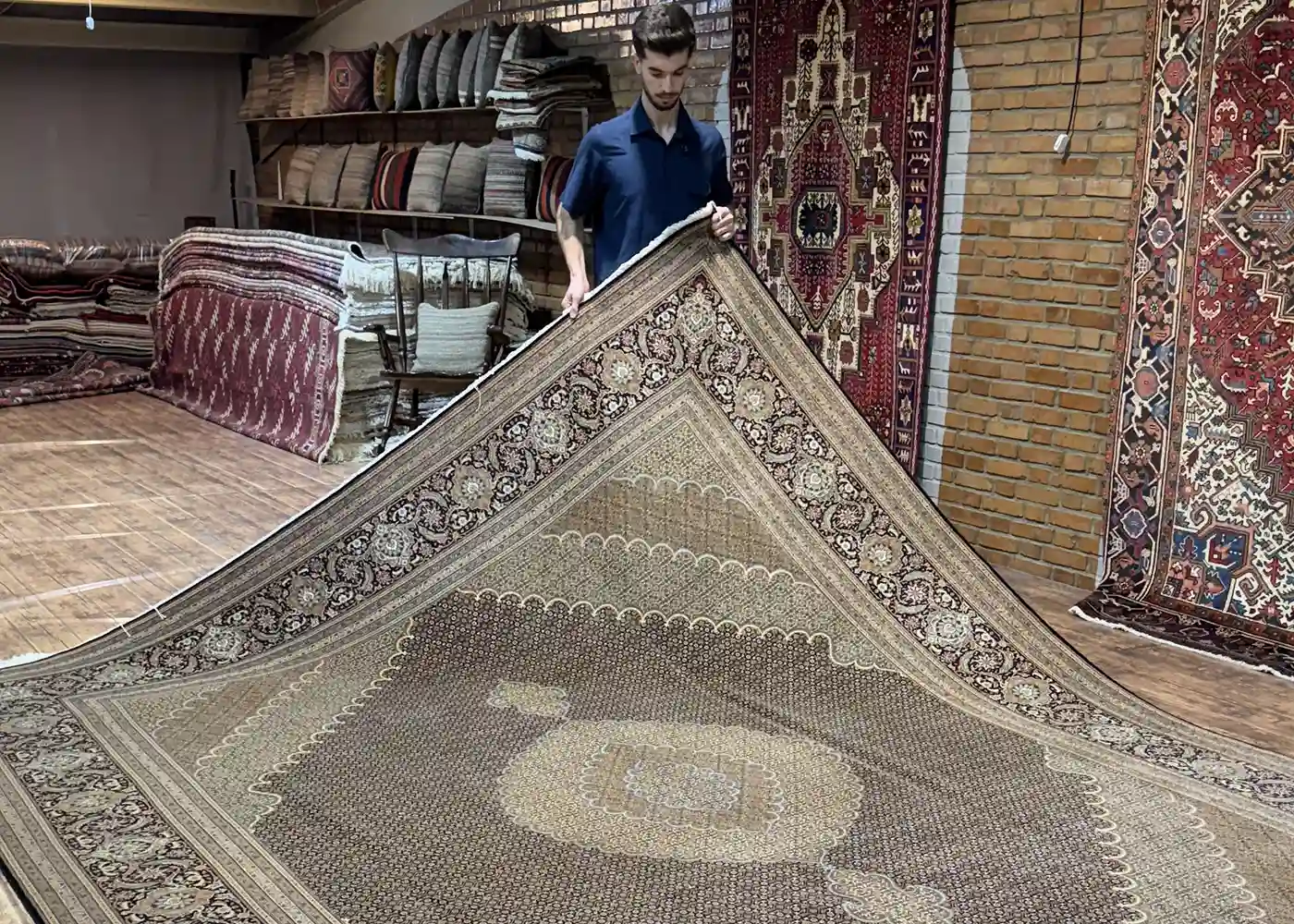
A Tabriz Mahi rug is a Persian hand-knotted carpet woven in or associated with the Tabriz weaving tradition and decorated with the Mahi form of the Herati pattern.
The word mahi means “fish” in Persian. The name does not necessarily mean that the carpet contains naturalistic images of fish. Instead, it usually refers to the curved, pointed or lancet-shaped leaves surrounding the central part of each repeated motif. When stylised and viewed together, these leaves have traditionally been interpreted as small fish moving around a central flower or pool-like diamond.
The design is also called:
- Herati pattern
- Mahi pattern
- Fish design
- Mahi Herati
- Mahi Darham or intertwined fish design
- Fish-in-the-pond pattern
These names are often used interchangeably in the rug trade. However, regional dealers, collectors and weaving communities may use them with slightly different meanings. A seller may call almost any carpet with a Herati repeat a Mahi rug, while another may reserve “Tabriz Mahi” for a particularly fine, curvilinear and closely spaced Tabriz interpretation.
The name of the pattern alone therefore does not prove where the rug was woven. Herati designs appear in rugs from several Persian weaving regions. Origin must be evaluated through construction, materials, knotting, palette, drawing, borders and provenance.
Mahi and Herati: Are They the Same Pattern?
In most commercial descriptions, Mahi and Herati refer to the same fundamental design family. The term Herati usually identifies the complete repeating pattern, while Mahi draws attention to the fish-like leaves within that pattern.
The safest way to understand the terminology is:
- Herati describes the complete repeat structure.
- Mahi describes the fish-like interpretation of its surrounding leaves.
- Tabriz Mahi usually describes a refined Tabriz execution of that structure.
These distinctions are useful, but they are not governed by one universal classification system. Historical patterns move between cities, villages and workshops. Their lines, proportions and names change as generations of designers reinterpret them.
For that reason, two rugs labelled “Mahi” may look noticeably different. One may have a large geometric repeat, while another may contain extremely small curvilinear fish forms. One may use an all-over layout, while another places the Mahi repeat around a central medallion.
The Anatomy of the Herati or Mahi Pattern
The Herati pattern is a modular design. A relatively small unit is repeated horizontally and vertically until it covers the field of the carpet.
A classic unit normally includes several connected elements.
1. The Central Flower or Rosette
At the centre of the unit is usually a flower, rosette or small floral form. Depending on the workshop and level of fineness, it may appear as a simple four-petal flower or a highly detailed blossom with several outlines and internal colours.
This central flower creates a visual anchor. If it is badly proportioned, off-centre or inconsistently drawn, the error becomes increasingly visible as the pattern repeats across the carpet.
2. The Diamond or Lozenge
The central flower is commonly enclosed by, or visually connected to, a diamond-shaped framework. This shape may be clearly geometric in village rugs or softened by vines and curved lines in fine city carpets.
In a sophisticated Tabriz Mahi rug, the diamond may not appear as a heavy solid outline. It can be suggested through the direction of stems, leaves and surrounding floral elements.
3. The Fish-Like Leaves
Curving leaves are positioned around the diamond. Their elongated forms, pointed ends and curved bodies have traditionally been compared to fish.
These leaves are one of the most important indicators of drawing quality. In a fine carpet, they should be recognisable without becoming heavy or disconnected. Their curves should flow naturally, and their position should remain consistent throughout the field.
4. Connecting Vines
Vines link one Herati unit to the next. They prevent the design from looking like a collection of isolated diamonds.
The most accomplished Tabriz designs create a continuous visual network. The eye can travel across the field without encountering broken lines, accidental gaps or awkward collisions between neighbouring motifs.
5. Secondary Flowers and Leaves
Small blossoms, palmettes and leaves may fill the negative spaces between the main repeats. Their purpose is not merely decorative. They control the density and rhythm of the overall composition.
If too many secondary elements are added, the field can become visually muddy. If too few are used, the repeat may feel empty or mechanical. Balance is essential.
Why Is It Called the Fish Design?
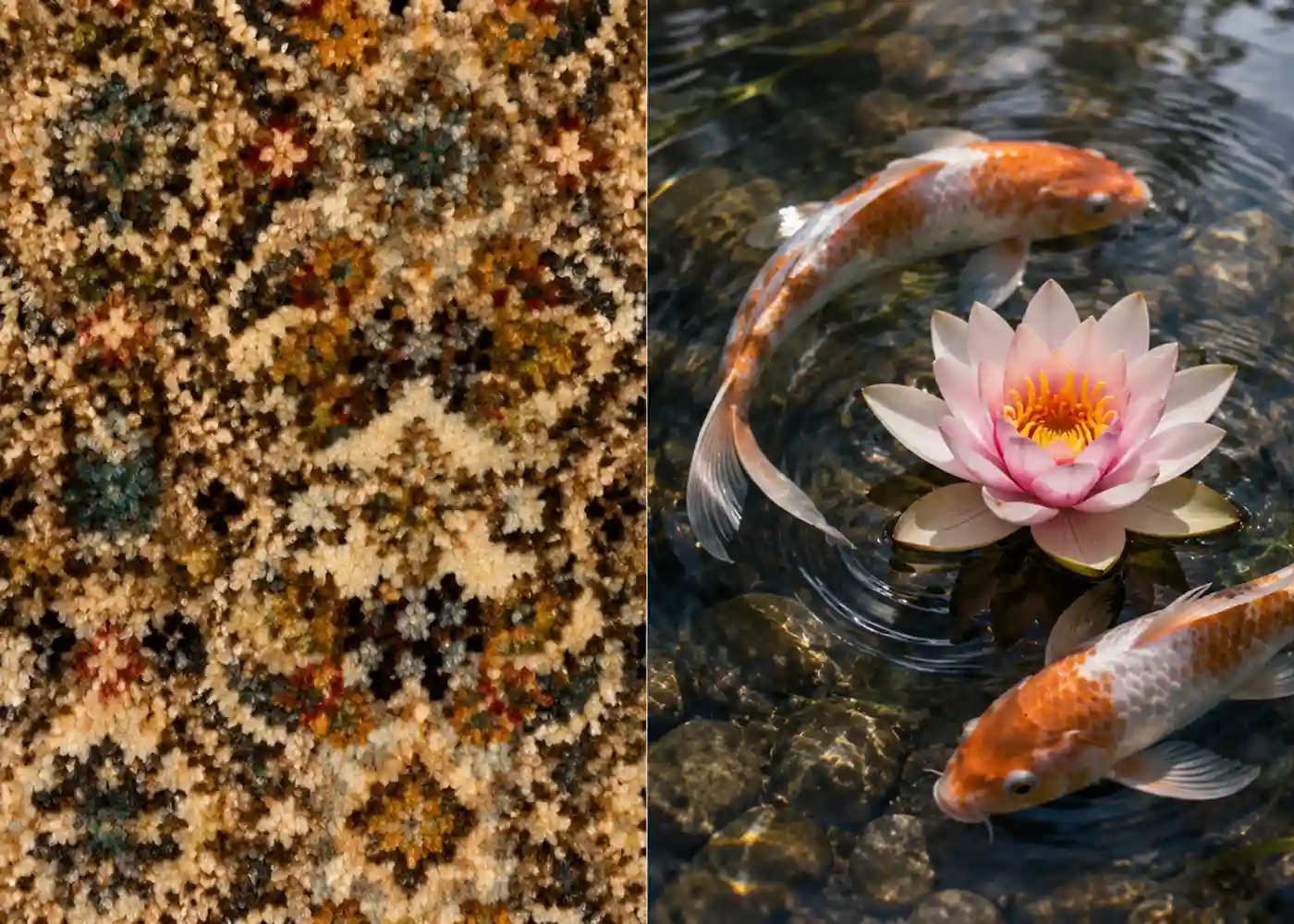
The curved leaves surrounding the central motif are commonly interpreted as fish. This visual association explains the Persian term Mahi.
However, buyers should be cautious with overly confident stories about the “hidden meaning” of every motif. Rug designs have migrated between regions for centuries. Shapes can change through stylisation, workshop adaptation, memory, drawing and commercial demand.
Some descriptions connect the fish motif with water, life, fertility, abundance, protection, movement or prosperity. These interpretations may be culturally meaningful, but they should not automatically be presented as the single original meaning of every Mahi rug.
A responsible interpretation separates three different ideas:
- Linguistic meaning: Mahi means fish in Persian.
- Visual interpretation: The curved leaves resemble fish.
- Symbolic interpretation: Fish may be associated with life, water or abundance, but meanings vary and are not always historically documented.
The artistic importance of the pattern does not depend on proving one fixed symbolic explanation. Its real power lies in repetition, movement, balance and the technical challenge of weaving it clearly.
Where Did the Herati Pattern Originate?
The word Herati is traditionally associated with Herat, an important historic cultural centre now located in western Afghanistan. The design later became widespread across Iran and neighbouring weaving regions.
Its precise origin is difficult to establish with certainty. Carpet motifs rarely remain fixed within modern political borders. Designers, merchants, workshops and weavers carried patterns along trade routes, reproducing and adapting them in different materials and local styles.
Over time, the Herati design became particularly important in western and northwestern Persian rugs. It appears in Tabriz, Bidjar, Farahan, Malayer, Hamadan, Senneh and other weaving traditions.
The presence of the motif therefore identifies a design family, not a single place of production.
What Makes a Tabriz Mahi Rug Different?
The Tabriz version is usually recognised by its controlled drawing, fine outlines and organised repetition. Tabriz has a long tradition of workshop production in which designers create detailed cartoons or weaving plans before the carpet is knotted.
This planned method is especially suited to the Mahi pattern because the design requires consistency across a large area.
Typical characteristics of a fine Tabriz Mahi rug may include:
- A precise and closely repeated Herati design
- Smooth curvilinear leaves rather than heavily angular forms
- Balanced spacing between individual motifs
- A strong cotton or, in very fine examples, silk foundation
- Fine wool pile, sometimes combined with silk highlights
- A relatively low and evenly clipped pile
- Clear outlines visible from both front and back
- Controlled corners, borders and medallion transitions
- A sophisticated palette rather than random colour changes
Tabriz also produces many other design types, including medallion, Afshan, garden, architectural and pictorial carpets. Read more about this range in our guide to why Tabriz rugs are famous worldwide.
All-Over Mahi vs Medallion Mahi Rugs
A Tabriz Mahi rug can use several overall layouts.
All-Over Mahi Design
In an all-over layout, the Herati repeat covers the entire main field. There may be no dominant central medallion.
This creates an even visual rhythm and makes the rug easier to place beneath a dining table or seating arrangement because furniture does not cover one essential central feature.
All-over Mahi rugs can work particularly well in:
- Dining rooms
- Libraries
- Offices
- Long living rooms
- Spaces with asymmetrical furniture placement
Central-Medallion Mahi Design
Some Tabriz carpets combine a central medallion with a Mahi-filled field. The medallion becomes the visual focus, while the repeated Herati structure gives depth and movement to the surrounding area.
The technical challenge is greater because the weaver must manage the transition between the medallion and the repeat. The motifs should appear intentionally interrupted or redirected—not randomly cut off.
Corner-and-Medallion Composition
In a traditional corner-and-medallion layout, the central form is echoed by decorative quarter-medallions in the corners. The Mahi pattern may fill the remaining field.
Examine whether the four corners are properly related to each other and whether the border frames the composition evenly.
How Raj Affects a Tabriz Mahi Rug
Raj is a traditional measurement used to describe the fineness of many Tabriz rugs. It generally refers to the number of knots counted across approximately seven centimetres of the rug’s width.
A higher Raj count can allow the weaver to make the Mahi units smaller, curves smoother and outlines more precise. However, Raj does not independently determine overall quality.
| Approximate Raj Grade | Typical Effect on a Mahi Design | General Character |
|---|---|---|
| 30 Raj | Larger fish forms, broader outlines and a more open repeat | Bold, practical and visually readable from a distance |
| 40 Raj | Good separation between flowers, leaves and diamonds | Balanced refinement and everyday usability |
| 50 Raj | Finer leaves, smoother curves and more sophisticated secondary details | Fine workshop-quality weaving |
| 60 Raj | Very small repeats, narrow outlines and highly controlled transitions | Highly refined and technically demanding |
| 70 Raj | Miniature-like detail and exceptionally compact Mahi structures | Rare, labour-intensive and potentially collector-level |
These categories should be used as a general guide rather than an automatic price scale. A well-designed 40 Raj Tabriz Mahi rug made with excellent wool can be more attractive and useful than a finer rug with weak colours, inconsistent knots or poor materials.
For measurements, approximate knot-density conversions and instructions for examining the back, read the complete Tabriz rug Raj guide.
Does Higher Raj Always Produce a Better Mahi Pattern?
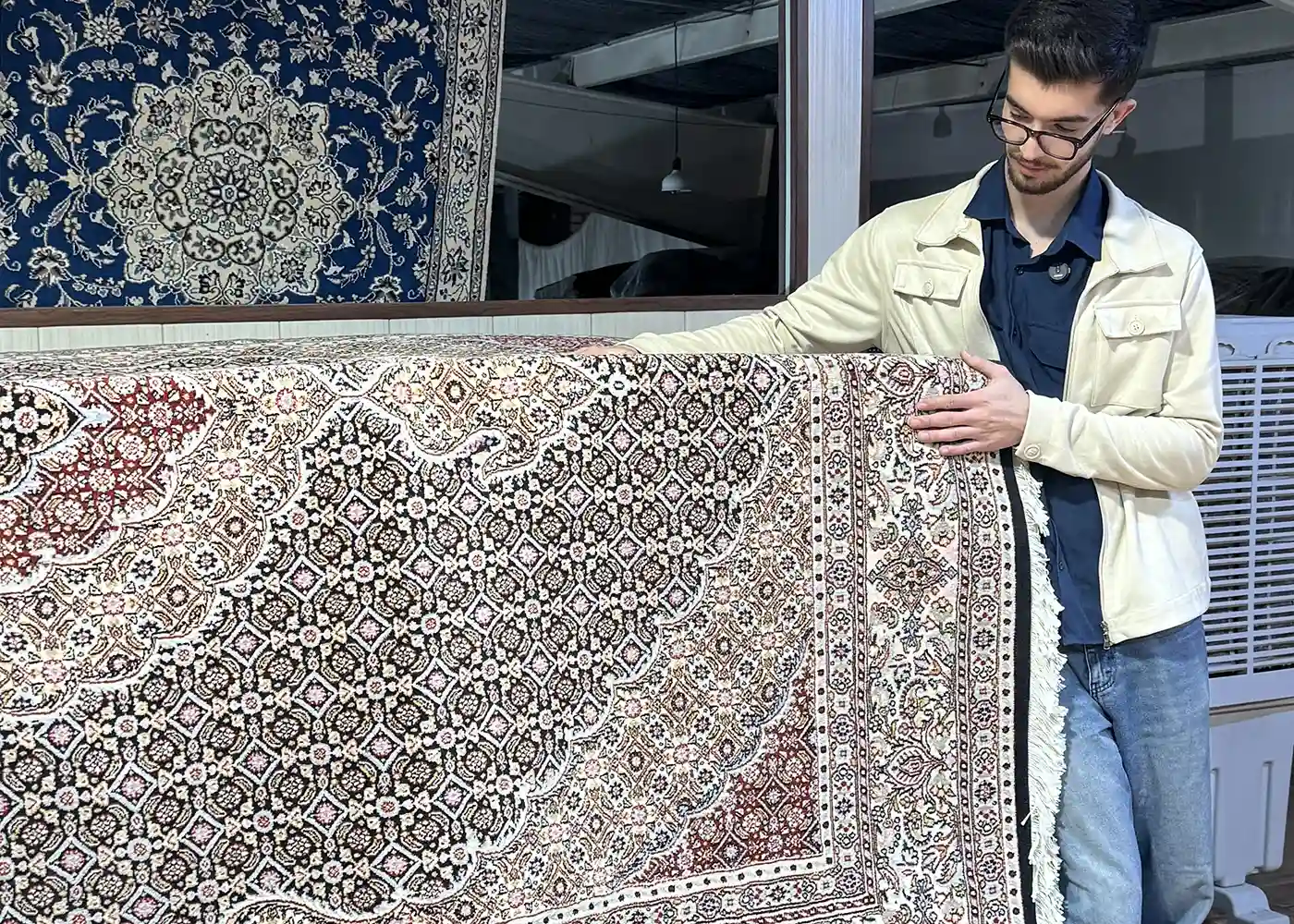
No. Higher Raj creates the potential for greater detail, but technical density is only one component of quality.
Imagine two Mahi rugs:
- The first has very high knot density but weak wool, uneven clipping and colours that lack harmony.
- The second has moderately fine knotting, excellent wool, confident drawing, balanced spacing and a beautiful palette.
The second rug may be more desirable despite its lower Raj.
A fine Tabriz Mahi rug must succeed at several levels simultaneously:
- The individual motif must be clearly drawn.
- The repeat must remain consistent.
- The complete field must feel balanced.
- The borders must relate to the scale of the centre.
- The materials must support the intended level of detail.
- The condition must allow the design to remain visible.
How to Judge the Drawing Quality
Drawing quality is one of the most important—and most overlooked—parts of evaluating a Mahi rug.
Examine the Repeated Units
Select several Mahi units from different parts of the carpet. Compare the central flowers, diamonds and surrounding leaves.
Because the rug is handmade, tiny variations are normal. Large and distracting differences may indicate inconsistent weaving, poor supervision or tension problems.
Follow the Vines
Trace a vine visually across several repeats. It should connect naturally without unexplained breaks or abrupt changes in direction.
Inspect the Curves
Fine Tabriz weaving is especially respected for its ability to render curving lines. Curves should appear smooth relative to the rug’s knot density.
A lower-Raj carpet will naturally show more stepped outlines than a very fine rug. The important question is whether the line is controlled within the technical limitations of its grade.
Look for Visual Congestion
A dense pattern is not automatically a clear pattern. Poor colour separation can cause leaves, flowers and vines to merge into one indistinct surface.
Good design uses contrast strategically so the Mahi units can be recognised without making the carpet look harsh.
Check the Direction of the Repeat
The pattern should remain correctly aligned across the length and width. Gradual distortion may indicate changes in warp tension or unequal compression during weaving.
Materials Used in Tabriz Mahi Rugs
Wool Pile
Wool is the most common and practical pile material. High-quality wool should feel resilient rather than brittle or lifeless.
Fine wool can be spun thinly enough to support detailed Mahi drawing while retaining durability. Wool-based Tabriz rugs are often suitable for living rooms, dining rooms, offices and other regularly used spaces.
Wool with Silk Highlights
Silk may be used selectively to outline the fish-like leaves, central flowers, vines, medallions or border details.
When used intelligently, silk catches light and separates important motifs from the background. More silk does not automatically mean better quality. It should strengthen the drawing rather than create random shine.
Full Silk or Silk-Rich Examples
Very fine Mahi rugs may use substantial amounts of silk or a silk foundation. These pieces can support extremely detailed drawing but generally require more careful placement and maintenance.
Cotton Foundation
Many Tabriz rugs are constructed on strong cotton warps and wefts. Cotton helps maintain dimensional stability and allows controlled tension across larger carpets.
Silk Foundation
A silk foundation can support finer yarns and compact knotting. It may appear in prestigious workshop pieces, but silk foundations should be examined carefully for structural condition, especially in older rugs.
For a practical comparison of fibres, durability and room suitability, see the wool vs silk Persian rug guide.
Knot Structure and Construction
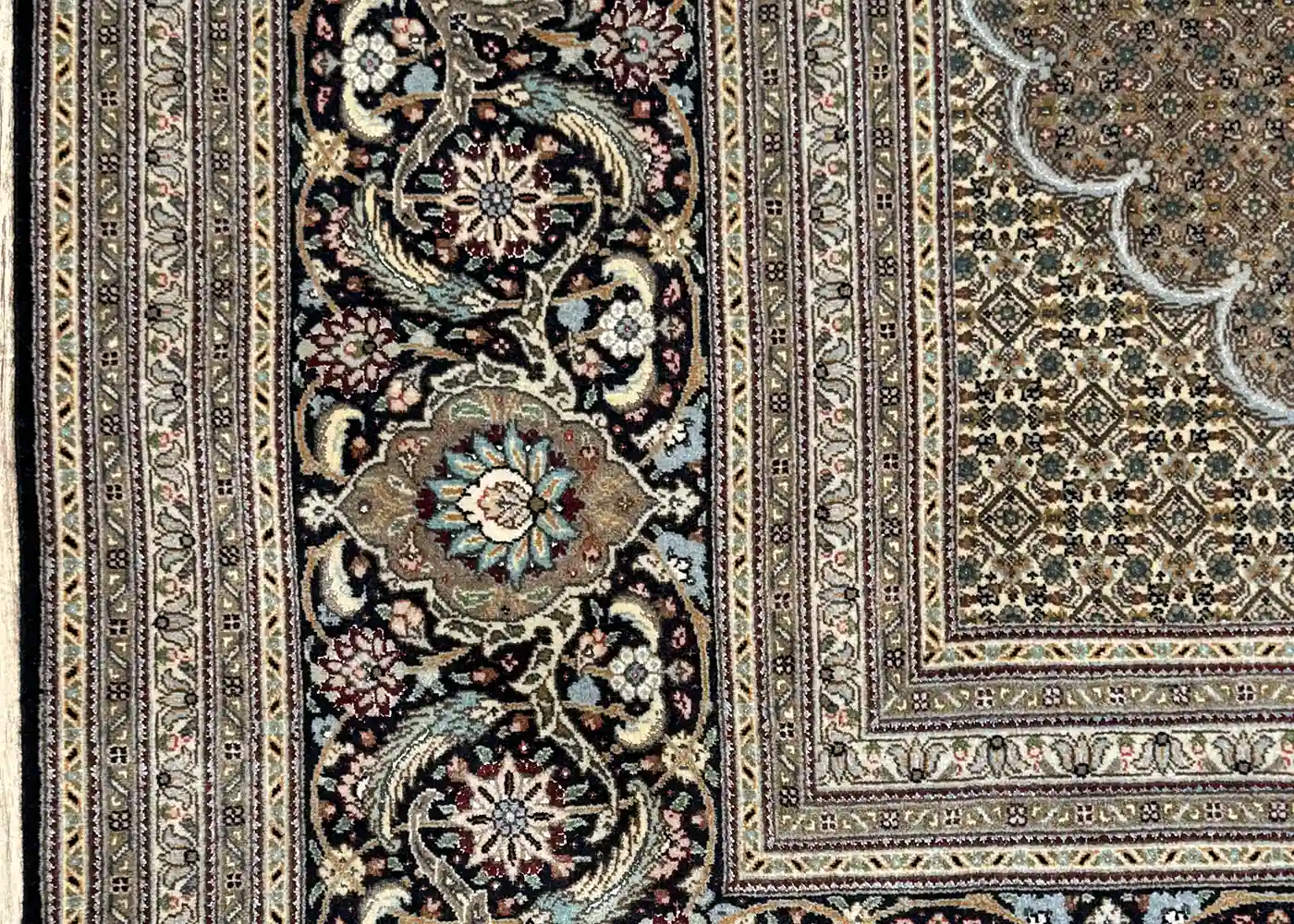
Many Tabriz rugs use the symmetrical knot, sometimes called the Turkish or Ghiordes knot. However, buyers should not identify origin from knot type alone because similar structures appear in other regions.
The knot is tied around pairs of warp threads, while wefts are inserted between rows to stabilise the structure. After knotting, the pile is clipped to reveal the design.
Fine Mahi rugs are often clipped relatively low because long pile can hide narrow outlines and small details. A short pile should not automatically be confused with wear.
To distinguish intentional clipping from wear:
- Intentional clipping is generally even across the surface.
- Wear tends to be concentrated in traffic areas.
- Wear may expose knot collars or foundation threads.
- Uneven low areas can interrupt the design.
How to Examine a Tabriz Mahi Rug from the Back
The back reveals information that the pile side can hide.
- Check whether the complete design is visible. A genuine hand-knotted rug should show the Mahi repeat structurally from the back.
- Examine knot consistency. The knots should be reasonably even for the rug’s age and production type.
- Compare several areas. Do not judge the entire carpet from one unusually fine section.
- Look for repairs. Rewoven areas may have different colours, knot shapes, texture or tension.
- Check the foundation. Inspect for broken warps, brittle sections or distortion.
- Study the edges and ends. Selvedges, fringes and end finishes are structurally important.
A Mahi pattern does not prove that a carpet is handmade or Persian. Machine-made rugs can reproduce a similar visual design. Use our guide to handmade vs machine-made rugs and learn how to identify an authentic Persian rug.
Colour Palettes in Tabriz Mahi Rugs
Tabriz Mahi rugs are produced in many palettes. There is no single colour combination required for the design.
Common field colours include:
- Deep navy blue
- Ivory and cream
- Brick red
- Soft beige
- Brown and walnut
- Pale blue
- Green
- Black or near-black
The finest palettes use colour to clarify the pattern. The flower should remain distinct from its diamond, the fish-like leaves should separate from the field, and the secondary vines should connect the design without overwhelming it.
Dark-Field Mahi Rugs
Navy or dark fields can create exceptional depth. Small cream, rust, blue and green motifs may appear to float across the surface.
Dark-field examples work well in libraries, formal dining rooms and interiors requiring visual weight.
Ivory-Field Mahi Rugs
Ivory and cream fields make the pattern appear lighter and more open. They can complement contemporary rooms with neutral upholstery and natural wood.
Because marks may be more visible on pale fields, condition and intended use should be considered carefully.
Red-Field Mahi Rugs
Red creates warmth and traditional Persian character. The exact effect depends on whether the red is bright, brick-toned, deep madder-like or softened by age.
Natural Dyes, Synthetic Dyes and Colour Quality
A buyer should not assume that every old rug uses natural dyes or that every newer rug uses synthetic dyes. Both categories contain a wide range of quality.
Evaluate colour through:
- Harmony between the field and motifs
- Stability and lack of bleeding
- Depth rather than flatness
- Appropriate contrast between neighbouring forms
- Natural variation known as abrash
- Evidence of later recolouring or surface painting
Abrash is a change in shade that can occur when a weaver begins using a new batch of dyed yarn. In handmade rugs, subtle abrash may add character and document the weaving process. Severe or unnatural colour changes should be investigated more carefully.
Tabriz Mahi Compared with Other Regional Herati Rugs
Tabriz Mahi vs Bidjar Herati
Bidjar rugs are often recognised for dense, firm construction and a powerful visual surface. Their Herati patterns may feel compact and strongly structured.
Tabriz interpretations are often more curvilinear, finely outlined and workshop-controlled. These are general tendencies rather than absolute rules.
Tabriz Mahi vs Farahan Herati
Farahan rugs may feature elegant all-over Herati fields with a lighter visual rhythm and distinctive antique character. Older Farahan examples are often valued for colour, drawing and age rather than extremely high knot density.
Tabriz Mahi vs Malayer or Hamadan Herati
Village interpretations from Malayer or the wider Hamadan region may use more angular drawing, larger repeats and greater handmade irregularity.
They can be highly attractive, but they should not be described as Tabriz merely because they contain a fish design.
Tabriz Mahi vs Nain Floral Rugs
Nain rugs often use scrolling floral compositions, Shah Abbasi flowers and medallions rather than a classic all-over Mahi structure. Both can be highly detailed, but their visual languages differ.
Browse the wider guide to Persian rug styles and regional types for additional comparisons.
How to Identify a High-Quality Tabriz Mahi Rug
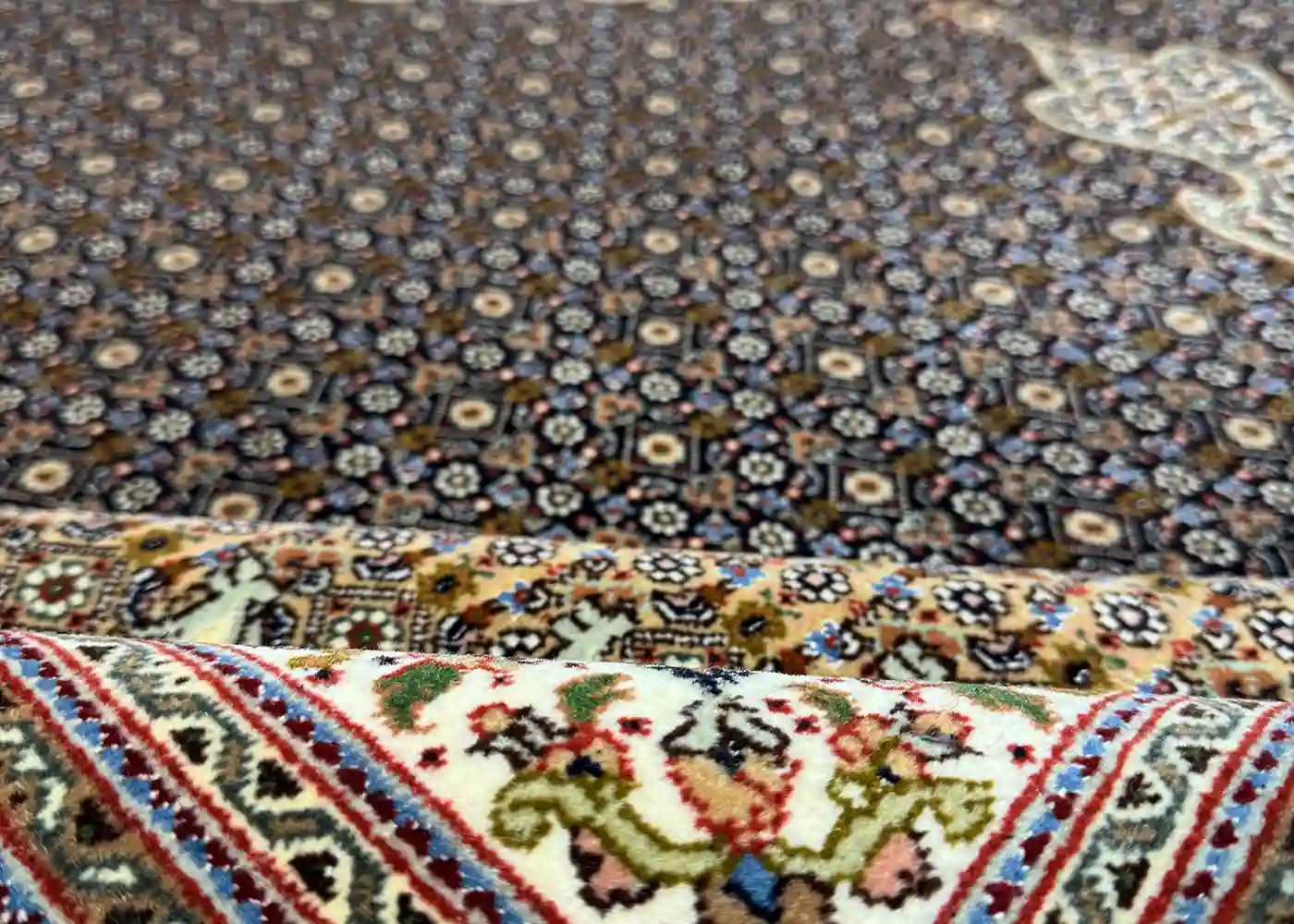
Use the following criteria together rather than relying on one sales label.
1. Pattern Clarity
The central flowers, diamonds, leaves and vines should remain recognisable. A pattern can be dense without becoming confused.
2. Repeat Consistency
Individual units should maintain similar scale and orientation across the field. Small handmade differences are acceptable and often desirable.
3. Knot Consistency
Inspect several sections of the back. Uneven knotting may affect the appearance and long-term stability of the carpet.
4. Balanced Proportions
The scale of the Mahi repeat should suit the size of the rug. Extremely small motifs can look impressive up close but may lose impact in a large room.
5. Border Integration
The main border should frame the field without overpowering it. Inner and outer guard borders should remain reasonably aligned.
6. Corner Resolution
Look closely at how the repeat reaches the edges and corners. Good designers adjust motifs intentionally rather than allowing them to end awkwardly.
7. Material Quality
The wool should have appropriate resilience and lustre. Silk should enhance selected details rather than compensate for poor drawing.
8. Controlled Pile
The surface should be clipped evenly enough for the design to remain clear. Check for low areas, exposed foundation and uneven wear.
9. Colour Harmony
Colours should create separation and depth. Knot count cannot compensate for an unbalanced palette.
10. Structural Condition
Examine fringes, ends, side cords, foundation, repairs, stains, moth damage and distortion.
Common Quality Problems
Not every Tabriz Mahi rug is a fine example. Watch for:
- Inconsistent motif sizes
- Broken or disconnected vines
- Fish-like leaves merging into the background
- Uneven borders
- Distorted corners
- Excessively long pile hiding the pattern
- Overly aggressive chemical washing
- Surface painting or recolouring
- Undisclosed repairs
- Reduced or shortened ends
- Weak, dry or brittle fibres
- Marketing claims based only on Raj
- A Tabriz-style label without evidence of Persian origin
What Determines the Value of a Tabriz Mahi Rug?
The market value of a Tabriz Mahi rug is influenced by several connected factors.
Origin
A genuine Persian Tabriz rug is different from a rug made elsewhere in a Tabriz-inspired style.
Fineness
Raj and knot density affect labour and potential detail, but should be confirmed rather than accepted from a label alone.
Materials
Fine wool, silk highlights and silk foundations can influence value when they are used skilfully and remain in good condition.
Design Quality
A beautifully balanced Mahi composition may be more desirable than a denser rug with mechanical or weak drawing.
Workshop or Maker
Documented association with a respected workshop can increase collector interest. Unverified signatures should be treated cautiously.
Age
Age alone does not create value. Older carpets must still be assessed for design, rarity, condition, colour and restoration.
Condition
Wear, reweaving, colour run, stains, shortened ends and damaged selvedges can affect both usability and market value.
Size
Large room-size examples require substantial labour, but unusual or highly usable dimensions may also attract demand.
Colour and Decorative Appeal
Market demand is influenced by how well the palette works in contemporary interiors. This does not replace artistic quality, but it affects commercial desirability.
Provenance
Reliable documentation of ownership, age, purchase history or workshop attribution may strengthen confidence and value.
Buyers interested in older pieces can compare the old and antique Persian rug collection.
Is a Tabriz Mahi Rug a Good Investment?
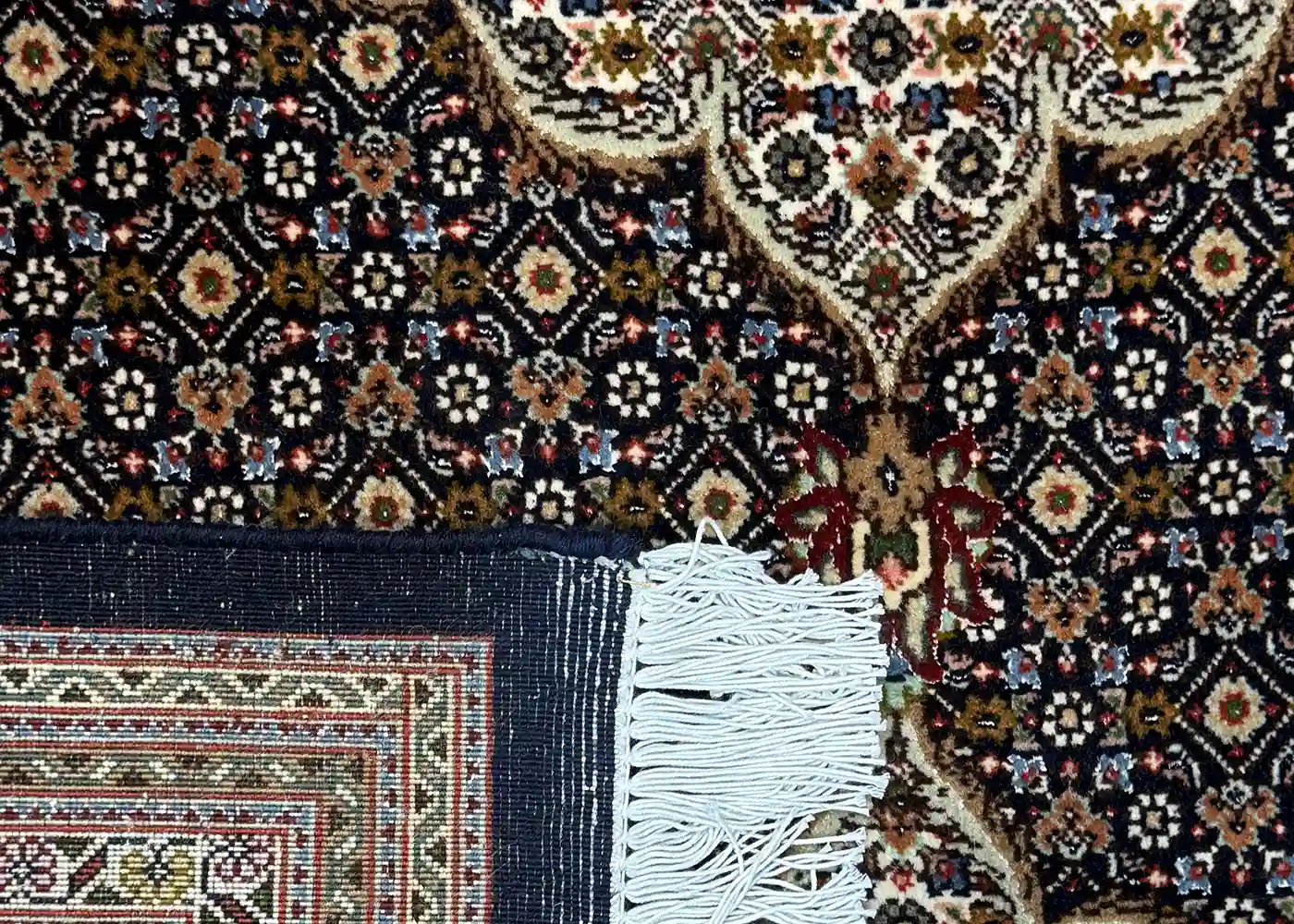
A handmade rug should primarily be purchased because its design, quality and size suit the buyer. Some fine or rare Tabriz rugs may retain or increase value, but no rug should be presented as a guaranteed financial investment.
Collector potential is generally stronger when a rug combines:
- Confirmed Persian origin
- Excellent drawing
- High-quality materials
- Consistent and appropriate fineness
- Attractive and stable colour
- Good condition
- Rarity or workshop importance
- Reliable provenance
A commercially described “high Raj Mahi rug” without documentation, strong design or good condition should not automatically be considered investment-grade.
Best Rooms for a Tabriz Mahi Rug
Living Room
A medium or large Mahi rug can define a seating area without forcing the furniture to align around one dominant medallion. This makes all-over versions particularly versatile.
Dining Room
The repeating pattern remains visually active even when the centre is covered by a table. Choose a size that keeps chair legs on the rug when the chairs are pulled out.
Home Office or Library
Dark navy, brown or red Mahi rugs can add depth and formality while maintaining an organised visual rhythm.
Bedroom
Ivory, beige and softly coloured examples can bring detail to a bedroom without becoming visually heavy.
Formal Reception Room
Fine wool-and-silk or high-Raj examples may suit low-traffic formal spaces where the pattern can be appreciated at close range.
Tabriz Mahi Rugs in Modern Interiors
A traditional pattern does not require a traditional room. The repetition and geometry of a Mahi design can work effectively with contemporary furniture.
For a balanced modern interior:
- Allow the rug to provide most of the room’s pattern.
- Choose upholstery that relates to one or two secondary rug colours.
- Avoid matching every accessory directly to the carpet.
- Use simple furniture lines to contrast with the detailed field.
- Leave enough visible rug surface to appreciate the repeat.
- Use warm wood, stone, leather or metal to create material contrast.
Explore the current handmade Tabriz rug collection to compare different palettes, scales and room-size examples.
How to Care for a Tabriz Mahi Rug
- Use a suitable rug pad to reduce movement and friction.
- Rotate the rug periodically to balance wear and sunlight.
- Vacuum gently without damaging the fringes.
- Blot spills immediately; do not scrub them deeper into the pile.
- Avoid household carpet shampooers and harsh chemicals.
- Keep the rug away from prolonged moisture.
- Protect it from moth activity during storage.
- Use a cleaner experienced with handmade Persian rugs.
- Do not trim or repair fringes without specialist advice.
- Have older repairs assessed before intensive cleaning.
Correct maintenance can significantly extend the lifespan of a handmade Persian rug.
Questions to Ask Before Buying
- Was the rug woven in Iran or only described as Persian-style?
- Is the stated origin Tabriz supported by its structure and provenance?
- Is the design all-over Mahi or medallion Mahi?
- What is the measured Raj?
- Was the Raj counted directly from the carpet?
- What are the horizontal and vertical knot counts?
- Is the pile wool, silk or a combination?
- Is the foundation cotton or silk?
- Are the dyes stable?
- Has the rug been chemically washed or recoloured?
- Are there repairs, reweaving or reduced ends?
- Is the pile intentionally low or worn?
- Are clear photographs of the front and back available?
- Can the seller provide close-ups of the fringes, corners and edges?
- Does the rug lie flat?
- Is the exact size suitable for the intended room?
When buying online, request enough information to evaluate the exact carpet rather than relying on generic photographs or design names.
Frequently Asked Questions
What does Mahi mean in Persian rugs?
Mahi means fish in Persian. In rug terminology, it usually refers to the curved leaves surrounding the central flower and diamond of the Herati pattern. These leaves are traditionally interpreted as small fish.
Is Mahi the same as Herati?
The terms are frequently used for the same design family. Herati usually refers to the complete repeating structure, while Mahi highlights the fish-like elements within it.
Are all Mahi rugs from Tabriz?
No. Herati or Mahi patterns are woven in several Persian regions. The design alone cannot prove origin.
How can I identify a Tabriz Mahi rug?
Examine the precise curvilinear drawing, regular repeat, knot structure, materials, foundation, pile, borders and overall construction. Origin should be evaluated from all these characteristics together.
What Raj is best for a Tabriz Mahi rug?
There is no universally best Raj. Forty Raj can offer a strong balance of detail and practicality, while 50 or 60 Raj can support smaller and more refined Mahi units. Overall quality still depends on materials, execution and condition.
Is a 50 Raj Tabriz Mahi rug considered fine?
Fifty Raj is commonly associated with fine Tabriz weaving. It can support clear leaves, flowers, outlines and complex repeating details when the knotting and materials are well controlled.
Does a high-quality Mahi rug need silk?
No. Excellent Tabriz Mahi rugs can be woven entirely with fine wool. Silk may be added for highlights or extra detail, but it is not required for quality.
Why do some Mahi rugs look geometric and others floral?
The Herati structure can be rendered in angular village styles or smoother curvilinear city styles. Knot density, regional tradition and the designer’s drawing all affect its appearance.
Are symbolic meanings of the fish pattern proven?
Fish are often connected with water, life and abundance, but symbolic interpretations vary. Not every claimed meaning can be historically proven for every carpet.
Is a short pile a sign of damage?
Not necessarily. Fine Tabriz rugs are often clipped low to reveal detailed drawing. Wear is usually uneven and concentrated in frequently used areas.
Can a machine-made rug have a Mahi design?
Yes. A Mahi pattern describes the visual design, not the manufacturing method. Inspect the back, knots, foundation and fringes to determine whether the rug is handmade.
Are antique Tabriz Mahi rugs valuable?
They can be valuable when they combine good age, colour, drawing, condition, rarity and provenance. Age alone does not guarantee value.
Final Evaluation
A Tabriz Mahi rug should never be judged by the fish-design label alone. The Herati pattern may be ancient and widely recognised, but the value of an individual carpet depends on how successfully that pattern has been translated into wool, silk, colour and structure.
Begin with the design unit. Look for a clear central flower, controlled diamond framework, recognisable fish-like leaves and vines that connect naturally. Then step back and evaluate the complete field. The repetition should create movement without confusion, density without heaviness and symmetry without appearing mechanically lifeless.
After studying the front, examine the back. Confirm knot consistency, materials, foundation and repairs. Consider Raj, but never treat it as a complete quality grade. Colour, wool, drawing, pile, condition, age and workshop discipline are equally important.
A successful Tabriz Mahi rug demonstrates one of the greatest strengths of Persian carpet design: the ability to transform a small repeated motif into a complete architectural surface.
Explore the artistic tradition of handmade Tabriz rugs, compare the available Tabriz rugs at Arghavan Rugs, or browse all handmade Persian rugs.
For additional photographs, measurements or guidance about a specific carpet, contact Arghavan Rugs.